9 March 2026
The Complete Guide to Amazon PPC Product Targeting
TweetLinkedInShareEmailPrint 18 min read By Rick Wong Updated Mar 10, 2026 TL;DR Why should new sellers...

 23 December 2025
For the first decade of the Amazon Gold Rush, “TV Advertising” was a phrase that made a $1 million-a-year seller laugh.
TV was for Coke, Nike, and the massive CPG conglomerates that could afford to burn $50,000 on a brand awareness campaign that might pay off in six months. If you were a mid-sized seller moving $80,000 of inventory a month, you stuck to what you knew: Sponsored Products. You paid for the click, you got the conversion, and you fed the flywheel. It was safe, predictable, and directly attributed.
But as we settle into late 2025, the landscape has shifted violently. Sponsored Product CPCs (Cost Per Click) in competitive categories like Supplements and Skincare are routinely exceeding $2.50. The “low-hanging fruit” is gone.
Enter Amazon Sponsored TV (STV).
Many sellers first hear about Sponsored TV through an Amazon rep or a new dashboard prompt, and the initial reaction is usually the same: “This sounds expensive and not meant for sellers like me.”
Formerly locked behind the high walls of the Demand Side Platform (DSP) with steep minimum spends, Amazon has democratized TV ads. They are now self-service. There is no minimum spend. And most importantly, they are putting your product on the biggest screen in the customer’s house—their Fire TV—right alongside The Boys or Thursday Night Football.
But accessibility does not equal profitability. Just because you can buy a TV ad, does it mean a seller doing $1 million in revenue should?
This is not a hype piece. We are going to look at the cold, hard math of your P&L to answer the question: Is Sponsored TV a vanity metric trap, or the smartest arbitrage opportunity left in 2025?
Article of Contents
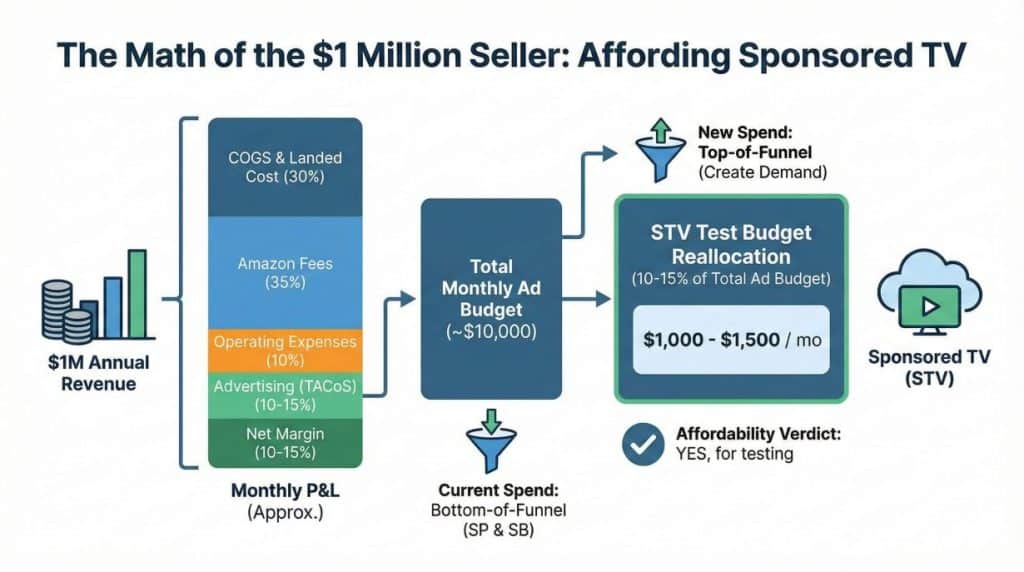
To understand if STV is “affordable,” we first need to profile who you are.
If you are generating $1 million in annual revenue, you are averaging $83,333 per month. Assuming you are running a healthy, sustainable brand, your P&L likely looks something like this:
Your total monthly ad budget is roughly $10,000. Historically, 100% of that went to Sponsored Products (SP) and Sponsored Brands (SB). These are “bottom of funnel” ads, capturing people who are already searching for “garlic press.”
The argument for Sponsored TV is that you need to allocate a portion of that budget to the “top of the funnel”, creating demand rather than just capturing it.
For most sellers at this stage, rising Sponsored Products CPCs are already squeezing margins before TV ads even enter the conversation.
The Affordability Verdict: Yes, it is affordable. With no minimum spend, you can technically run a Sponsored TV campaign for $500 a month. However, $500 in a vacuum is useless. To make STV work, you need to reach a specific frequency (the number of times a viewer sees your ad).
For a $1M seller, the “sweet spot” for a Sponsored TV test is 10% to 15% of your total ad budget. That means allocating $1,000 to $1,500 per month. This buys you entry. But does it buy you sales? That depends on the CPM.
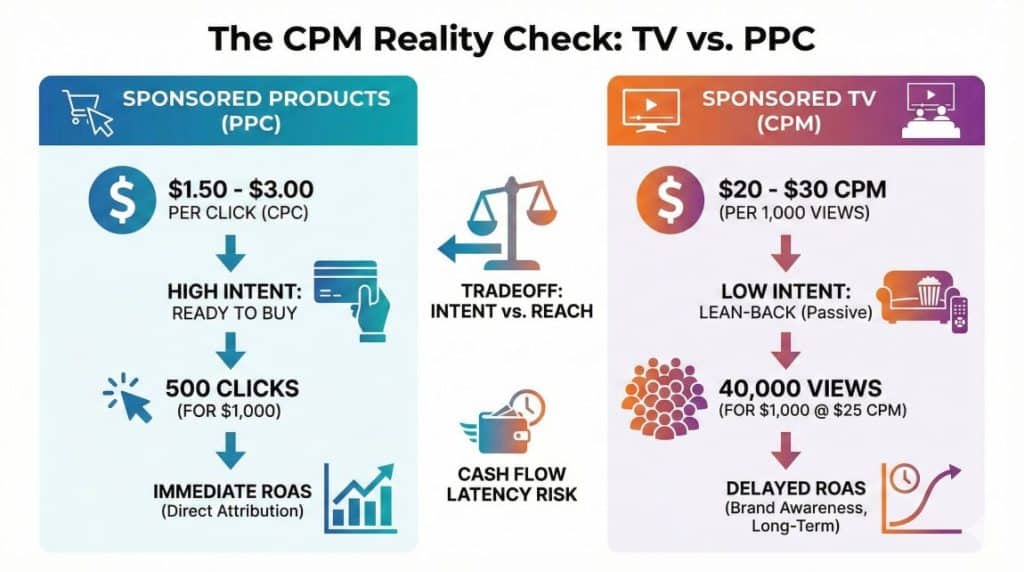
The biggest shock for sellers moving from Sponsored Products to Sponsored TV is the pricing model. You stop paying for Clicks (CPC) and start paying for Impressions (CPM – Cost Per Mille, or 1,000 views).
Let’s look at the benchmarks for Q3/Q4 2025:
The Translation: A $25 CPM means you are paying $0.025 (2.5 cents) per view. If you spend $1,000, you get 40,000 views.
In the world of Sponsored Products, $1,000 at a $2.00 CPC gets you only 500 clicks.
The tradeoff is intent. The 500 clicks are people with their credit cards in hand. The 40,000 TV viewers are leaning back on their couch, eating popcorn. They are not ready to buy right now.
For sellers who have only run cost-per-click campaigns, paying for impressions instead of clicks often feels risky and unfamiliar.
The “Hidden” Cost: Because TV is passive, you cannot rely on immediate ROAS (Return on Ad Spend). If you judge STV by “Last-Touch Attribution,” it will look like a failure. You will see a ROAS of 0.5x or 0.8x and want to turn it off.
Affordability isn’t just about the spend; it’s about the cash flow latency. Can your business afford to spend $1,500 this month to generate brand awareness that might not convert into sales for 30 to 60 days? For a $1M seller with tight cash flow, this is the real risk.
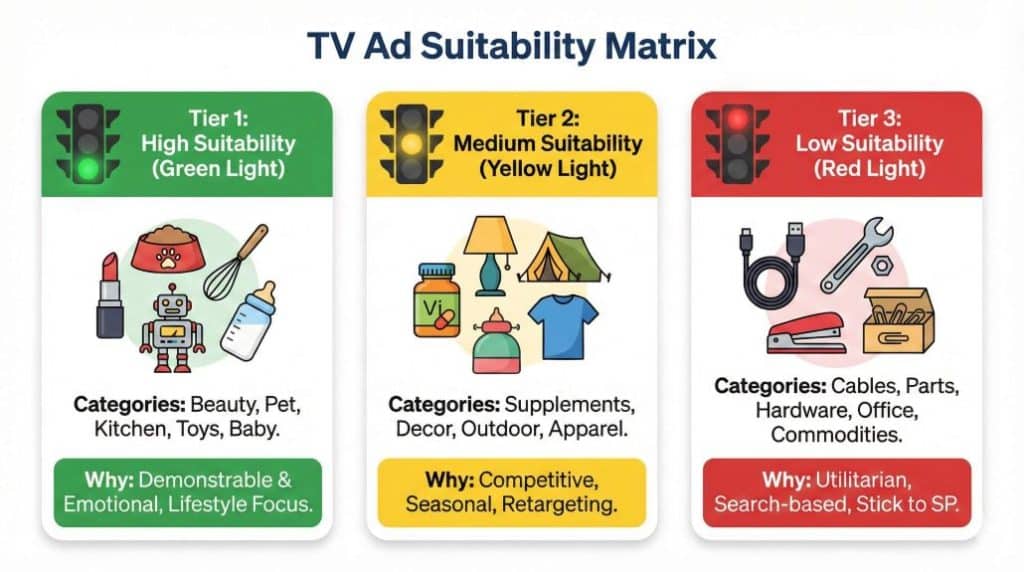
Not all $1M sellers are created equal. A $1M seller of industrial screws has no business being on TV. A $1M seller of a viral beauty product should have been on TV yesterday.
Revenue alone does not determine success with Sponsored TV; product type and buying behavior matter more. Here is the Suitability Matrix to determine if your product category justifies the spend.
For years, the problem with TV ads was measurement. You ran an ad, and you “hoped” sales went up.
As of October 2025, Amazon released measuring tools that change this equation specifically for smaller sellers: Branded Search Metrics.
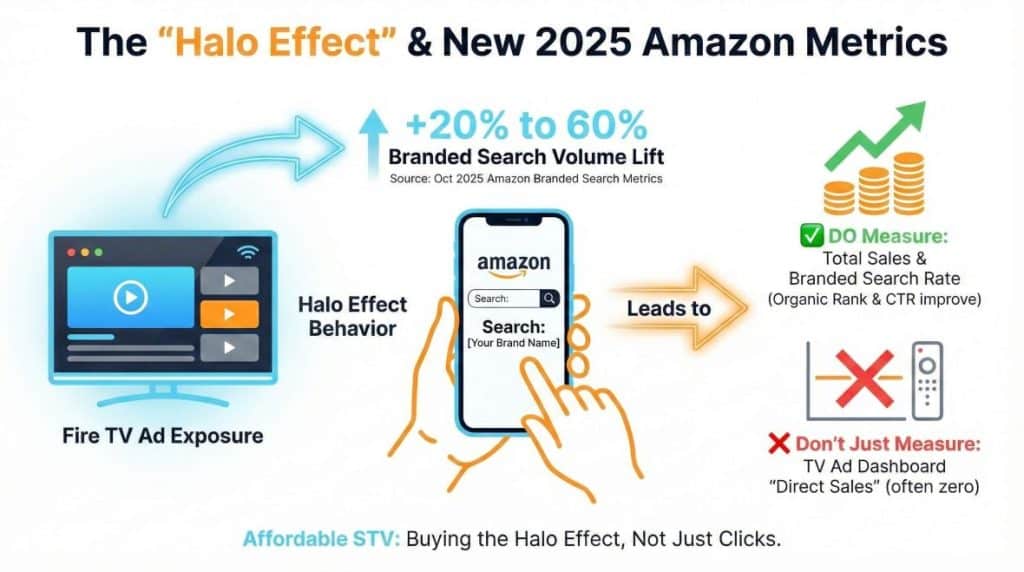
This is the key to making STV “affordable.” You are buying the Halo Effect. When a customer sees your ad on Fire TV, they rarely pick up the remote and click “Buy.” Instead, they pick up their phone and open the Amazon App. They search for your brand name.
The Stats: Data from Search Engine Land and Amazon’s internal case studies (2025) indicates that coordinated TV campaigns can boost Branded Search Volume by 20% to 60%.
If you spend $1,500 on TV, do not look at the ad’s sales alone. Look at your “Total Sales” and your “Branded Search Rate.”
For a $1M seller, a 20% lift in branded search volume, which usually converts at 15-20%, can easily pay for the TV campaign, even if the TV ad dashboard shows zero direct sales. In practice, this lift often shows up first in Brand Analytics and branded search reports, not in the Sponsored TV dashboard itself.
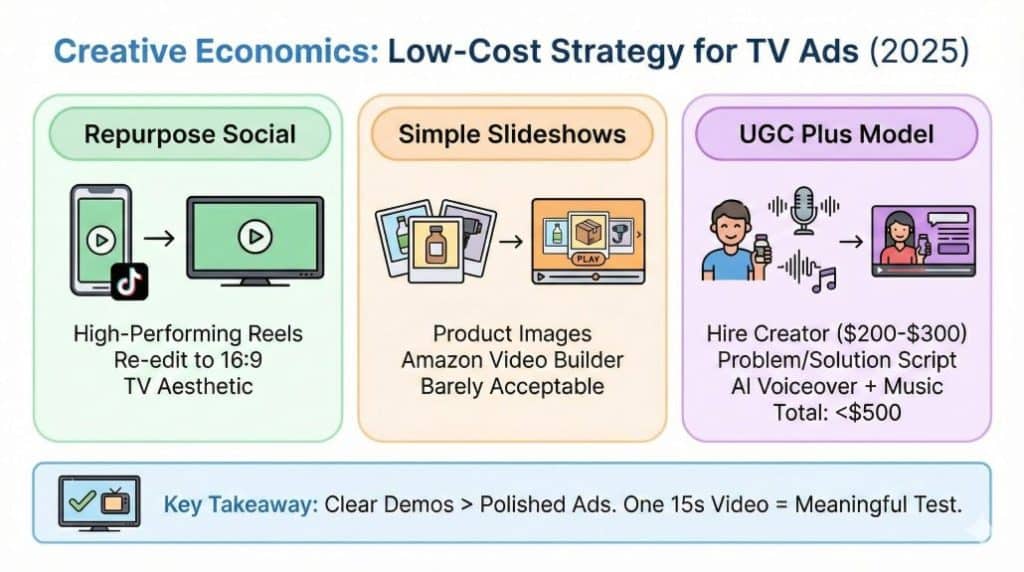
The final barrier to entry is the Creative Cost. “I can afford the $1,000 media spend, but I can’t afford a $10,000 video shoot.”
This is a misconception in 2025. The aesthetic of “TV” has changed. Thanks to TikTok and Reels, consumers are used to—and often prefer—User Generated Content (UGC) styles.
Total Creative Cost: Under $500. Affordability Check: Passed.
Clear product demos with simple messaging often outperform highly polished ads that lack focus. One strong 15-second video is enough to run a meaningful first test.
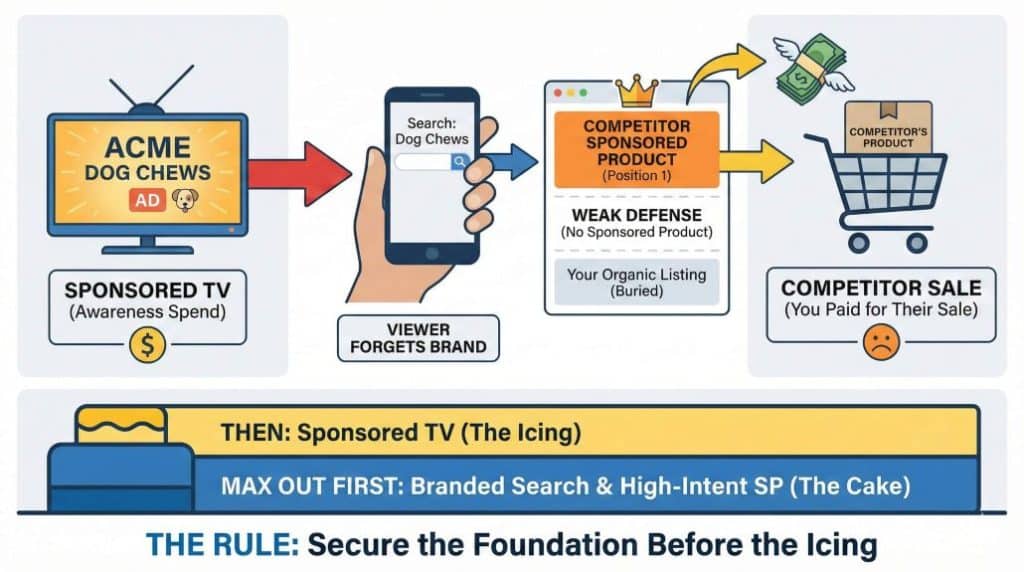
Here is how a $1M seller goes broke with Sponsored TV. They spend their budget driving awareness (TV Ads), but they fail to defend their listing (Sponsored Products).
Scenario:
You just paid to sell your competitor’s product.
This mistake is common among sellers testing Sponsored TV for the first time without tightening their search defense.
The Rule: You cannot afford Sponsored TV until you have maxed out your Branded Search defense and your high-intent Sponsored Product keywords. STV is the icing, not the cake. If you are not already dominating the search results for your own brand name, do not spend a dime on TV.
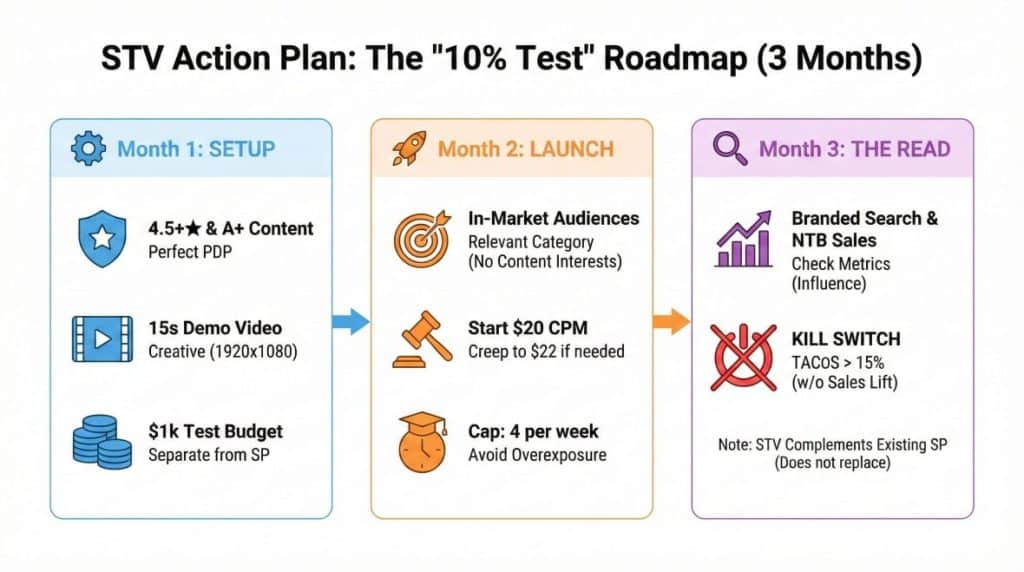
If you are a US-based seller doing $1M/year in a “High Suitability” category, here is your actionable roadmap to test STV without risking your business.
Sponsored TV should complement your existing Sponsored Products campaigns, not replace them.
Is Sponsored TV affordable for a $1M seller? Yes. Is it necessary? Not always. Sponsored TV works best as a controlled test, not as a long-term commitment made on day one.
For a seller of commodities, it is a vanity project. But for a brand builder in the Home, Pet, or Beauty space, it is the most affordable arbitrage available in 2025. It allows you to buy brand equity for pennies on the dollar compared to what your competitors paid five years ago.
The window of opportunity where CPMs are $25 won’t last forever. As more SMB sellers realize the barrier to entry is gone, prices will rise. If you have the margin and the creativity, the time to test is now.
There is no official minimum spend for self-service Sponsored TV. You can launch a campaign with a daily budget as low as $10 or $20. However, to see statistically significant data, we recommend a minimum monthly test budget of $1,000.
Sponsored TV is a simplified, self-service version of the TV inventory available on DSP. DSP offers deeper granularity, “lookalike” audiences based on your actual customer data, and access to third-party inventory. Sponsored TV is easier to use but has fewer targeting levers. For a $1M seller, Sponsored TV is the correct starting point.
Yes. Unlike Sponsored Brand Video (which autoplays muted in search results), Sponsored TV ads appear on streaming content (Freevee, Twitch, Fire TV apps) and typically play with sound on. This makes audio branding (voiceovers, music) critical.
Generally, no. With self-service Sponsored TV, you target Audiences (e.g., “Home Décor Enthusiasts”) or Content Genres (e.g., “Crime Dramas”), not specific show titles.
In 2025, a CPM between $20 and $30 is considered healthy for highly targeted US audiences. If you are seeing CPMs below $15, check your placements; you might be appearing on low-quality apps rather than premium Fire TV content.
You will use the advertising console’s attribution metrics. Look for “14-Day Last Touch” sales. However, be aware that TV is an “assist” channel. It often drives the customer to search, where a Sponsored Product ad gets the final credit. The new “Branded Search” metric is your best friend here.
No. Sponsored TV requires a 16:9 (Horizontal) aspect ratio (1920×1080). If you use a vertical video, it will have massive black bars on the sides and look unprofessional, likely damaging your brand perception.
Yes. Adding a QR code that links directly to your Amazon Storefront is a great way to drive immediate interaction. However, ensure it is large enough to be scanned from a couch 10 feet away. If viewers struggle to scan the code on the first attempt, the moment is lost and the ad effectively becomes brand-only with no immediate path to action.
Do not run Sponsored TV if you are low on stock. The “Halo Effect” can drive a spike in traffic across your entire catalog. If you stock out, you waste the ad spend and hurt your organic rank simultaneously.
Yes, as long as you are Brand Registered. However, Prime eligibility (FBA) significantly improves conversion rates for traffic driven by TV ads. We recommend sticking to FBA products for TV campaigns to maximize the ROI.

9 March 2026
TweetLinkedInShareEmailPrint 18 min read By Rick Wong Updated Mar 10, 2026 TL;DR Why should new sellers...
27 February 2026
TweetLinkedInShareEmailPrint 8 min read By Rick Wong Updated Feb 27, 2026 TL;DR What is the optimal len...
18 February 2026
TweetLinkedInShareEmailPrint 8 min read By Rick Wong Updated Feb 18, 2026 TL;DR Is AMC free and availab...