9 March 2026
The Complete Guide to Amazon PPC Product Targeting
TweetLinkedInShareEmailPrint 18 min read By Rick Wong Updated Mar 10, 2026 TL;DR Why should new sellers...

 15 January 2026
It’s no longer just creative copy; it’s a data source. Amazon’s AI uses it to define your “Brand Entity.” If it can’t tell clearly who you are from this section, it’s going to skip recommending you in conversational searches.
Marketing fluff is ignored by the system. Instead, the algorithm scans for structured specifics exact materials, standards, and clear use-cases. You must provide concrete data points that can be cross-validated across your catalogue, rather than emotional slogans.
No. Keywords are for Search (A9); Brand Story is for Context (Entity SEO). You need keywords to be found by the search bar, but a clear Brand Entity to be recommended by AI assistants.
It acts as a catalogue-wide trust signal. High consistency between your Brand Story and listings increases the AI’s “confidence score.” High confidence leads to better quality traffic and shoppers who trust your brand claims.
Engineering your Amazon ‘brand story’ for the age of AI shopping means structuring your brand narrative so Amazon’s AI systems can clearly understand who you are, what you stand for, and when to recommend your products. Instead of relying on keyword repetition alone, modern Amazon ranking depends on entity clarity, semantic consistency, and brand trust signals that AI assistants use to guide shopper decisions.
Engineering your Amazon ‘brand story’ for the age of AI shopping is no longer optional if you want sustainable visibility and sales on Amazon. As AI-powered shopping assistants increasingly influence how products are discovered, compared, and recommended, Amazon now prioritises brands it can clearly understand and trust. This shift requires sellers to rethink brand storytelling, not as marketing fluff, but as structured data that feeds Amazon’s AI-driven decision-making systems.
In the sections below, you will learn how Amazon’s AI interprets brand identity, why the Brand Story module has become one of the most powerful assets in Brand Registry, and how to rebuild your brand narrative so it works for both shoppers and machines.

For many years, Amazon search relied heavily on text matching and performance signals. Sellers focused on placing keywords in titles, bullets, and backend fields to ensure their listings appeared for relevant searches. That approach worked because Amazon’s systems primarily answered one question: Does this listing contain the words the shopper typed?
That model has now evolved.
Amazon’s modern search and discovery systems use machine learning models that attempt to understand intent, context, and relationships. Instead of only matching strings of text, Amazon’s AI tries to identify what a shopper is really looking for and which brand best fits that request.
This change is influenced by three major factors:
When a shopper asks a question instead of typing a keyword, Amazon’s AI must evaluate brands as entities, not just products. This is where brand story engineering becomes critical.
Amazon no longer evaluates products in isolation. Instead, it evaluates relationships between products, brands, categories, attributes, and customer behaviour.
At the centre of this system is the brand entity.
A brand entity represents everything Amazon knows about your brand, including:
Your Brand Story plays a major role in defining this entity.
While individual listings describe what a product does, the Brand Story explains who you are. AI systems use this information to decide when your brand should be recommended across multiple products and queries.
This is why sellers who only optimise at the SKU level struggle to compete with brands that invest in entity clarity.
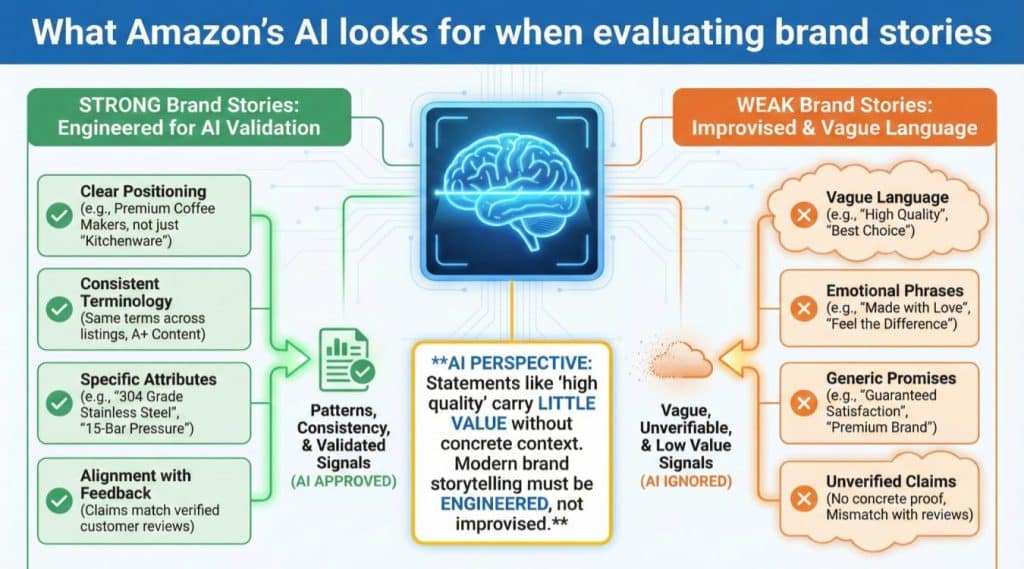
Amazon’s AI does not read brand stories the way humans do. It scans for patterns, consistency, and signals that can be validated across the platform.
Strong brand stories typically include:
Weak brand stories often rely on vague language, emotional phrases, or generic promises that cannot be verified.
From an AI perspective, statements like “high quality” or “premium brand” carry little value unless supported by concrete context.
This is why modern brand storytelling must be engineered, not improvised.
Although Amazon has introduced newer AI systems over time, the Amazon A9 algorithm still underpins much of how relevance and ranking are calculated. A9 focuses on relevance, conversion potential, and performance signals.
Brand Story optimisation supports A9 indirectly by improving relevance and conversion metrics across your catalogue. When Amazon’s AI understands your brand clearly, it can match your products more accurately to shopper intent. Better matches lead to higher click-through rates and stronger conversion signals, which A9 rewards.
In other words, brand clarity strengthens both AI discovery and traditional ranking mechanics.
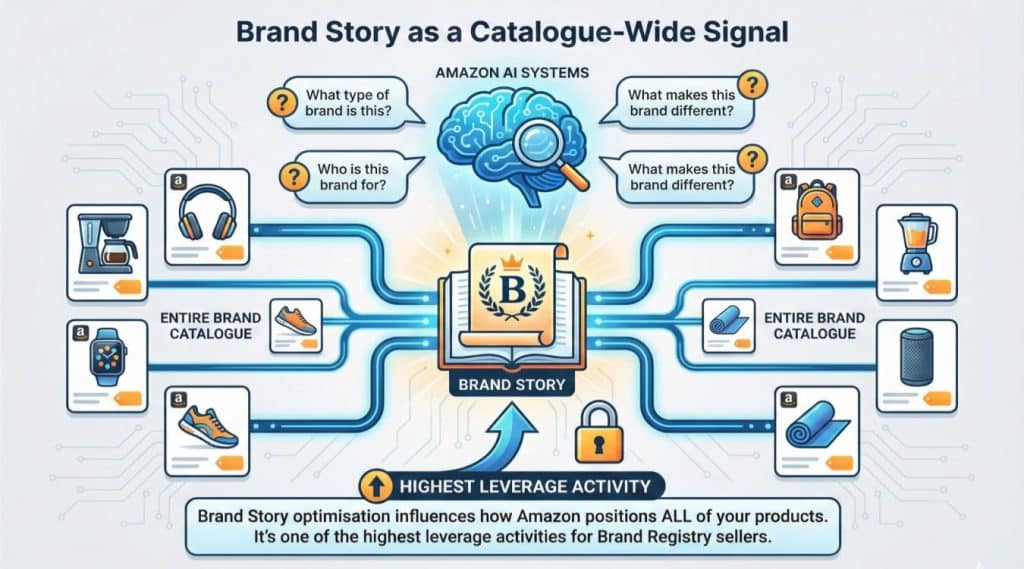
Unlike product descriptions or bullet points, the Brand Story applies across your entire brand catalogue. This gives it unique weight.
Amazon treats the Brand Story as a central reference point for your brand identity. It helps AI systems answer questions such as:
Because of this, Brand Story content influences how Amazon positions all of your products, not just one listing.
This catalogue-wide impact makes Brand Story optimisation one of the highest leverage activities available to Brand Registry sellers.
Brand Story optimisation supports multiple stages of the Amazon marketing funnel.
At the awareness stage, AI assistants use brand-level signals to introduce shoppers to new brands that match their needs. At the consideration stage, Brand Story content reinforces trust and differentiation. At the conversion stage, consistency between brand promises and listing details reduces hesitation.
When brand storytelling is weak or inconsistent, shoppers may still find your product, but they are less likely to trust it. AI systems also become less confident in recommending it.
This is why brand engineering should be viewed as part of a full funnel strategy, not just a branding exercise.
The Amazon flywheel describes how traffic, conversion, reviews, and sales velocity reinforce each other over time. Brand Story optimisation accelerates this flywheel by improving the quality of incoming traffic.
When AI-driven recommendations send better-matched shoppers to your listings, those shoppers are more likely to convert and leave positive reviews. These signals further strengthen your brand entity, making future recommendations more likely.
In contrast, poorly defined brands often receive mismatched traffic that fails to convert, slowing the flywheel and weakening long-term performance.
Many sellers still treat the Brand Story as a decorative section filled with founder anecdotes, lifestyle images, and generic claims. While this may appeal emotionally to some shoppers, it fails to provide AI systems with usable data.
Vague brand stories fail because:
AI systems prefer precise information that can be cross-checked. The more specific and consistent your brand story is, the easier it is for Amazon’s AI to trust and use it.

To engineer a brand story for AI shopping, you must shift your mindset. Instead of asking how your brand sounds, ask how your brand is understood.
Effective brand stories answer key questions:
This approach aligns closely with long-term brand-building principles and supports sellers who want to learn how to build a brand on Amazon that scales beyond individual product launches.
Amazon’s AI cross-references information from multiple sources. These include:
If your Brand Story claims one thing but your listings suggest something else, AI confidence drops. This inconsistency reduces recommendation frequency and visibility.
A well-defined brand story must be echoed consistently across all assets. This does not mean repeating the same phrases everywhere, but it does require alignment in meaning and intent.
Brand Story optimisation does not replace traditional optimisation. It enhances it.
A strong Amazon SEO strategy ensures that your listings remain discoverable through conventional searches while your brand story improves AI-driven discovery. Together, they create a balanced approach that supports both present and future ranking factors.
When SEO and brand engineering work together, Amazon’s systems receive a clearer picture of both what you sell and who you are.
Before moving into execution, sellers should assess their current brand clarity. This is where an Amazon listing audit becomes valuable. Audits help identify inconsistencies, weak claims, and missed opportunities across brand assets.
By understanding where your brand story currently lacks clarity, you can prioritise updates that deliver the greatest impact.
Once you understand how Amazon’s AI evaluates brands, the next step is execution. Brand Story optimisation is not about creativity alone. It is about structure, clarity, and repeatability.
Every Brand Story should be engineered with three goals in mind:
To achieve this, each module inside the Brand Story carousel must serve a clear purpose.

The “About” section is the foundation of your brand entity. Amazon’s AI uses this content as a primary reference point when determining what your brand represents.
Strong “About” sections share these characteristics:
Weak “About” sections focus on generic claims that could apply to any seller in the category. These statements do not help AI systems distinguish your brand from competitors.
When rewriting this section, focus on clarity over persuasion. Your goal is to reduce ambiguity, not to sound impressive.
While the Brand Story defines your brand entity, Amazon A+ premium content reinforces it at the product level. AI systems look for alignment between brand-level claims and product-level execution.
A+ Premium Content supports brand engineering by:
When A+ content echoes the same core attributes defined in your Brand Story, AI confidence increases. This consistency helps Amazon understand that your brand claims are reliable and supported across your catalogue.
Amazon’s AI systems do not only read text. They also analyse images to understand context and intent.
Brand Story imagery should visually represent the attributes you want your brand associated with. For example:
Generic product photos do not provide this context. Purpose-driven imagery helps AI connect your brand to specific concepts that shoppers care about.
Brand Story Q and A cards are an underused opportunity to clarify differentiation. Instead of basic logistics questions, these modules should address category-specific concerns.
Effective Brand Story Q&A content:
This content helps AI systems answer comparison-based queries more accurately. It also reduces confusion during the consideration stage of the buyer journey.
Amazon’s AI compares information across multiple sources. Any mismatch reduces trust.
To maintain high confidence scores, sellers must ensure consistency across:
Creating a central brand reference document helps maintain alignment. This internal resource should define approved claims, terminology, and brand positioning so updates remain consistent over time.
As AI-powered discovery expands, fewer shoppers browse long search result pages. Instead, they rely on recommendations, summaries, and comparisons generated by AI systems.
Brands with clear, structured identities benefit most from this shift. AI systems prefer recommending brands they understand well, especially when shopper intent is complex or nuanced.
This makes brand engineering one of the most sustainable growth strategies available on Amazon today.
AI writing tools can support research and drafting, but they should not define your brand narrative. Generic AI output often lacks specificity and introduces vague language that weakens brand signals.
For sellers exploring ChatGPT for Amazon sellers, the best approach is collaboration rather than delegation. Use AI to organise ideas, refine clarity, or summarise information, but manually inject facts, standards, and unique attributes.
Your brand story must reflect reality. AI can help you express it, but it cannot invent credibility.
Traditional keyword tracking alone no longer tells the full story. Brand engineering success is measured through broader indicators.
Key signals to monitor include:
Manual testing also matters. Periodically reviewing AI-generated responses and recommendations helps identify whether your brand story is being interpreted correctly.
The direction of e-commerce is clear. Conversational interfaces, AI recommendations, and entity-based discovery will continue to expand.
Brands that invest early in engineering their Amazon ‘brand story’ for the age of AI shopping gain a durable advantage. They become easier for AI to recommend and easier for shoppers to trust.
This is not a short-term tactic. It is a foundational shift in how Amazon evaluates and surfaces brands.
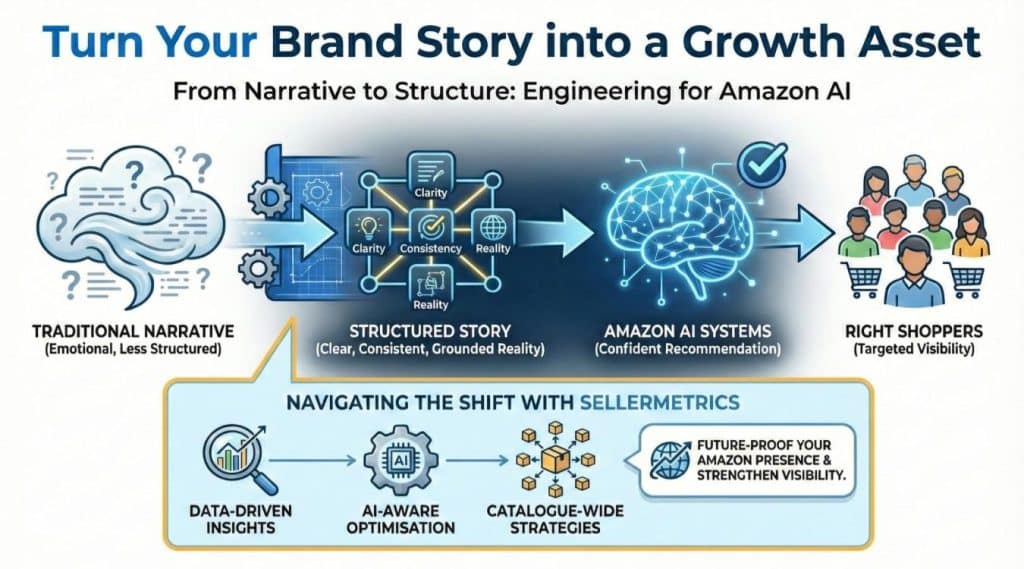
Engineering your Amazon ‘brand story’ for the age of AI shopping is about transforming narrative into structure. When your brand story is clear, consistent, and grounded in reality, Amazon’s AI systems can confidently recommend you to the right shoppers.
SellerMetrics helps brands navigate this shift with data-driven insights, AI-aware optimisation, and catalogue-wide performance strategies. If you want to strengthen brand visibility, improve AI-driven discovery, and future-proof your Amazon presence, SellerMetrics gives you the tools and expertise to do it right.
It is the process of structuring brand messaging so Amazon’s AI systems can understand and trust your brand. This goes beyond keywords and focuses on entity clarity, consistency, and validation. The goal is improved AI-driven discovery and recommendations.
Brand Story content supports ranking indirectly by improving relevance and conversion signals. AI-driven discovery increasingly influences which brands appear in recommendations. Strong brand clarity helps both traditional and AI-powered ranking systems.
Brand Story updates should occur when brand positioning, materials, or standards change. Frequent unnecessary edits can create inconsistency. Stability and accuracy are more important than constant revisions.
Yes, smaller brands can compete by being more specific and consistent. AI systems reward clarity and credibility, not size alone. Well-defined niche brands often perform strongly in AI-driven recommendations.
It is most impactful in competitive or comparison-heavy categories. When shoppers ask nuanced questions, AI relies heavily on brand-level signals. This makes Brand Story optimisation valuable across most categories.
AI interpretation updates gradually as systems rebuild confidence. Many sellers observe early signals within 30 to 60 days. Full impact often becomes clearer over several months.
No, it complements paid advertising. Clear brand identity improves ad efficiency by sending better-matched traffic to listings. Brand engineering strengthens long-term performance alongside ads.
The Brand Story should remain consistent across the catalogue. Individual products can highlight unique features, but the core brand attributes should not change. Consistency improves AI trust and shopper confidence.

9 March 2026
TweetLinkedInShareEmailPrint 18 min read By Rick Wong Updated Mar 10, 2026 TL;DR Why should new sellers...
27 February 2026
TweetLinkedInShareEmailPrint 8 min read By Rick Wong Updated Feb 27, 2026 TL;DR What is the optimal len...
18 February 2026
TweetLinkedInShareEmailPrint 8 min read By Rick Wong Updated Feb 18, 2026 TL;DR Is AMC free and availab...