
13 June 2026
Amazon Multi-Touch Attribution: What Sellers Need to Know in 2026
TweetLinkedInShareEmailPrint 8 min read By Rick Wong Updated Jun 13, 2026 TL;DR What is Amazon Multi-To...

 1 January 2026
Yes. Use brand ads as “launch scaffolding” to force initial sales velocity until organic rankings stabilize.
Use automated defense. Program your bidding rules to trigger only when a rival targets your specific name, saving you from constant over-bidding.
Audit aggressively. If an ad group isn’t actively blocking a competitor or cross-selling a high-margin item, kill it.
Run a 14-day holdout. Turn off branded ads for two weeks; if your total revenue remains stable, you’ve confirmed the spend was unnecessary.
For years, Amazon sellers have debated a deceptively simple question: Should you bid on your own brand name?
On one side are advertisers who view branded PPC as a necessary form of defense. If competitors appear above your listings when shoppers search for your brand, failing to bid can feel like leaving the front door unlocked. On the other side are profitability-focused operators who argue that branded campaigns often pay for clicks that would have converted organically anyway.
The reality is that brand bidding is neither universally essential nor universally wasteful. The right answer depends on factors such as competitive pressure, product lifecycle stage, organic visibility, and whether branded campaigns generate incremental sales rather than simply capturing demand that already exists.
This guide breaks down when bidding on your own brand name strengthens your Amazon growth strategy, when it becomes an unnecessary expense, and how to determine which side of the equation applies to your business.

If you have managed an Amazon advertising portfolio for any serious length of time, you are well aware that branded campaigns are structurally designed to look like the absolute heroes of an account. The data inside your advertising console always appears flawless: the return on ad spend (ROAS) reaches heights that category-level keywords can never match, the conversion rates routinely double digits, and the baseline advertising cost of sales (ACoS) stays remarkably low.
But anyone who presents account performance at the executive board level understands that highly flattering metrics can easily obscure operational waste.
For years, a vast percentage of brands routinely accepted these inflated performance numbers without question. The math was simple to ignore: branded clicks were cheap, category competition was manageable, and the blended account metrics kept clients and internal teams satisfied.
That passive environment has vanished. The contemporary landscape is crowded with high-volume private-label operators, international manufacturers selling direct-to-consumer, and institutional aggregators leveraging sophisticated programmatic tools to identify vulnerabilities in your listing metrics.
When these competitors deploy automated targeting models against your brand terms, they don’t just bid blindly. They evaluate your real-time review deficits, your pricing shifts, and your out-of-stock windows to steal market share when your visibility is compromised.
At the same time, customer discovery loops are evolving outside of traditional marketplace structures. If a buyer uses an AI assistant to discover the top-rated choice within your product category, and that assistant serves up a direct competitor, the customer journey bypasses your internal platform ads entirely.
Because of this shift, brand bidding cannot remain a default setting. Every dollar tied up defending an undisputed brand name is a dollar directly subtracted from new customer acquisition, mid-funnel category ownership, or the off-platform search engine optimization required to build true top-of-funnel brand equity.
In most cases, brand bidding is neither always necessary nor always wasteful. The right answer depends on competition, product lifecycle stage, organic visibility, and whether branded ads generate incremental sales rather than simply capturing demand that already existed.
To understand why these scenarios require such distinct actions, we first need to look at the massive shifts in the Amazon advertising landscape this year.
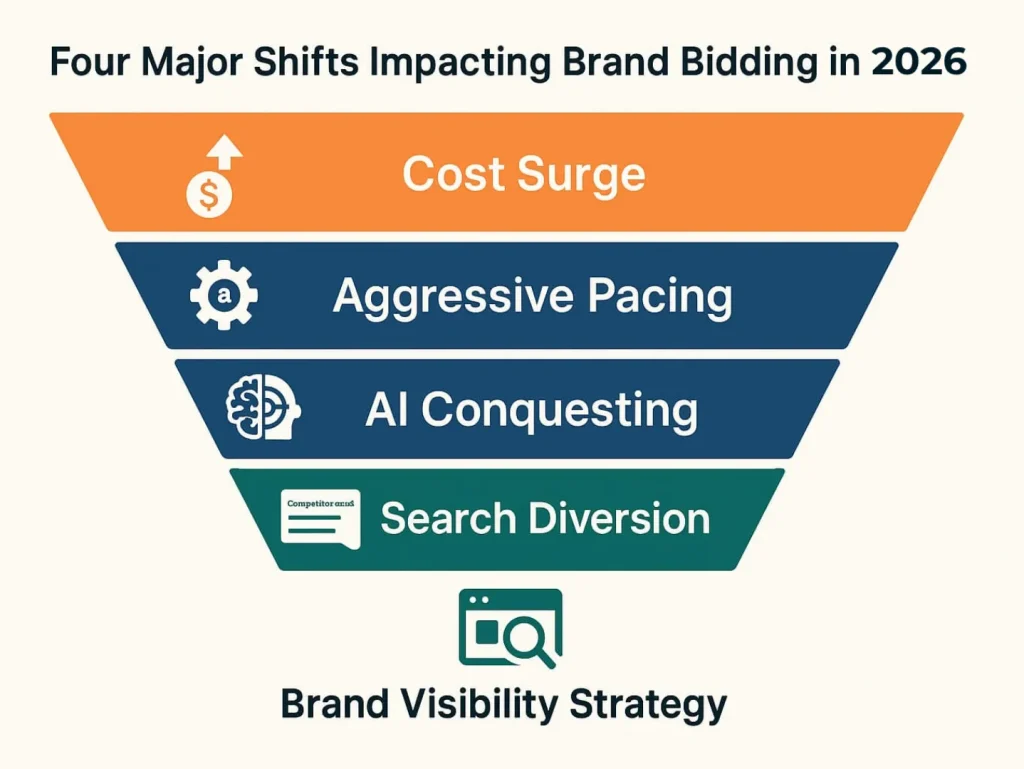
Brand bidding in 2026 exists in a fundamentally different environment than it did even two years ago.
Brand bidding is fundamentally an offensive execution designed to maximize digital shelf ownership. When an intentional customer enters your brand name into the Amazon search bar, counting on organic listings alone leaves your conversion funnel highly vulnerable. Organic listings are structurally rigid; they display standardized product titles, raw pricing, and basic star ratings. They offer zero room for dynamic marketing narrative.
By deploying Sponsored Brand and Sponsored Product ad layers directly above your organic rankings, you establish an ironclad visual sequence. Sponsored Brand ad formats allow you to craft custom editorial headlines, feature curated item portfolios, and deep-link traffic directly to your native Amazon Storefront. This visual real estate sequence effectively pushes competitor conquest placements below the fold, capturing the user’s absolute attention before their eye can wander to alternative options.
If you need help scaling these creative assets, our Amazon Listing Optimization Services help brands maximize their search real estate.
One of the most operational applications of branded PPC is the organic acceleration of new catalog additions. Amazon’s organic ranking algorithm relies heavily on historical sales velocity and conversion stability. Consequently, when you launch a new product, it is caught in a chicken-and-egg dilemma: it has no sales history, so it ranks on page three, where no one can buy it. Even when a customer explicitly searches for your brand name, Amazon will naturally prioritize your historical best-sellers organically, leaving your new release invisible.
Branded keyword targeting acts as the functional scaffolding to break this loop. By intentionally routing a segment of your brand-name search volume to your new ASIN via paid ad groups, you expose the product to your highest-converting audience segment. This targeted traffic injects the asset with immediate sales velocity and conversion data. These signals inform Amazon’s search engine, systematically elevating the product’s organic ranking. Once the item achieves top-tier organic placement, you can methodically scale back the defensive ad spend and capture clean, profitable margins.
Recent 2026 FBA fee changes and inventory-related surcharges have increased margin pressure for many sellers. With base fulfillment rates, storage calculations, and low-inventory surcharges altering your net margins, the historical luxury of running unmonitored brand defense campaigns is over.
If you are paying a premium CPC to secure a click from a customer who was structurally guaranteed to click your organic link, you are actively inflating your customer acquisition cost and compounding the margin squeeze caused by the 2026 fee hikes. Every branded ad group must be subjected to incremental lift testing. If a branded keyword group is not actively suppressing a conquesting threat or pulling cross-sell revenue into higher-margin products, those ad dollars must be reclaimed and redirected toward category-level conquesting that actually introduces new customers to your ecosystem.We have built a specific article about the framework for ChatGPT Amazon listing optimization to ensure your brand appears in these new AI-driven discovery flows.

At its surface, branded PPC appears entirely straightforward: you place a bid on your own name to ensure you control the top visual layer of your search engine results page. Yet beneath that interface lies a highly nuanced mix of consumer behaviors and operational realities.
A branded search is rarely an isolated event generated inside the marketplace. Instead, it is the downstream echo of your entire off-platform marketing investment. It is the measurable output of your influencer initiatives, your external content distribution, your social media presence on platforms like TikTok and Instagram, and the organic brand affinity built over years of delivering quality customer experiences.
However, accepting branded search revenue at face value can create a highly dangerous marketing illusion. In many instances, the data simply claims credit for a conversion that was already fundamentally locked in. If a repeat buyer is looking for your exact product name and intends to purchase it immediately, your paid ad block simply captures an expensive click that would have otherwise settled safely into your organic listing for free.
When this happens, your PPC architecture isn’t actually driving account growth; it is actively masking an underperforming customer acquisition engine by blending easy branded conversions with failing category-level campaigns. True marketplace value is never proven by how clean your branded ad metrics look; it is proven by your ability to scale total revenue while systematically managing your dependent ad spend.

If you are introducing new products and building brand identity, brand bidding can act like scaffolding. It reinforces your presence and ensures that early brand recognition is not lost to more established competitors.
The moment you stop defending your brand is often the moment your competitors start testing conquest campaigns against you. Similarly, when your brand has built a loyal audience and your repeat purchase behavior drives margin, brand defense ensures friction is minimized. Repeat shoppers searching for you should find you instantly. If you make them scroll past competitors, curated ads, and algorithm-suggested alternatives, you give away revenue and weaken loyalty loops.
Brand defense also matters during moments of rapid growth. When performance spikes (perhaps due to seasonal relevance, viral organic content, or retail expansion) competitors often target your momentum. In these peak windows, brand bidding becomes strategic. It helps ensure that momentum compounds. And then there is the threat from algorithmic conquering. You might not notice a competitor quietly showing up on your brand term for weeks. AI bidding systems will detect your demand curve. In those vulnerable moments, defensively maintaining a small but effective presence prevents you from losing high-intent customers.
In all of these cases, brand bidding functions not as cost but insurance—a cost incurred to prevent a far more expensive form of loss: brand dilution and market erosion. As insurance goes, you hope you never need it, but you’ll be glad it’s there when competition heats up. This level of precision is why many brands use Amazon PPC Software to automate defensive bidding rules.

Yet just as there are scenarios where branded ads are indispensable, there are times when they become a silent, ongoing tax on your margin. When your brand is mature, your organic ranking is dominant, repeat buyers already know where to find you, and competitors are not actively targeting your name, continuing to pump dollars into branded clicks can be wasteful.
In short, you might be paying for a customer who already had your product in their cart. This waste often hides in plain sight. It shows up as impressive ROAS but stagnating total sales. It masks a lack of non-brand momentum by propping up good TACoS metrics. It makes reports look good while failing to move the true north star of ecommerce profitability: incremental revenue. In practice, many brands over-advertise their own name because it feels safe. It provides comforting numbers in dashboards. It gives teams a sense of control. But comfort is rarely where competitive advantage lives. Smart operators understand that dollars used defending territory unnecessarily are dollars that could have built dominance in the battlefield that actually matters: non-brand discovery and category-level search.
In a world where generative search platforms increasingly influence what buyers see before they ever arrive at Amazon, over-indexing on branded PPC is like fortifying your castle walls while ignoring that the battlefield is moving to a new continent. Your job is not simply to protect current demand but to grow future demand. If branded PPC becomes a habit rather than a strategy, it risks becoming dead weight.

To strip away the data illusions native to standard advertising dashboards, professional media buyers look past basic return on ad spend and focus explicitly on total advertising cost of sales. ROAS operates in a silo; it tracks the revenue generated directly from an ad click, which means it will naturally treat your branded campaigns as top-tier performers because those audiences possess the highest pre-existing conversion intent.
TACoS provides the structural truth of your account math by tracking your total ad spend against your total gross revenue. This metric answers the only question that actually impacts your net margin: Is your ad spend actively expanding your entire revenue ecosystem, or is it merely shifting organic sales into paid attribution buckets?
If your branded campaigns are running at full capacity but your account-wide TACoS is rising while total revenue remains flat, the conclusion is mathematically clear: you are paying a variable tax on your existing organic audience. Managing this relationship requires a deep understanding of blended account metrics, moving away from dashboard vanity and toward incremental growth tracking.
The biggest mistake Amazon sellers make is treating brand bidding as either universally necessary or universally wasteful. In reality, branded PPC exists on a spectrum. The right decision depends on your competitive environment, catalog maturity, customer behavior, and overall advertising economics.
Instead of asking whether brand bidding is “good” or “bad,” ask a more practical question:
“Is this campaign generating incremental value, or am I simply paying for demand that already belongs to me?”
The matrix below provides a framework for evaluating when branded campaigns deserve budget and when they should be challenged through testing.
The goal is not to eliminate branded campaigns entirely. Rather, it is to ensure every dollar spent has a measurable purpose. A branded campaign should either defend market share, accelerate product adoption, improve merchandising control, or generate incremental revenue. If it does none of those things, it may be functioning as a convenience expense rather than a growth investment.
The most sophisticated Amazon operators regularly challenge their assumptions. They monitor competitor activity, track blended account metrics such as TACoS, and periodically test what happens when branded spend is reduced. In many cases, the data reveals that some level of defense is justified. In others, it exposes spend that can be reallocated toward category keywords, product launches, or broader customer acquisition initiatives.
Ultimately, the question is not whether to bid on your brand name. The question is whether the cost of defending that traffic is lower than the value you would lose by stepping away from it. The answer will vary from one business to the next, but a disciplined testing framework will always outperform assumptions.
Relying solely on Amazon PPC is no longer enough to protect your market share. The battlefield has fundamentally expanded. The sellers who dominate in 2026 and beyond will be the ones who defend their territory strategically rather than emotionally.
They will deploy branded PPC as a deliberate, calculated tool, not an automatic reflex. By trimming the waste from defensive campaigns, you can reinvest those crucial margins into category discovery, creative demand generation, and generative SEO strategies that ensure your products surface everywhere modern buyers ask questions.
Brand defense is now a two-front operation: you must protect existing demand on the marketplace while simultaneously capturing future demand before the search even begins. Generative SEO is not replacing your standard ad console; it is the essential complement that turns your bids into a precise lever rather than a costly crutch.
Brands that grasp this paradigm will build durable, long-term visibility. Those who refuse to adapt will watch their ad spend artificially inflate while their actual market power shrinks.If you are looking for guidance to navigate these structural shifts and kick the hassle out of the daily optimization process, our Amazon advertising management helps you architect a system built for the realities of 2026 commerce.
Yes, but only selectively and strategically, not by default.
Turning off branded ads may reduce sales velocity and visibility, which can indirectly affect organic performance.
They tend to show high ROAS, but profitability depends on whether they drive incremental sales or replace organic ones.
Competitor conquesting, particularly during virality spikes or stock dips.
Turn off branded ads for controlled periods and monitor TACoS and revenue stability.
Yes, it accelerates adoption and stabilizes brand search conversion early.
Absolutely. AI search is becoming a major product discovery channel.
Yes, competitors can set automated conquest triggers on your brand queries.
No, only when the cost of not defending exceeds the savings of pausing branded ads.
Treating branded bidding as mandatory rather than strategic.
13 June 2026
TweetLinkedInShareEmailPrint 8 min read By Rick Wong Updated Jun 13, 2026 TL;DR What is Amazon Multi-To...

12 June 2026
TweetLinkedInShareEmailPrint 8 min read By Rick Wong Updated Jun 13, 2026 TL;DR What is Alexa for Shopp...

8 June 2026
TweetLinkedInShareEmailPrint 14 min read By Rick Wong Updated Jun 08, 2026 TL;DR How should I structure...