13 June 2026
Amazon Multi-Touch Attribution: What Sellers Need to Know in 2026
TweetLinkedInShareEmailPrint 8 min read By Rick Wong Updated Jun 13, 2026 TL;DR What is Amazon Multi-To...

 12 November 2025
Article of Contents
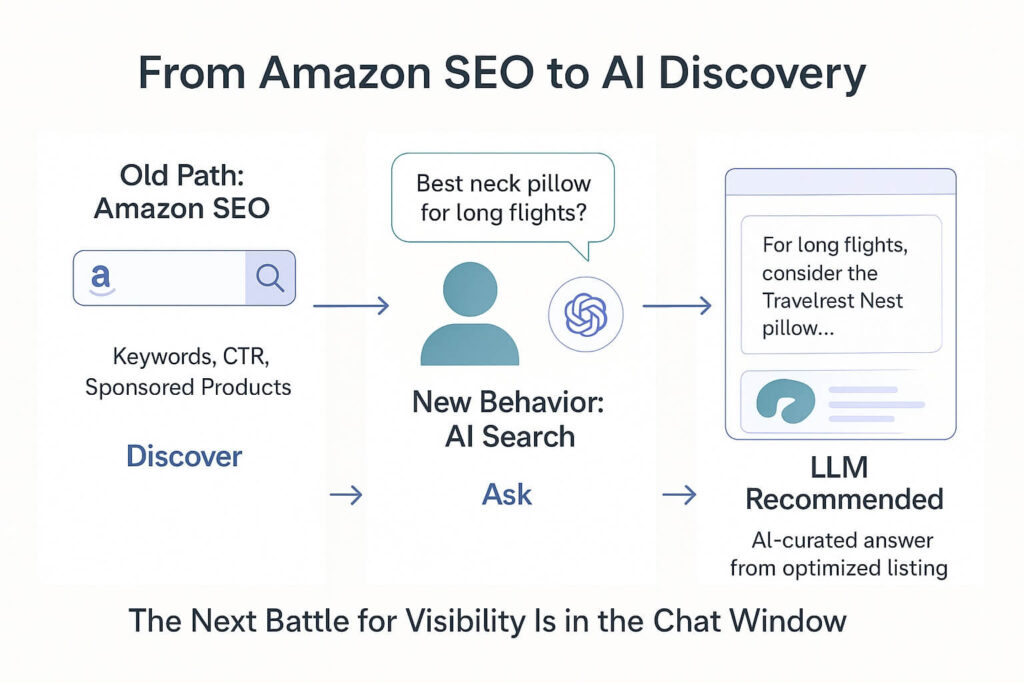
Not long ago, every conversation about “Amazon SEO” started and ended inside the marketplace. You worried about backend keywords, bullet formatting, reviews, and CTRs. Maybe you ran a few Sponsored Product campaigns to boost rank and velocity.
But the search landscape has changed—radically.
Think about how you personally shop today. You probably start with a quick question to ChatGPT instead of typing keywords into Google.
Today, consumers aren’t just typing keywords into Amazon or Google. They’re asking questions, in full sentences, to AI assistants like ChatGPT, Gemini, Perplexity, and Claude. “What’s the best neck pillow for long flights?” “Which vitamin D supplement absorbs fastest?” “What kitchen knife do chefs recommend for under $100?”
And here’s the remarkable part: these AIs answer back. They don’t just show search results. They curate them, summarize them, and increasingly, they recommend specific products.
If you’re an Amazon seller, that shift changes everything. Imagine your product becoming one of those AI-recommended picks users trust instantly. The buying journey is expanding beyond Amazon’s search bar. In 2026 and beyond, product discovery will begin where curiosity meets conversation: in the chat window.
That means your Amazon listings need to be LLM-discoverable—structured, optimized, and trustworthy enough for large-language-model tools like ChatGPT or Gemini to select your product as an authoritative answer.
Let’s unpack exactly how that works, why it matters, and what concrete steps you can take now to future-proof your listings for the AI discovery era.

When OpenAI released ChatGPT to the public in 2022, it changed how people find information. But by 2025, it started changing how people shop.
You can already see it in real data. Surveys show over 30% of Gen Z shoppers now use AI tools to research products before visiting an e-commerce site. Google’s own generative search (SGE) and Gemini are integrating purchase suggestions directly into AI answers. And while Amazon still dominates transactional intent, it’s no longer the first step of the funnel. This shift means your product could be chosen before a shopper even lands on Amazon.
The discovery journey is fragmented and conversational. This change is subtle but powerful, and it’s already happening.
Imagine a traveler planning a trip to Tokyo. They ask ChatGPT, “What’s a good compact travel adapter for Japan that supports fast charging?” The AI responds with a short list, maybe two or three products, often sourced from Amazon.
The shopper doesn’t see dozens of listings or pages of sponsored ads. They see a hand-picked short list, generated by an AI using signals like product relevance, clarity of description, customer sentiment, brand authority, and external reputation. This is where your listing’s clarity becomes your competitive edge.
If your listing is written for algorithms but not for understanding, if it doesn’t clearly answer who your product is for, what it does, and why it’s trustworthy, it won’t appear in that list.
In other words, you’re not competing for clicks anymore. You’re competing for citations.
Before you can optimize, you need to understand how LLMs interpret content. These models don’t crawl the web like Google does. They read, summarize, and interpret information to answer questions in context. In simpler terms, the AI is trying to ‘understand’ your product the same way a human would after reading your page.
When an LLM like ChatGPT or Gemini encounters product data (via Amazon’s public pages, brand sites, or structured feeds), it doesn’t just note the keywords. It builds an internal “representation,” an understanding of what the product is, what need it solves, who it’s for, and how it compares.
For example, if your listing headline reads:
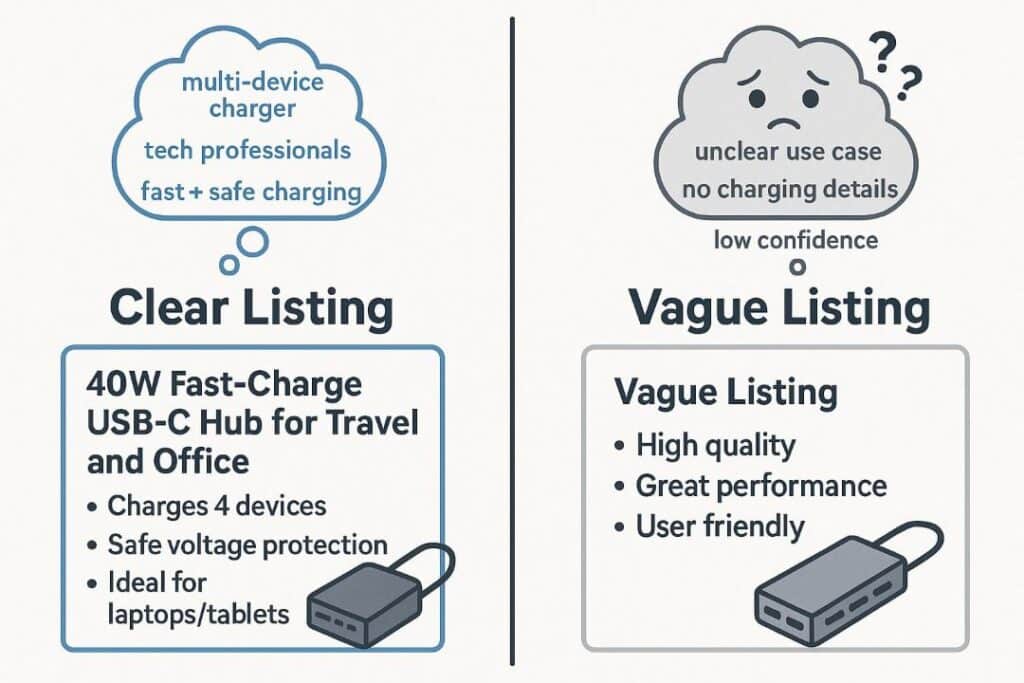
“BrandX Pro 8000—Advanced 40W Fast-Charge Multi-Port USB-C Hub”
The model will interpret this as a multi-port USB-C hub designed for users needing fast charging capacity, likely targeting tech enthusiasts or professionals.
But if your bullets are vague (“High quality design,” “Easy to use,” “Great performance”), the model lacks context. It can’t confidently answer a shopper’s query like “Which USB-C hub charges multiple devices safely?” because your listing doesn’t explicitly say that.
LLMs reward clarity, context, and completeness.
They also assess trust. Ratings, review volume, external mentions, and consistent brand identity all signal that a product is legitimate. Just as backlinks once told Google which sites to trust, external signals now tell AIs which products to recommend.
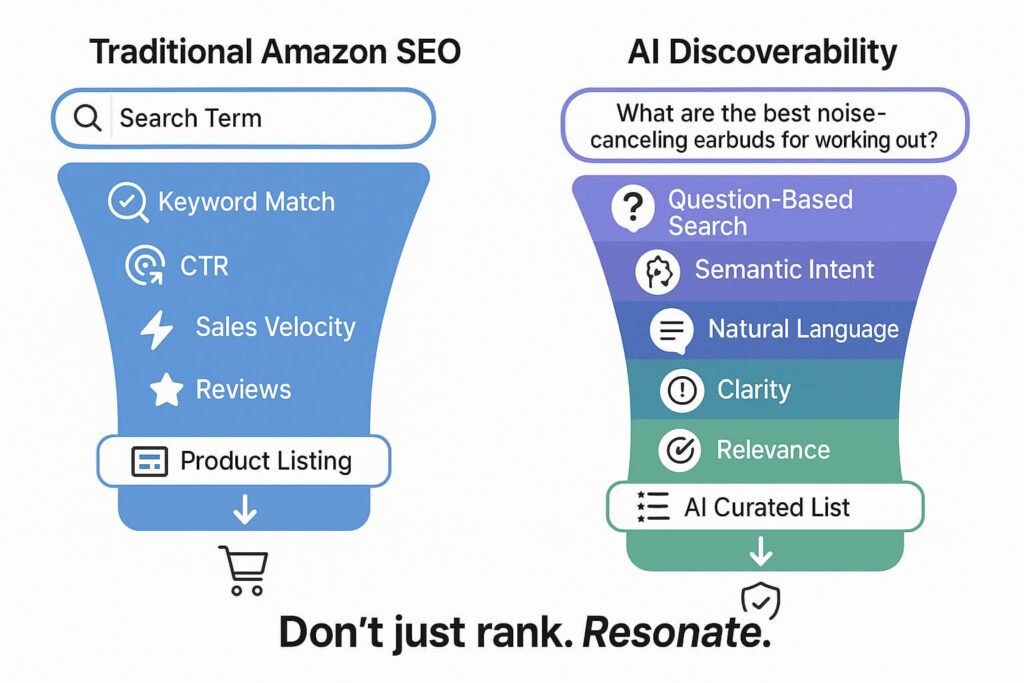
Traditional Amazon SEO is all about ranking within Amazon’s own ecosystem. It focuses on:
These remain critical. But AI discoverability adds a new layer: semantic intent.
You’re no longer just optimizing for “wireless earbuds.” You’re optimizing for questions like:
LLMs interpret and respond to intent, not just keywords. It’s no longer about who yells the loudest with keywords — it’s about who explains best.
So, the listings that win will be the ones that sound less like machine-written keyword stuffing and more like clear, natural answers.

Here’s the paradox of LLM optimization: it’s less about technical trickery and more about language empathy.
If your listing reads like something a human would naturally say to recommend the product — concise, confident, and contextual—it’s more likely to be understood and cited by AI. If your product copy sounds like a real person talking, you’re already halfway there.
That doesn’t mean dumbing it down. It means writing as if you’re teaching a smart but curious reader exactly what makes your product special, in plain English. Think of it as writing mini-stories about your product instead of bullet lists. It’s about being human in how you explain and precise in what you say.
For example, instead of:
“Premium ergonomic pillow with advanced support technology and innovative design.”
Try:
“Designed for side-sleepers who wake up with neck pain. The memory-foam contour supports spinal alignment while staying cool through the night.”
That sentence does three powerful things:
Now the AI has substance to work with.
In LLM-readable terms, that’s gold.
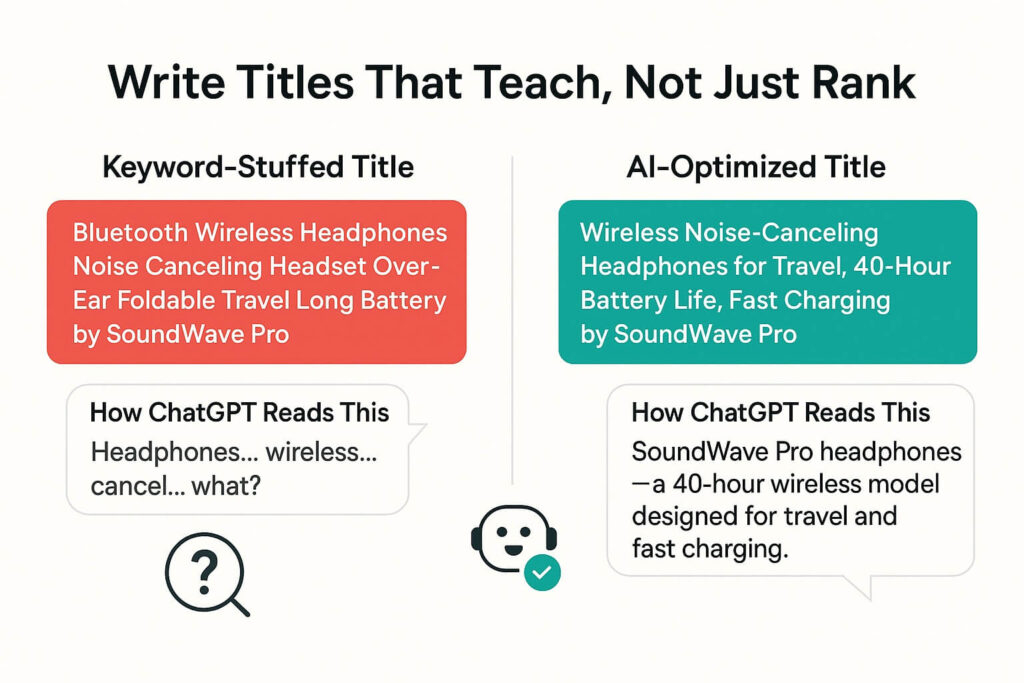
Your title is the headline the algorithm reads first and the one the AI most heavily references when describing your product.
Many Amazon sellers over-optimize titles for internal search, cramming in every variation of a keyword to increase their visibility. That may still work for Amazon’s algorithm, but it makes your product harder for LLMs (and humans) to parse. Imagine your title being read aloud by ChatGPT. Would it still make sense?
style=”text-align: justify;”Instead, focus on semantic precision. Lead with what the product is, then add use-case and benefit.
For example:
“Wireless Noise-Canceling Headphones for Travel, 40-Hour Battery Life, Fast Charging, by SoundWave Pro.”
A title like that still contains high-value keywords, but it’s structured like an answer.
When ChatGPT sees it, it can confidently recommend:
“SoundWave Pro headphones—a 40-hour wireless model designed for travel and fast charging.”
Your listing has essentially written its own AI snippet.

Next, turn your product description into a conversation, not a pitch.
When you write, imagine a buyer asking you directly, “Why should I buy yours?” or “How is this different?”
Your goal isn’t to sound like marketing copy. It’s to anticipate the follow-up question.
Take this example:
“Our blender uses 1,500 watts of power and stainless-steel blades for fast, consistent blending.”
That’s fine. But it doesn’t answer what shoppers actually ask. A more LLM-friendly rewrite would be
“Need a blender that crushes ice and frozen fruit without stalling? The BlendForce 1500 delivers commercial-grade performance in a countertop design. Its stainless-steel blades and 1,500-watt motor create smooth textures in seconds—no chunks, no overheating.”
Notice how this version builds intent around use-case and outcome. It’s written like something an AI might quote in response to a prompt like “Which blender handles frozen fruit best?”
That’s the essence of Generative Engine Optimization (GEO)—content designed to be used in an AI answer. The clearer your description, the easier it is for AI to quote it back to users.
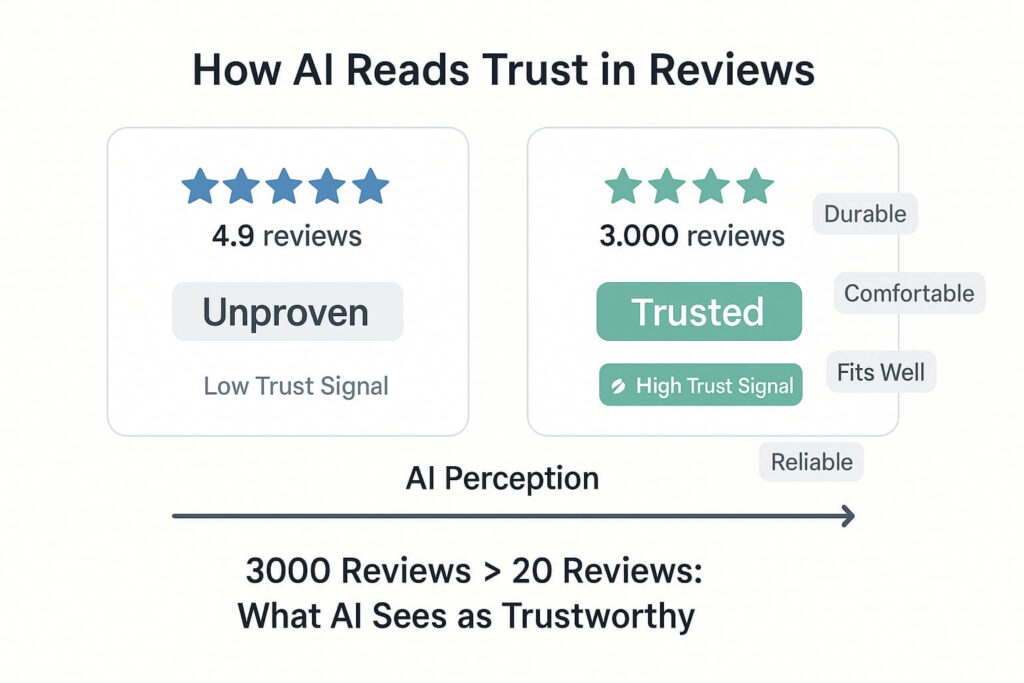
No matter how well you write your listing, it won’t earn trust if your review profile is weak.
LLMs don’t think like consumers, but they learn from human patterns, and they’re trained on billions of review snippets, sentiment markers, and brand signals. Products with consistently positive sentiment and large sample sizes carry more weight. AI tools notice patterns in reviews the same way shoppers do.
A product with 3,000 reviews and a 4.7 average tells the model, “Safe to recommend.”
A product with 20 reviews and a 4.9 average says, “Unproven.”
So your job isn’t just optimization; it’s credibility engineering.
That means proactively requesting reviews (within Amazon policy), responding to negative feedback, and addressing common pain points in your listing. If half your reviewers complain about size, adjust your bullets to clarify measurements. If people praise durability, use that language intentionally.
AI models notice consensus language, the words many humans repeat. “Durable,” “comfortable,” “fits perfectly.” These become semantic anchors that reinforce your product’s identity across the web. AI ‘hears’ what customers repeat most.
Here’s a subtle but critical insight: LLMs don’t live inside Amazon’s walls.
When ChatGPT or Gemini reference a product, they’re not limited to Amazon’s search data. They also read brand websites, press releases, blog reviews, social mentions, and affiliate posts. These off-Amazon signals shape how the model understands and trusts your product. Put simply, your brand’s story needs to live beyond Amazon. Consistency is key—mismatched details confuse both people and machines.
If you have a DTC website or blog, that’s your secret weapon. Publish helpful, educational content that naturally references your own products, not as hard sells, but as context.
For instance, if you sell skincare, write an article titled “How to Choose a Vitamin C Serum That Actually Works.” Explain key ingredients, benefits, and what to look for, and mention your product naturally.
LLMs crawl that content, index it, and associate your product with the broader topic of “effective vitamin C serums.”
Similarly, social proof from credible influencers, editorial reviews, or mentions in reputable sites creates knowledge graph density. The more connected your brand is across the web, the more discoverable it becomes in AI search results.
In practical terms: if the internet keeps saying good, consistent things about your product, AI models will too. Think of your brand as an ecosystem, not a single listing.
Structured data—things like schema markup, GTINs, brand identifiers, and product metadata—act as digital scaffolding for AI. Structured data acts like a digital name tag that helps AI connect the dots.
Even if you can’t directly alter Amazon’s backend schema, you can reinforce it through your brand site and external pages. Adding a Product schema to your website, for example, ensures LLMs can easily connect your Amazon listing with your official brand representation.
Include:
When a model sees this structured consistency across multiple sources, it strengthens confidence that your listing is accurate and current, increasing its likelihood of being cited.
Unlike Amazon’s algorithm, which rewards brevity and keyword precision, LLMs thrive on natural language.
When optimizing your listings, think in questions and answers. The simplest way to do this without breaking Amazon’s guidelines is to integrate conversational phrasing inside your bullets and description.
Instead of “Long battery life,” write, “Worried about your headphones dying mid-flight? These deliver 40 hours of uninterrupted playtime.”
Instead of “Compact and durable,” try “Fits easily into a carry-on bag and survives the bumps of travel, thanks to reinforced aluminum casing.”
You’re not just describing features; you’re writing dialogue. And that dialogue is exactly what large language models are designed to extract and repeat. If your copy answers questions before users even ask them, you win twice: with humans and with AI.
Here’s the tricky part: there’s no “ChatGPT analytics” dashboard (yet). So how do you know if your optimization efforts are working?
You’re looking for clues, not direct data—at least for now. Start by tracking indirect indicators:
Over time, more tools will emerge to quantify AI visibility. But for now, the right content patterns—human clarity, trust, and consistency—will deliver measurable benefits inside Amazon, too.
As brands race to “optimize for AI,” a few predictable mistakes are already showing up.
The first is keyword stuffing 2.0: sellers trying to cram LLM-related phrases (“ChatGPT-friendly,” “Gemini-recommended”) into listings. That’s not how this works. You can’t trick an LLM; you can only feed it better context. Remember, AI rewards meaning, not marketing fluff.
The second is treating this as a gimmick. Real AI discoverability is built on the same timeless principles as good marketing: clarity, credibility, and connection. If your product genuinely solves a problem, your job is simply to make that solution easy to understand.
The third is ignoring off-Amazon presence. The future of visibility isn’t isolated to one platform. The more consistent your messaging, tone, and data across every channel (Amazon, website, social, PR), the stronger your brand’s AI “fingerprint.”
Finally, some sellers assume this is years away. It isn’t. Already, millions of daily queries are being answered by LLMs. And as those models integrate more e-commerce APIs, the shift from “research” to “purchase” will blur. Optimizing now gives you an early-mover advantage that compounds.
For brands that think ahead, this isn’t just an SEO adjustment—it’s a new growth layer.
AI discoverability opens an opportunity to reach shoppers before they’ve even decided to visit Amazon. This is where marketing meets machine learning, and smart sellers will lead the charge. If ChatGPT or Gemini consistently mentions your brand in relevant product conversations, you gain mindshare before competitors even bid for a click.
Imagine this scenario: a user asks, “What are the best noise-canceling headphones for students?” and the AI replies, “Many users recommend SoundWave Pro for its comfort and 40-hour battery life.” That line alone could drive thousands of qualified shoppers straight to your Amazon storefront, without a single ad impression.
This is what forward-thinking marketers call generative demand capture: influencing the decision moment before the marketplace click.
In that sense, optimizing for AI doesn’t just boost Amazon’s rank. It expands your brand’s relevance across the digital ecosystem.
If you take one thing away from this article, let it be this: every word in your Amazon listing is now a data point for a conversation you can’t hear.
When someone asks an AI assistant for advice, your listing’s clarity, tone, and completeness will determine whether that AI remembers you or forgets you.
The framework for success is straightforward but demanding:
If you do these five things, you’re not just chasing another SEO fad—you’re building a brand architecture that aligns with how people (and machines) now find, evaluate, and recommend products. Every tweak you make today builds long-term discoverability tomorrow.
A decade ago, Amazon SEO was about stuffing keywords. Then it became about earning conversions. In 2026 and beyond, it’s about owning the conversation.
ChatGPT, Gemini, and other LLM tools aren’t replacing search; they’re reframing it. They filter noise, summarize options, and deliver what users truly want: trustworthy answers that save time.
The brands that rise to the top won’t be the loudest or cheapest. They’ll be the clearest, the ones whose listings read like natural, human explanations of real value. In short, if your listing sounds like it could be read out loud in a helpful ChatGPT reply, then you’re on the right track.
So don’t wait for “AI-search optimization” to become an Amazon seller webinar buzzword. Start now. Audit your top listings. Rewrite them with clarity, empathy, and depth. Align your off-Amazon content. And think less about gaming algorithms and more about teaching intelligence—human and artificial alike—and why your product deserves to be part of the answer.
In the next few years, listings written for AI will define who wins search visibility. Because the next time a shopper asks ChatGPT, “Which one should I buy?” you’ll want the AI to know your name.
Optimizing for LLM tools means making your Amazon listings easily interpretable by AI models that answer consumer questions. These AIs scan product pages, brand sites, and structured data across the web. When your listing clearly explains what your product does, who it’s for, and why it’s trustworthy, the AI can confidently include it in a recommendation or product roundup. In short, you’re training the machines to understand and trust your brand narrative.
They do—though indirectly. When users ask, “What’s the best budget coffee grinder?” or “Which pillow is good for side sleepers?”, these tools often cite Amazon listings, editorial reviews, or affiliate recommendations. ChatGPT (via Browse or OpenAI’s retail integrations) and Gemini both retrieve structured product data, price points, and review summaries. As this behavior expands, being AI-discoverable will increasingly influence Amazon traffic before the shopper even opens the app.
Traditional Amazon SEO is inward-facing—it focuses on ranking inside Amazon’s search algorithm through keywords, CTR, and sales velocity. AI optimization looks outward. It’s about making your product understandable in natural language and verifiable through external trust signals. Instead of only asking, “What keyword ranks?”, you start asking, “Would an AI recommend this listing if a shopper asked it a question?”
Large-language models read context, not code. They draw from publicly visible text such as your Amazon title, bullet points, description, customer reviews, brand store content, press mentions, and even your DTC website. They also interpret structured metadata like schema.org markup and consistent product identifiers (GTIN, ASIN, and brand). Every piece of text that describes your product—anywhere online—becomes part of the AI’s understanding.
The foundation is the same: clarity and completeness. But remember that ChatGPT relies on conversational context, while Gemini often prioritizes factual accuracy and schema consistency. That means your tone should be natural and human (for ChatGPT-style answers), while your facts—specs, measurements, price ranges—should be precise (for Gemini’s structured retrieval). Blending storytelling with data is the winning formula.
Indirectly, yes. Ads create engagement and sales velocity, which in turn generate reviews and social proof. Those human interactions feed the signals that AIs later use to gauge credibility. You can’t buy your way into an AI recommendation, but you can amplify the trust metrics that make your listing more likely to be chosen when the model looks for reliable products. Paid and organic efforts still reinforce each other.
The big three are brand authority, content consistency, and sentiment. Authority comes from verified reviews, media mentions, and backlinks. Consistency means your product name, price, and description match across Amazon, your website, and social platforms. Sentiment refers to tone—if reviews, influencers, and blog posts describe your product positively and coherently, that consensus becomes a “confidence cue” for AI models deciding what to recommend.
Right now, tracking is manual. You can test this by asking ChatGPT or Gemini open-ended shopping questions that match your niche (“What are the top running shoes for flat feet?”). If your brand appears—even without a link—you’re already indexed in that AI’s knowledge layer. Over time, analytics tools will emerge to measure this visibility more precisely, similar to how we once learned to measure SEO impressions.
The most common mistake is chasing gimmicks—adding “ChatGPT-optimized” phrases or filler text. AI doesn’t respond to keywords; it responds to meaning. The second mistake is writing sterile, over-templated listings that sound like machines talking to machines. The third is ignoring off-Amazon signals. A flawless Amazon page can still be invisible to AI if your brand site is empty or inconsistent. Treat discoverability as an ecosystem, not a hack.
Absolutely. We’re at the early stage of a long trend. As conversational AI becomes the default way people search, brands that already read well to machines will dominate first-generation product recommendations. Think of this like mobile optimization circa 2012—early adopters didn’t just gain incremental visibility; they captured entire markets before competitors caught up. Investing now means your listings will already speak the language of AI when everyone else starts translating.
Start by rewriting one of your top listings as if you were explaining it to a friend. Remove jargon. Clarify the audience, use case, and outcome. Then check that your brand website, social bios, and product metadata echo the same description. You’ll be amazed at how quickly clarity turns into discoverability—not just for people, but for the algorithms that increasingly speak on their behalf.
13 June 2026
TweetLinkedInShareEmailPrint 8 min read By Rick Wong Updated Jun 13, 2026 TL;DR What is Amazon Multi-To...

12 June 2026
TweetLinkedInShareEmailPrint 8 min read By Rick Wong Updated Jun 13, 2026 TL;DR What is Alexa for Shopp...

8 June 2026
TweetLinkedInShareEmailPrint 14 min read By Rick Wong Updated Jun 08, 2026 TL;DR How should I structure...