9 March 2026
The Complete Guide to Amazon PPC Product Targeting
TweetLinkedInShareEmailPrint 18 min read By Rick Wong Updated Mar 10, 2026 TL;DR Why should new sellers...

 3 January 2026

Ad copy optimization for Rufus means writing Amazon ad headlines and video scripts that sound like a helpful response to a shopper’s question, then validating that match with tighter targeting, better creative, and cleaner search term hygiene. Rufus can interpret intent and context, so the ads that win tend to explain who the product is for, what problem it solves, and why it is credible, without sounding like a keyword dump.
Ad copy optimization for Rufus is no longer about squeezing every keyword into a headline and calling it a day. It is about being the clearest, most trustworthy answer inside a conversation, while still working within Amazon’s ad formats and policies.
The shift is real: shoppers are asking longer questions and expecting faster clarity, and they are letting AI do more of the sorting for now.
Article of Contents
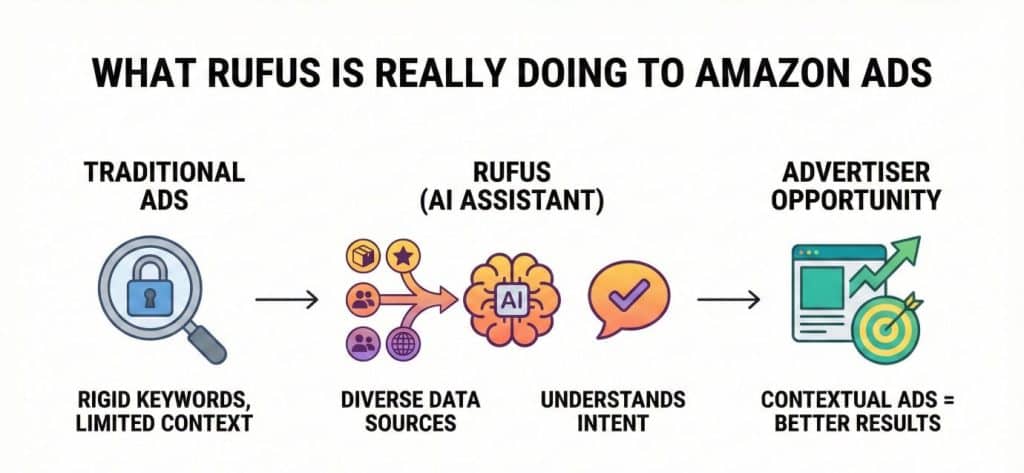
Rufus is Amazon’s generative AI shopping assistant, built to answer shopping questions, compare options, and recommend products based on conversational context. It is trained on Amazon’s product catalog, customer reviews, community Q&A, and information from across the web, which is why it behaves less like a keyword matcher and more like a reader. Competitor guides tend to focus heavily on listing optimization and “more context” language, which is directionally right, but they often stop short of giving advertisers a practical copy system for each ad type. The opportunity for you is to translate that same context and clarity into paid creative, where small wording changes can lift click quality and efficiency quickly.
If this article is meant to rank, it needs to feel like it was written for a human who is trying to make a decision today, not for a crawler. Google’s own guidance is blunt: create helpful, reliable, people-first content, and avoid content made primarily to manipulate rankings.
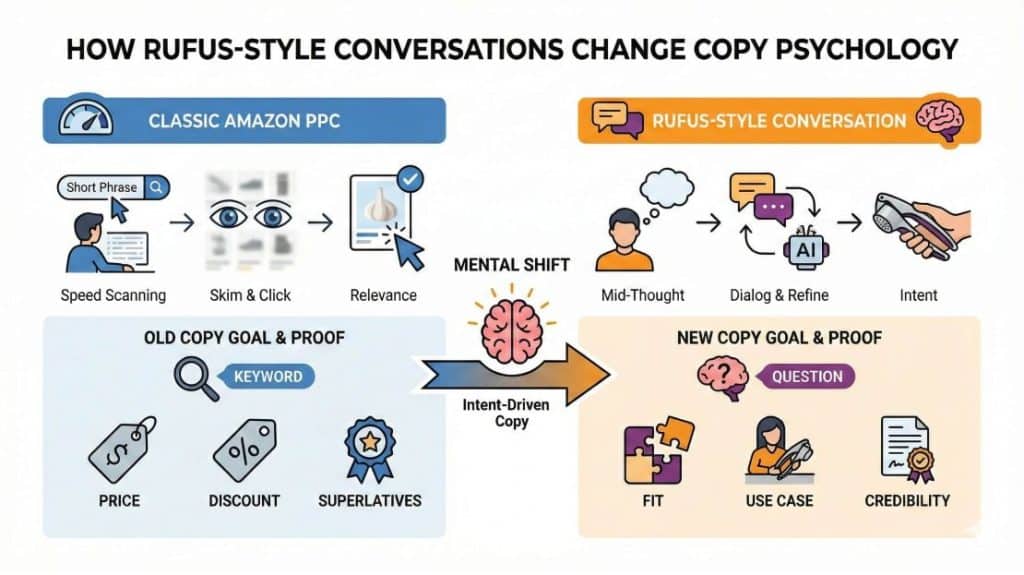
Classic Amazon PPC assumes speed scanning. A shopper types a short phrase, skims, clicks, and you win by being the most relevant click.
In a Rufus-style conversation, the shopper is mid-thought. They ask, refine, ask again. They are not just buying a “garlic press,” they are buying “a garlic press that does not hurt my wrist.” Your copy has to carry intent, not just topic.
Here is the mental shift:
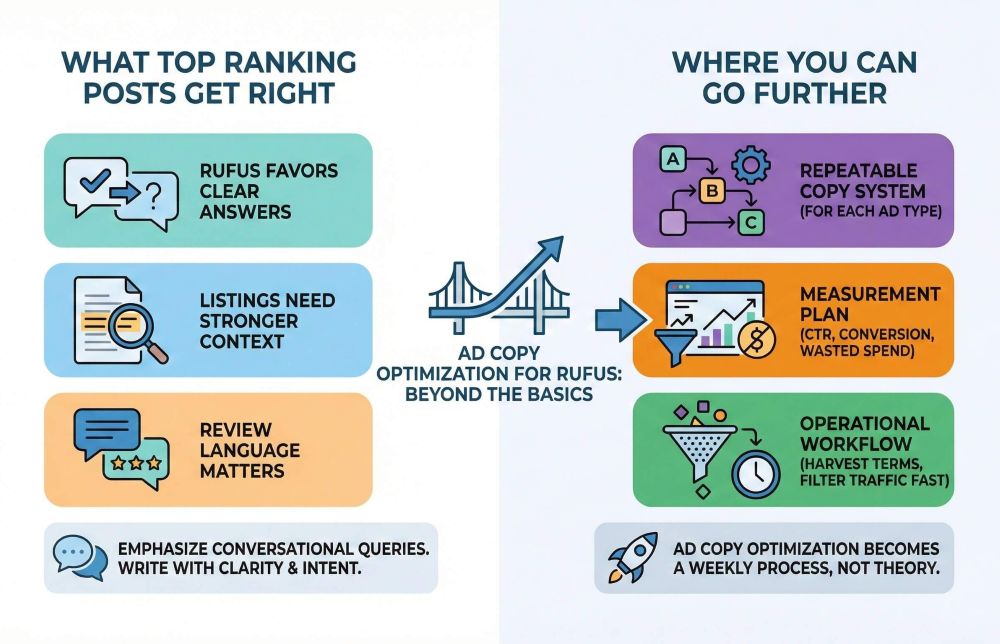
Most pages currently ranking for this topic agree on three fundamentals: Rufus favors clear answers, listings need stronger context, and review language matters. They emphasize that Rufus responds to conversational queries and that sellers should write with clarity and intent.
Where many of those posts stay a bit light is the paid side. They will tell you to “answer questions,” but they rarely show you how to turn a specific question into a headline, a video hook, and a negative keyword rule, then measure whether the shift worked.
This is why Ad copy optimization for Rufus deserves its own playbook: listings explain the product, and ads earn the moment.
To outperform competitors, add three things they often skip:
If you include those three, Ad copy optimization for Rufus stops being theory and becomes a weekly process your team can run.
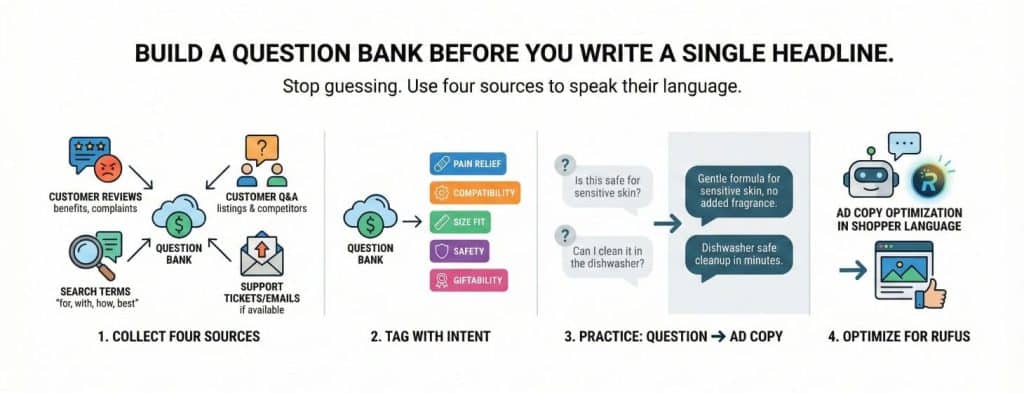
The easiest way to write better ads is to stop guessing what shoppers ask. Build a question bank from four sources:
Then tag each question with an intent label like “pain relief,” “compatibility,” “size fit,” “safety,” or “giftability.”
Here is what that looks like in practice:
Now you are doing Ad copy optimization for Rufus in the same language shoppers already use.
Conversational does not mean casual claims. Keep your copy compliant and defensible. Amazon’s moderation guidance highlights that ads must meet creative requirements, and certain character tricks and phrasing can lead to rejection.
Before you publish, confirm you can substantiate the claim, avoid guarantees, and match the on page proof. If anything feels shaky, rewrite. Ad copy optimization for Rufus works best when the copy is both helpful and precise.
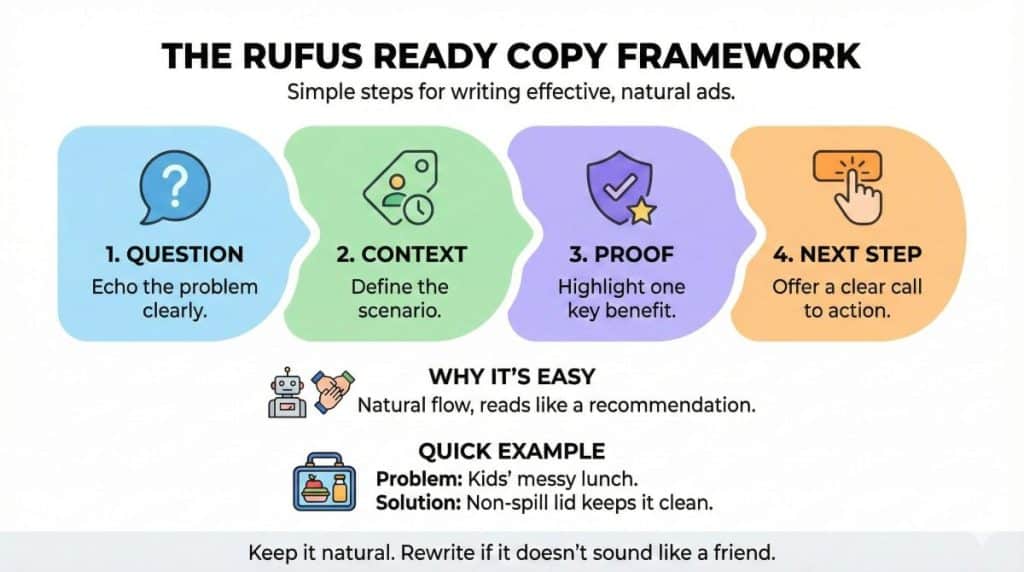
When you sit down to write or refresh ads, use a repeatable structure instead of improvising.
This framework works because it produces text that an assistant can summarize. It also reads like a recommendation, not an interruption.
Keep it natural. If you would not say it to a friend, rewrite it.
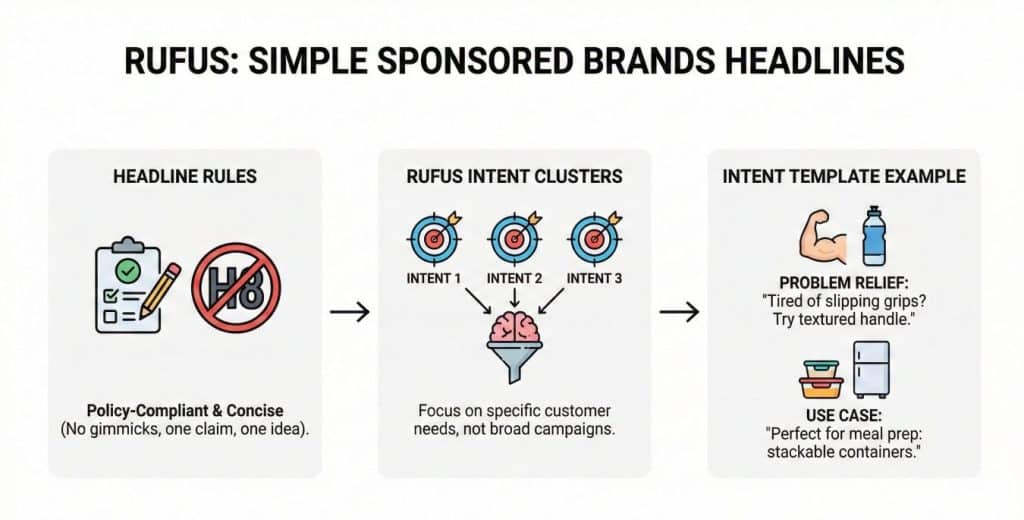
Sponsored Brands headlines are still one of the few places where you can directly write a short message. Your headline has to meet policy standards, and Amazon reviews it for compliance. For example, Amazon’s moderation guidance restricts gimmicky special characters and shorthand that can cause disapproval.
Now the Rufus part: build headlines by intent clusters, not mega campaigns that try to speak to everyone.
Problem relief
Use case fit
Comparison moment
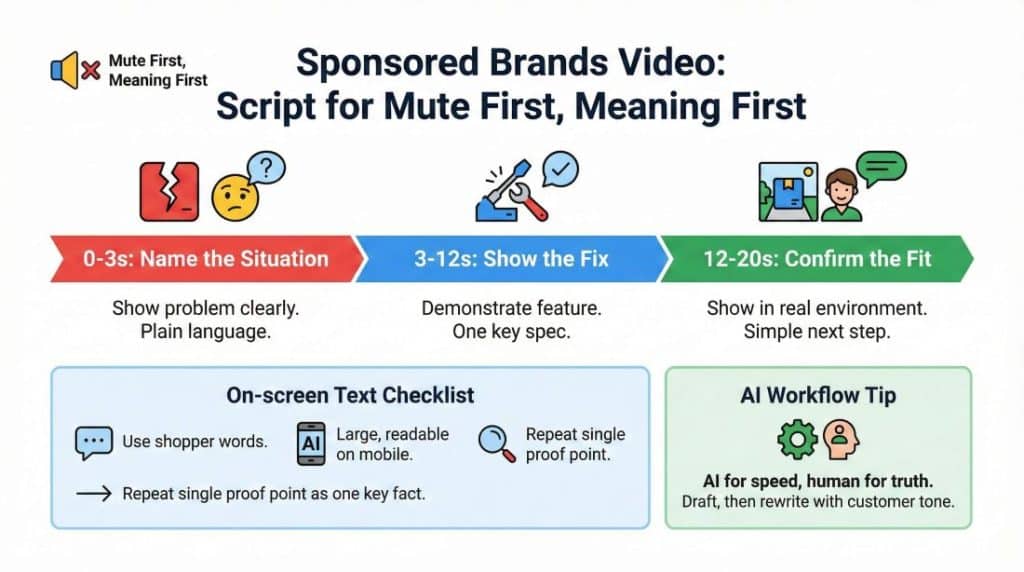
Video is where many brands accidentally go silent. Sponsored Brands video plays automatically and starts without audio by default, so captions and on-screen text are not optional if you want the message to land. Amazon also recommends making a strong first impression in the first few seconds and keeping the video brief and easy to understand. That lines up perfectly with conversational shopping, because a shopper’s question tends to have a tight “why” behind it.
0 to 3 seconds: name the situation
3 to 12 seconds: show the fix
12 to 20 seconds: confirm the fit
If you want a fast workflow, draft your script in ChatGPT for Amazon Sellers, then rewrite it so it sounds like you, using your customers’ review language as the guide. Use AI for speed, but keep human judgment for truth and tone.
Sponsored Products does not give you a custom headline field, which means your “copy” lives in the listing itself: title, images, bullets, and sometimes A plus content. The practical implication is simple: if your listing cannot answer the conversation, your ads will struggle to convert even if you win clicks.
Treat your listing and ads as one system:
This is where Amazon SEO and PPC stop being separate teams and become one feedback loop.
Rufus conversations often include comparison and “what else should I consider” moments. Sponsored Display and product targeting can help you show up while a shopper is weighing options.
If reviews in your niche complain about “hard to clean,” your ad should calmly explain your cleaning advantage.
Conversational queries mean broader phrasing, and that usually pushes you toward broader match coverage somewhere in the account. But broader targeting without hygiene can turn into an expensive mess.
Here is the safeguard: separate exploration from efficiency, then maintain ruthless negatives.
This is the place to decide on Manual PPC or Automated PPC based on your team and your volume. If you are running dozens of products, automation can protect you from falling behind on negatives and bid updates. If you are running one hero ASIN, manual work can still be razor sharp.
Amazon uses an auction to determine placements and the final cost per click, and Amazon notes that auctions consider factors beyond the bid when deciding both placement and final CPC. Amazon Ads. In practice, that means clearer relevance can help you pay less for better traffic, because you are not relying on raw bid alone.
This is why copy belongs in your performance conversations. If your text and creative lift relevance and engagement, you often see efficiency improvements without changing product price.
Ad copy optimization for Rufus is visible in proxy metrics long before you see any official “Rufus” reporting.
You cannot yet pull a report that says “Rufus assisted conversions” in one neat column, so you watch proxy signals.
If your CTR rises while conversion holds, your copy is matching intent better. If CTR rises and conversion drops, you may be attracting curiosity, not buyers, so refine the promise and your negatives.
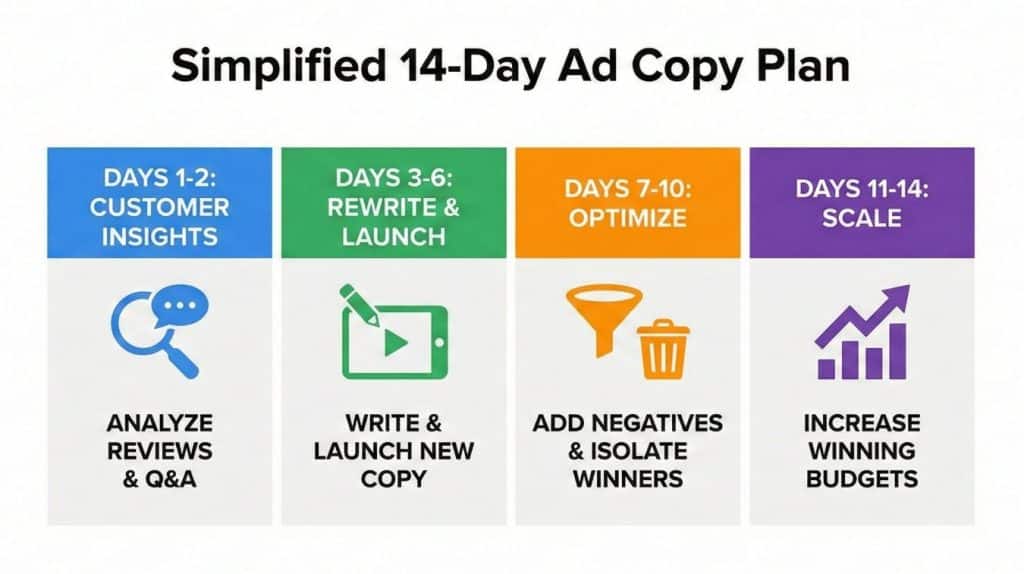
You do not need a massive rebrand to improve copy. You need a tight testing loop.
Treat Ad copy optimization for Rufus like a sprint: tight inputs, fast edits, and clean measurement.
If you need a system to do this at speed, Amazon PPC Software can automate harvesting, negatives, and bulk changes so your team spends time on strategy instead of spreadsheet triage.
Ad copy optimization for Rufus rewards the brands that take a breath and speak plainly. When your headline and script sound like a confident, helpful response, you earn better clicks, better data, and usually better efficiency over time. If you want to operationalize this without living inside reports every day, SellerMetrics offers Amazon Sponsored Ads Management workflows, automation rules, and bulk tools designed to keep your account clean while you focus on the ideas that move revenue. Explore the platform, set up your intent-based structures, and let the boring parts run on autopilot.
No, you do not need to name it, and in most categories, it looks forced. Focus on the shopper’s question and the use case, because that is what the conversation is really about. Keep the wording natural and policy compliant.
Start with your reviews and Q&A, then scan search term reports for “how,” “best for,” and “what is” phrasing. Turn each repeated question into one intent cluster headline and one proof point. Launch, then keep only what earns clean clicks.
Keep it short and direct, because Amazon recommends brief, easy-to-understand videos and strong early hooks. A 15 to 30-second format is usually enough to state the situation, show the fix, and confirm the fit. If you cannot explain the value in that window, your message is probably too broad.
Yes, because match type changes the breadth of intent you capture. Broad and auto need more cautious promises and stronger negatives, while exact match can be sharper and more specific. Align your copy to the tightest common intent inside that ad group.
Top of funnel copy should teach and reassure, because the shopper is still figuring out what they need. Mid-funnel copy should compare and reduce risk, like ease of cleaning or fit. Bottom funnel copy should make the decision easy, like a clear bundle, size, or compatibility note.
The auction still decides placement and pricing, so you cannot ignore bids. But better relevance and engagement can make your spend work harder, because auctions consider factors beyond the bid when determining CPC and placement.
They can draft them, but you need to review for accuracy, substantiation, and Amazon’s moderation rules. Amazon’s guidance also flags certain gimmicky shortcuts and special character tricks that can cause disapproval. Use AI for variations, then keep the ones that are true, clear, and human.
First, check that your promise matches what the listing proves, then tighten your negatives. Next, isolate the queries that drive clicks without orders and either reframe the headline or remove the traffic. Finally, test one sharper proof point so you attract buyers, not browsers.

9 March 2026
TweetLinkedInShareEmailPrint 18 min read By Rick Wong Updated Mar 10, 2026 TL;DR Why should new sellers...
27 February 2026
TweetLinkedInShareEmailPrint 8 min read By Rick Wong Updated Feb 27, 2026 TL;DR What is the optimal len...
18 February 2026
TweetLinkedInShareEmailPrint 8 min read By Rick Wong Updated Feb 18, 2026 TL;DR Is AMC free and availab...