9 March 2026
The Complete Guide to Amazon PPC Product Targeting
TweetLinkedInShareEmailPrint 18 min read By Rick Wong Updated Mar 10, 2026 TL;DR Why should new sellers...

 27 February 2026
Aim for 15 to 20 seconds. Shorter videos that hook shoppers in the first three seconds and immediately demonstrate value drive the highest conversion rates.
Yes. Although 85% of shoppers watch on mute, Amazon requires an audio track with a minimum 96 kbps bitrate. Silent files trigger automatic rejections.
Compliance traps include starting or ending with blank frames, featuring star ratings, using promotional buzzwords like “huge savings,” or including URLs directing traffic off Amazon.
SPV captures high-intent shoppers with single-ASIN ads in the search grid. SBV uses larger banners for mid-funnel browsing, building brand awareness and directing traffic to storefronts.
If you’re selling on Amazon in 2026, you already know this: getting to Page 1 is harder than ever, and visibility still depends heavily on the Amazon A9 algorithm.
The days when a few polished product images were enough to launch and coast are over. Sellers who want consistent traction need a clear Amazon SEO strategy alongside stronger creative.
Amazon has become a competitive, visually driven marketplace. Many shoppers don’t read bullet points first. They want to see the product working, fast. That’s why many sellers pair video ads with Amazon listing optimization services so the listing is built to convert once the click comes in.
But, there is one important thing to remember: it is not enough to simply have a video ad; you need a video that converts and makes you money.
There are many Amazon sellers who spend tens of thousands of dollars on high-end video ads and still experience a flat click-through rate (CTR) with an advertising cost of sales (ACoS) through the roof. That is why it helps to understand what is a good ACoS on Amazon before scaling spend.
To make effective Amazon Video Ads, you have to think like an Amazon customer and try to foresee their needs and how they will engage with your ad. In addition to fulfilling their needs, you also have to identify where on the Amazon website to place your ad and ensure that your ad is technically compliant with Amazon’s requirements.
This guide provides the best practices to help your video ads get noticed, stand out in search results, and grow your business through affordable advertising.
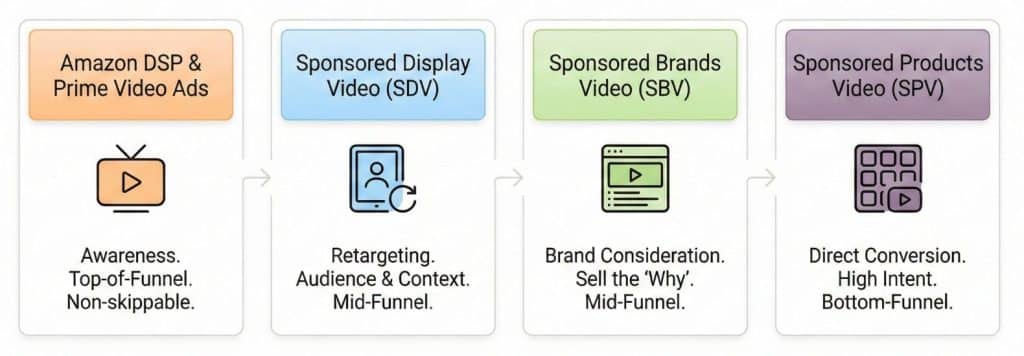
Sellers often make the first error in their selling process when they treat “amazon video ads” as a single format. This is the same thought process that prevents them from completing an Amazon listing audit before increasing their ad spend.
In reality, Amazon has several video placement formats available for use; each fit into a different area of the buyer’s journey. Pick the wrong placement and your budget can burn fast.
Sponsored Products Video is a lower-funnel format built to drive direct conversions. It works best for one product and one clear search intent.
SPV works well with Amazon search term optimization, as well as an optimized backend search term structure to improve relevance and help Amazon match your ad to the right queries.
You will often see this ad in the search results, usually further down the page, appearing in the product grid. Performance depends on how fast the video shows the core benefit and whether it improves amazon click-through rate without attracting low-quality clicks.
Sponsored Brands Video is a larger video placement that appears in the search results. When someone clicks, they go to a product detail page or your Amazon Store.
Sponsored Display Video targets shoppers based on audiences and context, not keyword searches. It can show on Amazon placements like the homepage or product detail pages, and sometimes across Amazon-owned properties such as Twitch.
This is at the top of the funnel. Brands can run non-skippable OTT (over-the-top) video advertisements through Amazon DSP on platforms such as Prime Video and Freevee.
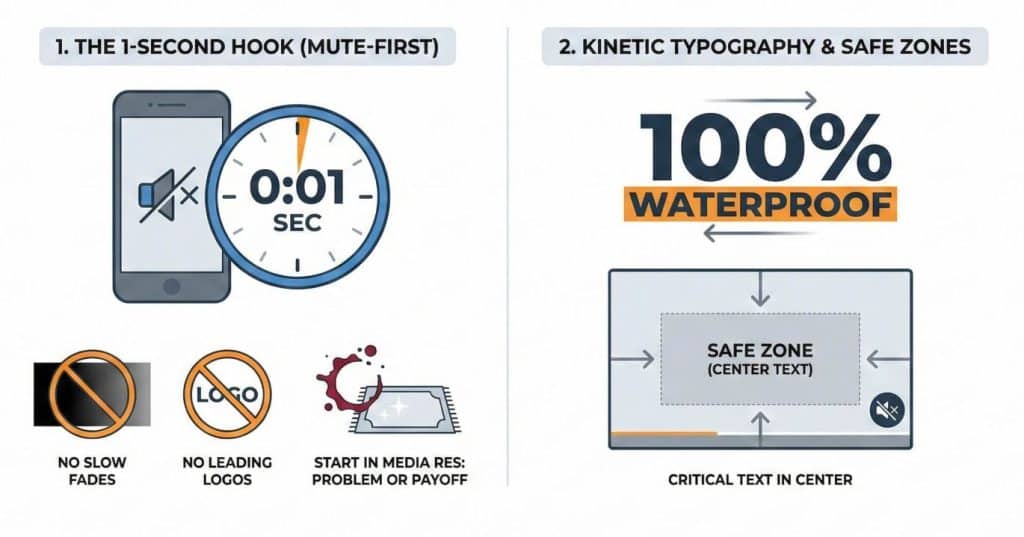
More than 85% of Amazon shoppers will view your video on their phones, and it will be muted the entire time.
Amazon sponsored brands and sponsored product video ads play automatically when a user scrolls through an ad with no audio.
Your video campaign is doomed if it is dependent on a clear voiceover to provide the viewer with the core value of your product. You must design for a mute-first experience.
On platforms like YouTube and Facebook, you have three seconds to earn buyer’s attention. On Amazon, you may have less than one second before a shopper scrolls past.
In this game, the frame is more important than the clock.
Since your video will be viewed without audio, you can use bold and contrasting text that moves rapidly to highlight the key features of your product. For example, for a waterproof backpack, you can use “100% WATERPROOF” in a clear font.
Amazon uses “safe zones” as the ads are displayed on desktop, tablet, and mobile devices with different screen sizes. The critical text should be at the center so that it remains visible. The text positioned at the edges or bottom right corner may get hidden by the mute button or will be clipped off when viewed on a smaller screen.
Amazon allows video ads up to 45 seconds, but shorter usually performs better. A clear 15–20 second video often wins because Amazon shoppers are not looking to watch a commercial. They want proof fast, then they want to buy.
Long videos often lose viewers before the product’s value is clear. That lowers completion rate and weakens performance.
The best way to get the most conversions possible from your Amazon ads is with a quick and direct storyboard. This blueprint is especially effective for Amazon sponsored product video ads.
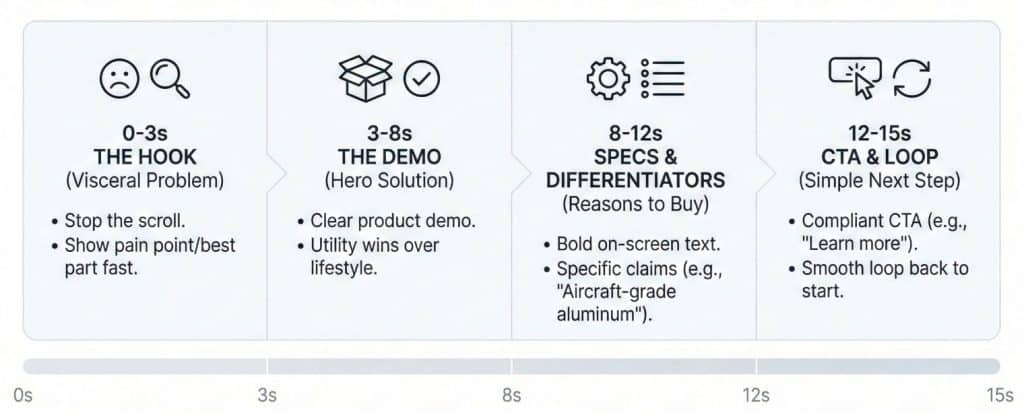
Use this proven 15 second format:
Show your customer’s biggest pain point or the best part of your product immediately. Use tight shots and fast pacing so the shopper understands the problem and the solution at a glance. The goal is to stop the scroll.
Show the product working exactly as intended. A clear product demo often outperforms lifestyle footage on Amazon. If you sell a pop-up tent, show the tent pop open in two seconds. Utility wins.
At this point you’ve got their attention and now it’s to give the reasons to buy. Bold on-screen text will help call out the top two or three reasons why your product is better than the competitor. Avoid vague claims.
Instead of: “High quality”
Use: “Aircraft-grade aluminum”
Instead of: “Easy to clean”
Use: “100% dishwasher safe”
End with a simple next step and a clean brand cue. Amazon limits aggressive promotional language, so use compliant CTAs such as: “Learn more,” “See details,” “Shop the store,” or “Browse options.”
Important note: Amazon video ads autoplay and loop. Make the ending flow smoothly into the first frame. A hard jump from a calm logo screen back to a chaotic hook looks sloppy and can hurt viewer experience.
If you want context for realistic expectations, compare performance to Amazon conversion rate by category so you don’t assume the video failed when the category itself converts lower.
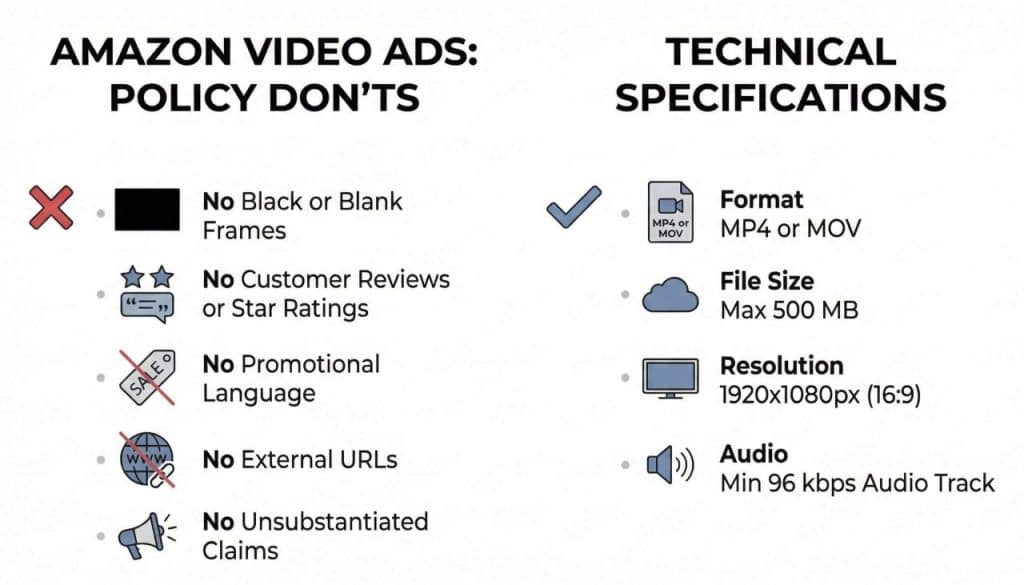
Amazon’s moderation team can quickly stop your ad momentum. If your video looks like spam or breaks a policy, it will be rejected, which is why many sellers include compliance checks and upload QA in their amazon advertising management process.
Follow these technical guidelines and policy guidelines to get your ad campaign live without any issues.
Your video must meet Amazon’s exact media requirements:
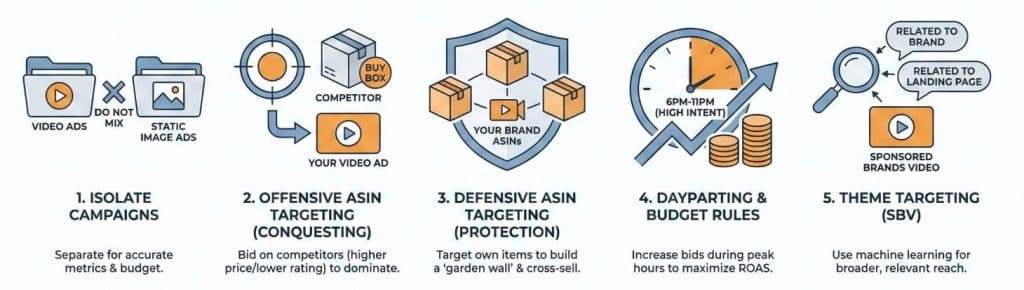
Winning with video is not only about the creative. It also depends on your bidding and targeting. This matters even more as Amazon CPC online advertising keeps climbing, which means weak hooks and sloppy targeting get expensive fast.
To connect your ad structure to long-term ranking results, treat Amazon SEO and PPC as one system, not two separate efforts.
You should not run static image ads and video ads together in the same campaign. Amazon’s algorithm will usually favor the format with the higher CTR, which can distort the performance metrics for both your image ads and your video ads.
It can also cause budget competition inside the same campaign, where one format steals spend from the other. If you are deciding how to structure campaigns, start by reviewing the trade-offs between Manual PPC and Automated PPC.
One of the best video strategies for the most powerful impact are Offensive ASIN Targeting campaigns. Instead of running keyword bids, you bid on your competitor’s specific ASINs (the product detail page).
Take a search term report and find out what ASINs are the same as your competitor’s products that have a higher price, a lower star rating, or less features in comparison to your product. Set up an Amazon SDV or SPV campaign targeting those ASINs exactly.
Once a customer has opened your competitor’s detail page, your HD video will begin playing underneath their Buy Box, and show why your product is better. This strategy can drive high-converting sales and reduce your competitor’s market share.
You have to defend your territory too. If you are an effective brand, then competitors will be proactively using the offensive strategy described above for you.
You need to run SBV and SDV campaigns that target your own ASIN Catalog. The only related products or video ads a shopper sees when they land on one of your product pages is another item from your own brand. This builds a “garden wall” around your product pages, which can increase average order value through cross-sells and limit competitor ads from showing to those shoppers.
The Cost-Per-Click (CPC) of Video Ads is typically higher than static ads because the placement takes up more valuable real estate. Since prices are set by the bidding system, understanding the overall Amazon advertising cost helps you avoid paying too much for low-quality clicks.
Using Amazon’s budget rules, and dayparting (bidding based upon schedule), will help you get the most bang out of your dollars, and maximize your Return on Ad Spend (ROAS).
Review your company reports to determine when your highest converting windows occur. If you are selling a B2C product, you may discover that 70% of all conversions occur between 6pm-11pm.
Use third-party PPC software or Amazon’s native budget rules to increase your video ad bids by 30% during high-intent evening hours. Then lower bids back to a maintenance level during early morning periods that convert less.
Take advantage of the new Theme Targeting features with SBV campaigns on Amazon. Instead of manually entering hundreds of individual keywords, you can target “keywords related to your brand” to capture all brand searches relevant to your company.
You can also target “keywords related to your landing page,” which allows Amazon’s machine learning to automatically match your video to shoppers searching within product categories related to your offer.
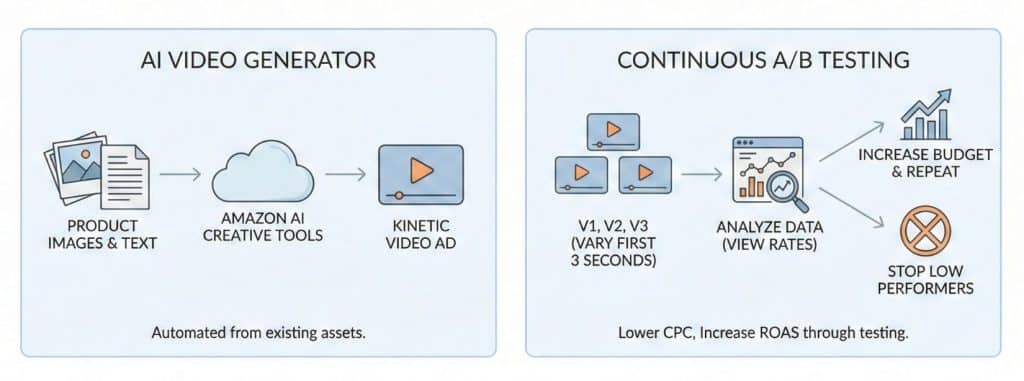
This 2026, there will be no more excuses to say “video production is just too expensive.” With Artificial Intelligence now being used by Amazon in an extensive way through its advertising console, high-quality creative can now be achieved by sellers of all sizes.
You can use Amazon’s video generator (which is found in the creative tools tab), if you don’t have a dedicated videographer. The video generator uses artificial intelligence to take your existing high-resolution product images, bullet points, and A+ Content and creates a compliant, kinetic video advertisement complete with text overlays and royalty free background music.
Amazon’s top performing brands are using the Amazon ad console’s detailed video ad performance data to run continuous scientific testing on their video ad campaigns. It makes no sense to ever simply “set and forget” a video campaign.
With such fine-grained detail in the Amazon ad console data – including Video First Quartile View Rate (how many people viewed at least 25% of your video) and Video Complete View Rate (how many people viewed all of your video), you’ll able to identify exactly where your video is losing viewers through simple mathematical analysis.
If your First Quartile View Rate is terrible, your 1 second hook isn’t working. People are scrolling right over it. If your First Quartile View Rate is high but your CTR is low, your call to action or mid-video product demonstration isn’t inspiring clicks.
You can use either an AI tool or basic video editing software to generate three versions of the same video and only vary the first three seconds of each version of your video. Then, run these versions of your videos at the same time with equal ad spend for 14 days.
After that, shut off the versions that didn’t perform well and increase the budget of the version that did best. And then do this again. This is how you lower your CPCs and increase your ROAS.
In 2026, Amazon’s algorithm made a complete transition from a basic keyword-matching engine to an advanced, AI-based customer matching recommendation engine. Using only exact match sponsored products is a race to the bottom of your profit margin.
Amazon sellers who are the most successful are using a full funnel video strategy. Amazon DSP is used to create brand awareness across all streaming tv platforms; SBV is used to target mid funnel category browsers; SPV is used to intercept high intent keyword searchers; and SDV is used to aggressively retarget abandoned cart buyers.
By implementing these Amazon video ad best practices, you can stop wasting spend on ignored impressions and turn more clicks into customers. For additional ways to scale beyond video placements and creative, see this guide on how to increase sales on amazon.
The optimal length of time for an Amazon video ad is fifteen to twenty seconds. Although Amazon will allow videos up to forty-five seconds long, the highest click-through rates (CTR) and conversion rates are generated by short, highly focused videos that immediately show the shopper the value proposition of the product.
Amazon video advertisements automatically play on mute across both desktop and mobile search results. Since over 85% of shoppers view video advertising while muted, it’s a major best practice to use bold, high-contrast, on-screen text overlays to present your primary selling points to the shopper.
Sponsored Brands Video (SBV) appears as a large banner in the search results, directing consumers to a product detail page or your Amazon storefront. It is a great way to increase brand awareness. Sponsored Products Video (SPV) appears in the standard search results grid and showcases a single ASIN, targeting high-intent, quick purchases.
Amazon frequently disapproves video ads for a variety of reasons. These include the beginning or end of the video with black or blank screens, customer reviews or star ratings, use of promotional copy such as “enormous savings” or “purchase today,” and difficult-to-read text.
Your video should be in MP4 or MOV format and not exceed 500 MB. You should aim for a 1920×1080 resolution (16:9) with audio, and the audio bitrate should be a minimum of 96 kbps.
For a 15-second ad: You should capture the audience’s attention in the first 3 seconds with a visible problem or action, and then follow up with a 5-second high-quality product demonstration. Next, highlight the product’s key features in text overlays for 4 seconds, and finally, conclude with a 3-second Call-to-Action.
Yes, you can utilize ASIN targeting (product targeting) to display your video advertising directly to a competitor’s product detail page within your video campaign. Utilizing this form of targeting is a very aggressive way to steal market share from competitors that offer inferior products or charge higher prices than your business.
Product demonstrations significantly outperform lifestyle footage in terms of conversion rates. Amazon shoppers typically have a high purchase intent and want to see how a product functions, what it looks like, and how it can help solve their problems. Therefore, save abstract lifestyle branding for social media and concentrate on providing direct utility to Amazon shoppers.
No, Amazon explicitly prohibits the placement of external URLS, website links, social media profiles, and/or any directive(s) attempting to drive traffic away from the Amazon marketplace. Therefore, your call-to-action (CTA) must direct the shopper to purchase directly on the Amazon marketplace.
Prime Video Ads are non-skippable streaming television commercials that run prior to or during movies and TV programs available to customers of Amazon Prime. Eligible brands and agencies can purchase Prime video ads through Amazon DSP, utilizing Amazon’s rich first-party data to target large audiences on the largest screens in their home.

9 March 2026
TweetLinkedInShareEmailPrint 18 min read By Rick Wong Updated Mar 10, 2026 TL;DR Why should new sellers...
18 February 2026
TweetLinkedInShareEmailPrint 8 min read By Rick Wong Updated Feb 18, 2026 TL;DR Is AMC free and availab...
18 February 2026
TweetLinkedInShareEmailPrint 8 min read By Rick Wong Updated Feb 18, 2026 TL;DR What is it? It’s a re...