
1 July 2026
Amazon vs Walmart: What’s the Best Place to Sell in 2026?
TweetLinkedInShareEmailPrint As Walmart continues growing its marketplace, many US eCommerce brands start won...

 21 April 2026

Seller Central (3P). Vendor Central (1P) is actively undergoing severe margin compression, with base Co-op fees surging to 8–12% alongside aggressive retroactive rebates for minor supply chain infractions.
In Vendor Central, your bottleneck is Amazon’s internal algorithm; if it doesn’t issue a Purchase Order (PO), your product loses momentum. In Seller Central, your bottleneck is your own ability to engineer organic ranking on the A9 search engine through direct PPC and traffic.
For 1P vendors, failing to meet a rigid 98-99% fill rate triggers immediate chargebacks. For 3P sellers, Amazon has compressed FBA storage limits to a trailing 5-month maximum and eliminated US-based warehouse prep, forcing you to internalize complex logistics.
Yes, if your brand generates less than $5M to $10M annually. Amazon is actively executing a vendor purge, pushing sub-enterprise brands out of the wholesale 1P model entirely to focus on a marketplace-first (3P) structure.
Choosing between Amazon Seller Central (3P) and Vendor Central (1P) is one of the most critical operational decisions an e-commerce brand can make. The platform you select dictates your supply chain logistics, inventory management, fee structures, and ultimate profit margins.
There is no universal solution. A strategy that works for a localized luxury manufacturer will not apply to a high-volume B2B wholesaler. Seller Central provides granular control over pricing, FBA inventory logistics, and brand presentation, making it the standard for direct-to-consumer operations. Conversely, Vendor Central operates on a wholesale model, offering bulk Purchase Orders (POs) and streamlined corporate distribution, but requires an efficient infrastructure to navigate strict operational compliance.
In this guide, we break down the technical differences between the two platforms, analyze the impact of chargebacks and FBA fees, and detail how advanced sellers are utilizing a hybrid model to scale their market share.
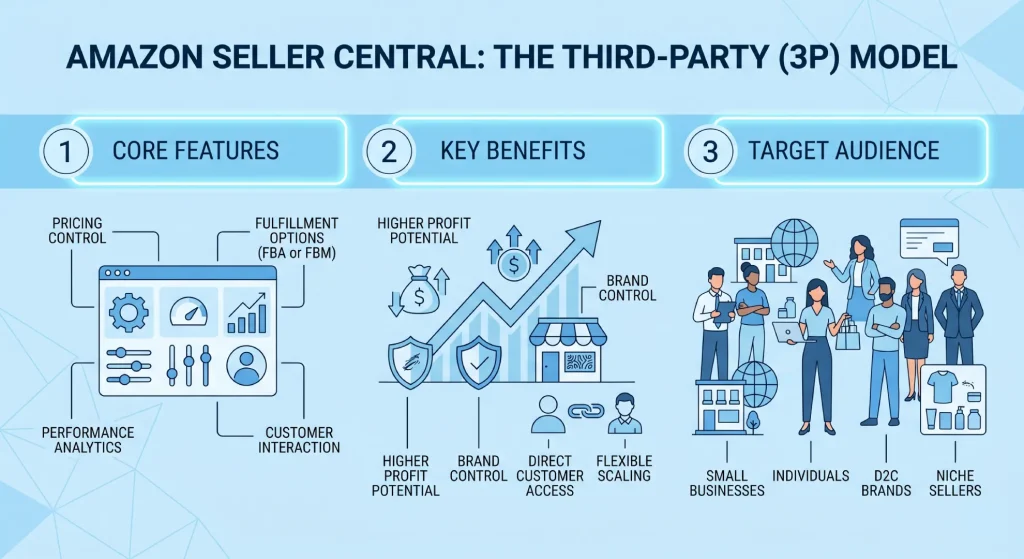
Operating as a third-party (3P) seller via Amazon Seller Central shifts the operational burden and the control directly onto your brand. In this model, you utilize the Amazon infrastructure purely as a marketplace to facilitate direct-to-consumer (DTC) transactions.
The defining feature of Seller Central is absolute administrative control over your digital storefront and inventory pipeline. Sellers operate through a central dashboard that provides direct access to the Amazon catalog, allowing for immediate listing creation, real-time title adjustments, and exact management of A+ Content.
From a logistics standpoint, Seller Central provides two distinct fulfillment mechanisms: Fulfillment by Merchant (FBM), where your own warehouse handles the direct-to-consumer shipping, and Fulfillment by Amazon (FBA). With FBA, you bypass Amazon’s corporate purchasing department and manually allocate inventory to Amazon’s fulfillment centers based on your internal forecasting. The platform also features a dedicated advertising console, granting sellers granular control over Sponsored Products, Sponsored Brands, and Sponsored Display campaigns, allowing for precise daily budget allocation and exact keyword bid management.
The most significant benefit of Seller Central is total pricing authority. Because you remain the legal retailer of record, you dictate the final consumer price. This allows brands to strictly enforce Minimum Advertised Price (MAP) policies, preventing the channel conflict that often occurs when Amazon discounts wholesale inventory to aggressively compete with other big-box retailers.
Additionally, Seller Central offers a highly efficient financial loop. Amazon disperses revenue on a rolling 14-day cycle. For growing brands, this rapid cash flow velocity is critical, allowing operators to immediately reinvest retail revenue into fresh manufacturing runs or scaled PPC campaigns without relying on high-interest credit lines. Finally, because you control the inventory injections via FBA, you are never dependent on reactive corporate purchase orders. You can engineer sustained A9 search velocity by ensuring your top-converting ASINs never run out of stock.
Seller Central is the optimal infrastructure for direct-to-consumer (DTC) brands, private label operators, and agile manufacturers who require strict brand governance. It is designed for 7- and 8-figure operators who need to actively manage their A9 search ranking and control their own profit margins. If your business model relies on rapid product iterations, strict price enforcement, and protecting your localized retail distribution channels, the 3P model provides the necessary operational agility.
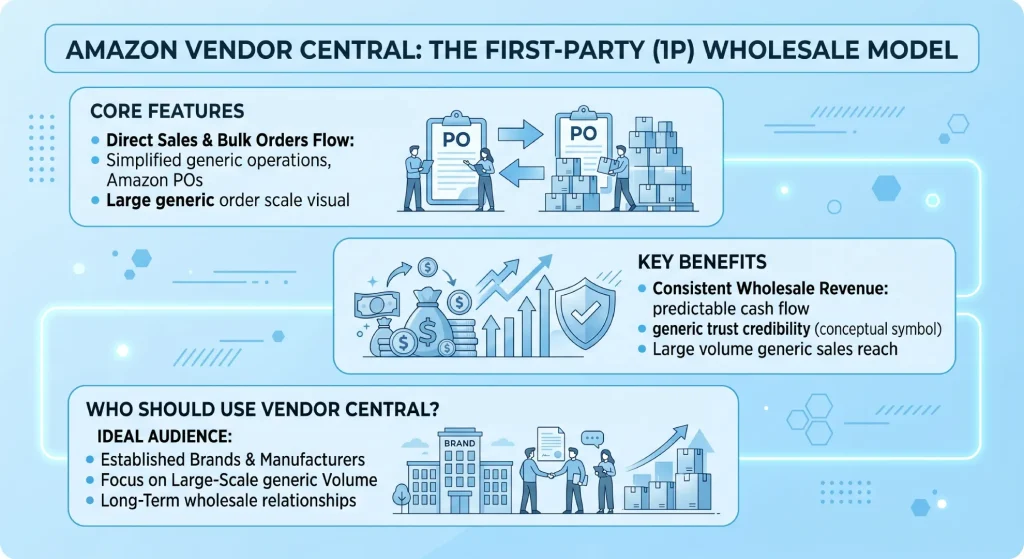
Amazon Vendor Central is a platform designed for manufacturers and distributors who want to sell their products wholesale to Amazon. In this model, Amazon acts as a retailer and purchases products directly from vendors, who then ship their products to Amazon’s fulfillment centers.
Vendor Central replaces manual inventory management with an automated, algorithmically driven purchasing system. Brands process orders through Electronic Data Interchange (EDI) systems or the Vendor Central portal. Amazon’s internal forecasting algorithm analyzes trailing category velocity and seasonal demand to issue weekly Purchase Orders (POs).
Once a PO is accepted, the brand ships the requested bulk inventory directly to an Amazon distribution node. A critical feature of this platform is the strict operational compliance system. Vendors must adhere precisely to Amazon’s routing guides, which dictate exact carton dimensions, pallet configurations, and strict delivery windows. Furthermore, Vendor Central operates on traditional corporate payment terms, meaning financial disbursements are typically scheduled on Net 60 or Net 90 timelines, requiring substantial working capital to sustain the lag between manufacturing costs and revenue realization.
The primary conversion benefit of Vendor Central is securing the “Ships from and sold by Amazon” badge. This designation carries the highest level of consumer trust and traditionally results in higher baseline conversion rates compared to standard 3P listings.
Beyond front-end conversions, Vendor Central drastically simplifies the retail mechanism. Amazon assumes responsibility for determining the optimal retail price, managing individual consumer fulfillment, handling all localized sales tax compliance, and executing customer service protocols. For the vendor, this eliminates the need to monitor individual FBA storage limits or manage micro-level consumer returns. Furthermore, Vendor Central integrates seamlessly with the Amazon Demand Side Platform (DSP), allowing massive wholesale brands to allocate large-scale advertising budgets toward programmatic, top-of-funnel display ads across the broader internet to drive aggregate demand.
Vendor Central is built specifically for high-volume manufacturers, traditional B2B wholesalers, and legacy household brands that possess a highly efficient logistics infrastructure. It is strictly for companies capable of executing flawless Advanced Shipping Notice (ASN) compliance to avoid crippling shortage deductions and chargebacks. If your organization’s primary focus is moving massive container volumes, and you possess the established working capital to absorb Net 60 payment terms without disrupting your supply chain, Vendor Central provides the necessary wholesale scale.
Algorithmic Purchasing (POs) vs. A9 Search Dominance
| Operational Metric | Vendor Central (1P) | Seller Central (3P) |
|---|---|---|
| Primary Driver | Reactive corporate purchasing algorithm | A9 search engine velocity & conversion |
| Inventory Control | Dependent on weekly Purchase Orders (POs) | Absolute manual control via FBA/FBM injections |
| Ranking Strategy | Subject to Amazon’s internal forecasting | Direct engineering via traffic and external PPC |
Success on either platform requires satisfying completely different Amazon algorithms.
In Vendor Central, your primary customer is the Amazon purchasing algorithm. This system predicts consumer demand based on historical sales data, seasonal trends, and trailing category velocity to generate weekly Purchase Orders (POs). The challenge is that this algorithm is entirely reactive. If an external marketing campaign drives a sudden spike in demand, the system often fails to issue POs fast enough, resulting in out-of-stock periods that kill product momentum. You are entirely dependent on Amazon’s internal forecasting logic to maintain stock levels.
Seller Central bypasses the purchasing algorithm and directly engages the Amazon A9 Algorithm. As a 3P seller, you control the inventory availability. Your objective is to feed the A9 algorithm with high conversion rates, Amazon click-through rates (CTR), and sustained sales velocity. By managing your own FBA stock limits, you can engineer rank spikes through external traffic or aggressive PPC without waiting for Amazon to issue a PO. You dictate the availability, which directly protects your organic search ranking.
Cash Flow Velocity: Net 60 Terms vs. Rolling Disbursements
| Financial Metric | Vendor Central (1P) | Seller Central (3P) |
|---|---|---|
| Payment Timeline | Net 60 or Net 90 days | 14-day rolling disbursements |
| Capital Efficiency | Low; capital locked in post-shipment | High; allows for rapid inventory reinvestment |
| Financing Needs | Heavy reliance on bridge credit / lines of credit | Self-funded manufacturing loops possible |
When evaluating Amazon Seller Central against Vendor Central, operators frequently overlook cash flow velocity. The timeline of your capital return dictates how quickly you can reinvest in supply chain manufacturing and aggressive advertising.
Vendor Central operates on traditional B2B retail payment terms. Standard contracts typically issue payments on Net 60 or Net 90 schedules. While Amazon may offer a 1% or 2% quick-pay discount, the fundamental reality is that your capital remains tied up for months after the inventory leaves your warehouse. For brands scaling rapidly, this delayed cash flow often requires expensive bridge financing or lines of credit to fund continuous manufacturing runs.
Seller Central operates on a much tighter financial loop. Amazon disperses funds every 14 days, reflecting the actual retail sales made directly to the consumer, minus FBA and referral fees. This rapid 14-day velocity allows brands to execute highly efficient inventory turnover. You can fund your next production run using the direct revenue from the current run, reducing reliance on outside capital. If your business model depends on high-frequency product launches and aggressive reinvestment, the Seller Central disbursement schedule provides a distinct operational advantage.
2026 FBA Constraints and Logistics Shifts
| Logistics Factor | Vendor Central (1P) | Seller Central (3P) |
|---|---|---|
| Inbound Fees | N/A (Standard bulk freight costs) | Increasing +$0.08/unit & Overmax surcharges |
| Warehouse Prep | Strict ASN compliance required pre-shipment | Must be internalized (Amazon US prep discontinued) |
| Storage Allowances | Unlimited for officially accepted POs | Compressed to 5-months trailing velocity max |
Conversely, Seller Central operators cannot rely on legacy logistical models to maintain profitability. The financial mechanics and operational requirements of Fulfillment by Amazon (FBA) have fundamentally shifted in 2026. Sellers must account for baseline FBA fulfillment fee increases averaging $0.08 per unit, compounded by new “Overmax” surcharges that actively penalize the storage and transit of extra-large items.
More critically, Amazon is actively stripping away inbound seller support. The cessation of US-based FBA prep and labeling services means 3P sellers can no longer rely on Amazon’s fulfillment centers for last-mile prep tasks. You must now fully internalize processes like poly-bagging, kitting, and FNSKU labeling to avoid costly Amazon FBA Mistakes, or route goods through a third-party logistics (3PL) partner before the inventory ever reaches an Amazon node.
Simultaneously, inventory forecasting is under severe pressure. Amazon has compressed standard storage allowances from six months of trailing sales velocity down to just five months. This artificially constricts the inventory pipeline, forcing brands to execute highly complex, high-frequency freight injections just to survive Prime Day and Q4 demand spikes without incurring punitive overage storage fees.
MAP Enforcement and Brand Protection Realities
| Brand Protection | Vendor Central (1P) | Seller Central (3P) |
|---|---|---|
| Retail Price Control | Amazon dictates final algorithm price | Brand dictates exact consumer price |
| MAP Compliance | High risk of multi-channel price conflict | Maintains strict offline retail agreements |
| Enforcement Burden | None (Amazon holds the Buy Box) | High (Requires daily Brand Registry policing) |
Maintaining a Minimum Advertised Price (MAP) policy is critical for brands with off-Amazon retail channels. The two platforms handle pricing control in fundamentally opposite ways.
When you sell via Vendor Central, Amazon takes legal ownership of the inventory. As the retailer, Amazon sets the final consumer price. Their algorithm aggressively scrapes the internet for lower prices (including temporary discounts at big-box retailers) and will instantly drop the Buy Box price to match. Amazon does not adhere to your MAP policy. If you have strict pricing agreements with brick-and-mortar distributors, a Vendor Central relationship can cause severe channel conflict.
Seller Central gives you absolute authority over your retail price. You set the price, ensuring strict compliance with your internal MAP policies. However, this control introduces a different operational burden: policing unauthorized 3P resellers. Brands on Seller Central must actively utilize Amazon Brand Registry to monitor their listings, report IP violations, and remove gray-market hijackers who attempt to undercut the established price. Seller Central protects your pricing logic, but it requires active, daily enforcement.
Navigating Deductions, Chargebacks, and Hidden Fees
| Compliance & Fees | Vendor Central (1P) | Seller Central (3P) |
|---|---|---|
| 2026 Co-op Fees | 8% to 12% across most categories | 0% (Replaced by standard 8-15% Referral Fee) |
| Operational Target | 98-99% Fill Rate required | IPI Score management required |
| Penalty Mechanics | 1-3% retroactive rebates; 7-14 day chargebacks | FBA storage overages and low-IPI limits |
When calculating profitability, the surface-level fees of Vendor Central do not tell the whole story. In 2026, 1P operators are facing severe and unprecedented margin compression. Historically, Amazon Marketing Cooperative (Co-op) allowances hovered between 3% and 7%. Today, those baseline requirements have surged, demanding 8% to 12% across most major categories just to maintain vendor status.
Furthermore, Amazon has aggressively weaponized its supply chain compliance. Fill-rate targets now demand a rigid 98% to 99% accuracy rate. Dipping below this threshold no longer results in a mere warning; it immediately triggers a 1% to 3% retroactive rebate penalty on the affected Purchase Orders (POs).
Compounding this pressure, the chargeback processing window has been drastically compressed. Amazon is now issuing immediate deductions for minor labeling infractions and newly categorized “customer experience deductions” within a brutal 7-to-14 day window. If your Electronic Data Interchange (EDI) and warehouse operations are not executing flawlessly, these expanded deductions will eradicate your net margins long before your Net 60 invoice even clears.
Advertising Strategies: PPC vs. Demand Side Platform (DSP)
| Advertising Tactic | Vendor Central (1P) | Seller Central (3P) |
|---|---|---|
| Primary Tools | Native Amazon DSP integration | Sponsored Products, Brands & Display |
| Core Objective | Top-of-funnel, programmatic, off-Amazon reach | Bottom-of-funnel, high-conversion search intent |
| Budget Control | Large scale, minimum commitments required | Highly granular daily ACoS adjustments |
Your choice of platform dictates your approach to customer acquisition and Amazon advertising. Historically, Vendor Central provided exclusive access to advanced marketing tools. Today, the gap has narrowed, but distinct technical differences remain.
On Seller Central, brands execute bottom-of-the-funnel strategies using Sponsored Products, Sponsored Brands, and Sponsored Display ads. This standard PPC ecosystem allows for granular control over keyword bidding, negative targeting, and daily budgets, directly impacting your ACoS (Advertising Cost of Sales) and organic ranking.
When comparing Amazon ads vs Amazon DSP, Vendor Central users frequently integrate with the Amazon Demand Side Platform (DSP). While DSP is accessible to Seller Central users via approved agency partners, it aligns naturally with the large-scale budget allocation of 1P vendors. DSP allows you to target audiences off-Amazon based on their browsing and purchasing behavior. Instead of just capturing existing search demand, you proactively drive top-of-funnel awareness. Balancing FBA inventory levels with aggressive DSP campaigns requires precise synchronization to prevent stockouts and subsequent ranking drops.
Many established brands assume they must make a definitive choice between Amazon Seller Central and Vendor Central. However, the most efficient e-commerce strategy often involves a hybrid approach, utilizing both platforms to mitigate risk and maximize market share.
In a hybrid model, a brand acts as both a 1P supplier and a 3P seller. You utilize Vendor Central for your high-volume, established products. Amazon’s predictive ordering algorithm handles the bulk purchasing, ensuring these core items benefit from the “Ships from and sold by Amazon” badge, which traditionally yields higher conversion rates.
Simultaneously, you utilize Seller Central to launch new products, test variations, and manage inventory that Amazon’s Vendor algorithms may not immediately issue Purchase Orders (POs) for. Seller Central provides absolute control over pricing, allowing you to maintain Minimum Advertised Price (MAP) policies on premium items. If Amazon halts POs on Vendor Central due to algorithmic shifts or inventory limits, your Seller Central account acts as a fail-safe, ensuring your products remain in stock and your ranking is preserved.
| Decision Factor | Vendor Central (1P) | Seller Central (3P) |
|---|---|---|
| Required Infrastructure | Must maintain a 99% fill rate and absorb 12% Co-op fees | Agility to manage internal prep (poly-bags) & strict 5-month storage limits |
| Failure Penalty | Margins destroyed by rapid-fire chargebacks and retroactive rebates | Paralyzed Q4 inventory flow and critical out-of-stock periods |
| The Verdict | For enterprise models with flawless bulk logistics | For agile operators capable of managing complex FBA constraints |
Basing your 2026 e-commerce strategy on legacy definitions of 1P and 3P will leave your business financially exposed. The decision is no longer just about who controls the retail price; it is a calculation of which operational penalties your infrastructure can absorb. If your warehouse cannot maintain a 99% fill rate and survive 12% Co-op fees, Vendor Central’s automated POs will destroy your margins through rapid-fire chargebacks. Conversely, if your supply chain lacks the agility to manage your own poly-bag prep and navigate a compressed 5-month FBA storage limit, Seller Central’s logistics will paralyze your Q4 inventory flow. Choose the platform that aligns not just with your sales goals, but with your exact logistical capabilities.
Deciding between Amazon Seller Central and Vendor Central is a fundamental calculation of your supply chain’s efficiency and your brand’s financial resilience. As Amazon continues to compress 1P margins through aggressive 8-12% Co-op fees and strict shortage penalties, relying solely on reactive Purchase Orders (POs) leaves enterprise brands highly exposed. Conversely, 3P operators must navigate increasing FBA inbound constraints and active A9 search management to protect their organic market share.
For 7- and 8-figure operators, the hybrid model remains the most secure infrastructure. By diversifying across both platforms, brands maintain absolute MAP control, engineer sustained search velocity, and build a reliable fail-safe against unpredictable algorithm shifts.
Executing these advanced strategies requires precise financial and advertising control. At SellerMetrics, our Amazon PPC software provides the granular bid automation, bulk execution, and advanced analytics necessary to scale your 3P operations efficiently. We equip brands and agencies with the exact data required to optimize ACoS and protect margin profitability amid rising acquisition costs.
About the author: Rick Wong is a Senior Amazon PPC Strategist at SellerMetrics with seven years of experience managing Amazon advertising campaigns across CPG, electronics, and home goods categories. He has overseen more than $50M in cumulative Amazon ad spend and specializes in Sponsored Brands and DSP strategy for mid-market brands scaling on Amazon.
Seller Central (3P) grants the brand absolute control over retail pricing, A9 search velocity, and inventory pipeline. Vendor Central (1P) is a wholesale relationship where Amazon buys bulk inventory via predictive Purchase Orders (POs) and assumes control of the final retail price. Today, deciding between the two is less about platform preference and entirely about which logistical requirements and financial penalties your supply chain can efficiently absorb.
Historically, Vendor Central was an invite-only platform for established brands. In 2026, it is actively exclusionary. Amazon has executed massive vendor purges, pushing brands generating under $5M to $10M annually out of the 1P ecosystem and forcing them onto the 3P marketplace. Today, Vendor Central is strictly reserved for enterprise-level manufacturers capable of sustaining massive wholesale volume.
Seller Central guarantees exact retail price control, allowing brands to maintain strict Minimum Advertised Price (MAP) compliance. On Vendor Central, Amazon takes legal ownership of the inventory and its algorithm aggressively scrapes the internet for lower prices. Amazon will systematically break your MAP to match temporary competitor discounts, frequently causing severe channel conflict with your offline retail distributors.
Chargebacks are severe financial penalties that act as hidden margin killers. While they cover minor labeling non-compliance, they have expanded in 2026 to include massive “shortage penalties” that automatically deduct 10% to 25% of your COGS for confirmed out-of-stocks, as well as new customer experience deductions. Compounding this risk, Amazon has compressed the dispute window to a brutal 7-to-14 day timeline.
Yes, and in 2026, this hybrid model is no longer just an option; it’s the dominant survival strategy. With Amazon aggressively increasing Vendor Central Co-op allowances (often demanding 8% to 12%+) and PO algorithms becoming highly unpredictable, enterprise brands utilize a 3P Seller Central account as a mandatory financial hedge to keep top ASINs in stock when 1P purchase orders stall.
The advertising capabilities between the two platforms have reached functional parity. While Vendor Central historically held exclusive access to programmatic display ads, sophisticated Seller Central operators now utilize Amazon Marketing Cloud (AMC) to access the Amazon Demand Side Platform (DSP). This allows 3P sellers to execute the exact same top-of-funnel targeting strategies as 1P vendors, while retaining highly efficient control over their daily Sponsored Products ACoS.
In 2026, Seller Central (FBA) is strictly constrained by compressed 5-month storage limits and requires brands to internalize warehouse prep (like poly-bagging) due to the cessation of US-based Amazon prep services. Conversely, Vendor Central requires flawless Advanced Shipping Notice (ASN) execution and a rigid 98-99% fill rate; dipping below that threshold triggers immediate retroactive rebates on your POs.
No. Only products sold directly through Vendor Central (1P) secure this exact badge. While this badge traditionally boosts baseline conversion rates, modern operators must calculate whether that conversion lift justifies the aggressive 1P Co-op fees and margin compression. FBA listings on Seller Central display “Sold by [Your Brand] and Fulfilled by Amazon.”
Amazon handles primary Tier 1 customer support for both Vendor Central and Seller Central (if utilizing FBA). However, in 2026, Vendor Central operators face new “customer experience deductions,” where Amazon financially penalizes the vendor directly for high product return rates. 3P sellers simply manage the return metrics against their own internal margins. Sellers using FBM (Fulfillment by Merchant) must handle all inquiries internally.
Seller Central disperses funds on a highly efficient 14-day rolling cycle, enabling rapid working capital reinvestment for manufacturing or advertising. Vendor Central locks capital into traditional Net 60 or Net 90 wholesale terms. For rapidly scaling 1P brands, this delayed cash flow often requires expensive bridge financing or lines of credit to fund continuous supply chain operations.

1 July 2026
TweetLinkedInShareEmailPrint As Walmart continues growing its marketplace, many US eCommerce brands start won...

8 May 2026
TweetLinkedInShareEmailPrint 8 min read By Rick Wong Updated May 09, 2026 TL;DR Can I use AI tools like...

8 May 2026
TweetLinkedInShareEmailPrint 9 min read By Rachel Go Updated May 08, 2026 TL;DR Why is operating exclus...