18 February 2026
Amazon Marketing Cloud (AMC) for Non-Enterprise: Complete Guide
TweetLinkedInShareEmailPrint 8 min read By Rick Wong Updated Feb 18, 2026 TL;DR Is AMC free and availab...

 26 December 2025
You are likely noticing that your old “Exact Match” keyword strategies are gradually failing to deliver the same traffic they did two years ago. For a decade, the path to Amazon dominance was simple: stuff the title with high-volume search terms, jam the backend with misspellings, and run aggressive PPC until sales velocity forced the A9 algorithm to rank you.
But that era is over. It didn’t end with a bang; it ended with a chat bubble.
With the maturity of Rufus, Amazon’s generative AI shopping assistant, and the complete integration of the COSMO (Common Sense Knowledge Generation) algorithm, the fundamental architecture of Amazon Search has shifted from “Lexical Matching” (matching text strings) to “Semantic Understanding” (matching intent).
The difference is subtle but violent to your bottom line.
If your listing is optimized for “running shoes” but lacks the semantic data points connecting it to “plantar fasciitis,” “shock absorption,” and “concrete surfaces,” you are invisible. You aren’t just ranked lower; you are effectively removed from the consideration set because the AI doesn’t believe you are the answer to the user’s problem.
This is not a drill. This is the new SEO. Most sellers don’t realize they’ve already lost visibility—they just don’t see it in keyword reports anymore.
In this comprehensive guide, we are going to dismantle your 2026 listing strategy and rebuild it for the age of Agentic Commerce. We will move beyond basic keyword placement and into the realm of Knowledge Graph Optimization (KGO). We will teach you how to feed the machine exactly what it wants: structure, context, and verifiable truth.
Article of Contents

To defeat the algorithm, you must first empathize with it. Most sellers make the mistake of thinking Rufus is just a “chatbot.” It is not. It is the user interface for a massive backend overhaul called COSMO. If you still think Rufus works like Amazon search did even two years ago, this guide will feel uncomfortable—and that’s the point.
In the old A10 algorithm, Amazon’s database was essentially a giant Excel sheet. It looked for rows that matched the user’s search query.
COSMO changes Amazon into a Knowledge Graph. A Knowledge Graph doesn’t just store data; it understands relationships.
When you optimize a listing today, you are not trying to rank for a keyword string. You are trying to secure your node in the Knowledge Graph. You want COSMO to confidently link your product (Entity A) to a specific User Intent (Entity B). This is why two products with similar keywords can now get completely different visibility in Rufus chat results.
Rufus operates on a principle called Retrieval-Augmented Generation.
The Optimization Goal: You must lower the “Hallucination Risk.” If your listing is vague, Rufus won’t risk recommending it. You need to provide “High-Confidence Data Tokens” so the AI feels safe suggesting you. Rufus is conservative by design; it avoids recommending anything it cannot explain with confidence.
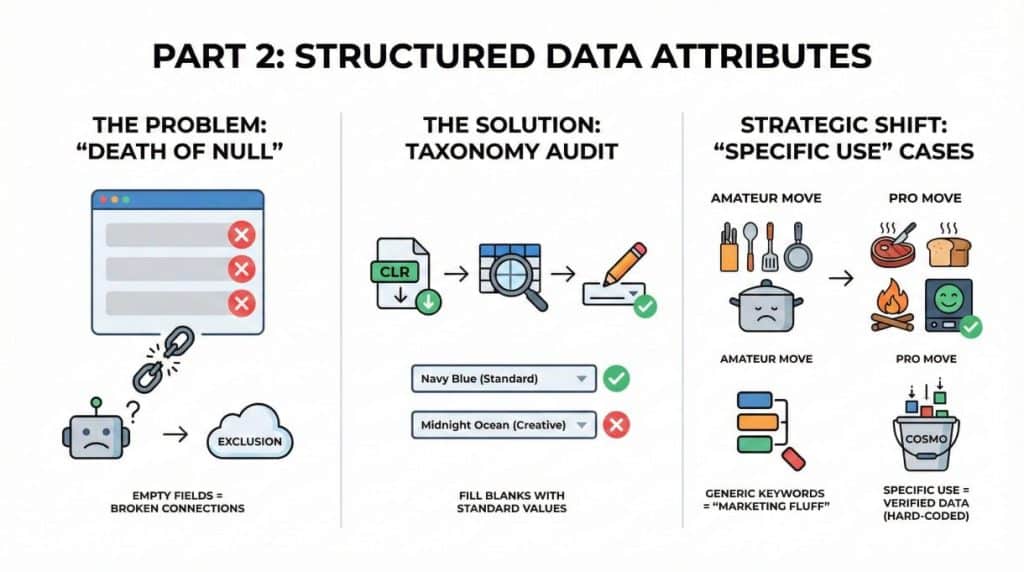
Before we write a single word of sales copy, we must fix the backend. In 2025, the “Attributes” section of Seller Central is the most important SEO field you have—more important than your title.
Why? Because LLMs (Large Language Models) crave structure. They prefer clean, labeled data over messy paragraphs of text.
Go to your listing’s backend. Look at the fields for Subject Matter, Intended Use, Material Composition, Care Instructions, Connectivity Protocol, etc.
How many are empty?
Every empty field is a severed connection in the Knowledge Graph. From Rufus’s point of view, a blank field means uncertainty, and uncertainty means exclusion.
Actionable Strategy: The Taxonomy Audit
The “Specific Use” Shift. There is often a field called Specific Uses For Product.
By populating these fields, you are hard-coding your product into specific “Intent Buckets” within COSMO.
Now we move to the visible text: Your Title and Bullet Points.
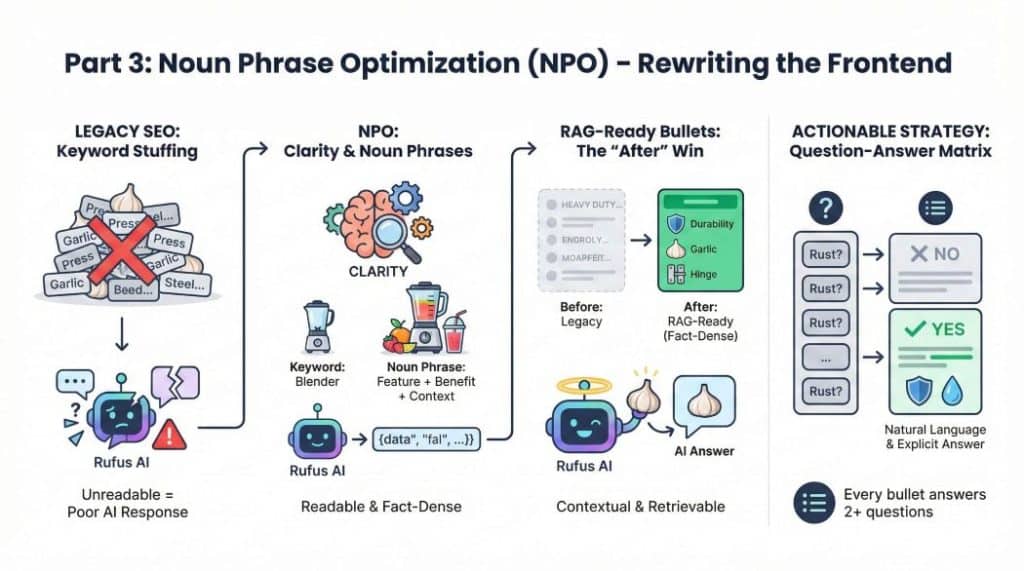
The days of “Keyword Stuffing” (e.g., Garlic Press Stainless Steel Peeler Crusher Mincer Ginger…) are over. Rufus penalizes listings that are “unreadable” because they degrade the quality of its generated response.
We are shifting to Noun Phrase Optimization (NPO).
Rufus does not reward clever wording; it rewards clarity that survives conversation.
A keyword is “Blender.” A noun phrase is “High-speed blender for green smoothies.”
Rufus processes queries in noun phrases. It looks for listings that contain Feature + Benefit + Context strings. Readable listings now outperform aggressive ones.
The Bullet Point Overhaul: You need to rewrite your bullets to be “RAG-Ready.” This means they should be grammatically correct, fact-dense sentences that can be easily “lifted” by the AI to answer a question. Think of each bullet as a ready-made answer Rufus can quote.
The “Before” (Legacy SEO):
HEAVY DUTY & DURABLE: Made of 304 stainless steel, anti-rust, non-slip handle, dishwasher safe, great for garlic and ginger, best kitchen gadget.
The “After” (Rufus Optimized):
Professional Grade Durability for Dense Ingredients: Constructed from solid 304 stainless steel, this press features a reinforced hinge mechanism designed to crush unpeeled garlic cloves and fibrous ginger root without bending.
Why the “After” Wins:
Actionable Strategy: The Question-Answer Matrix
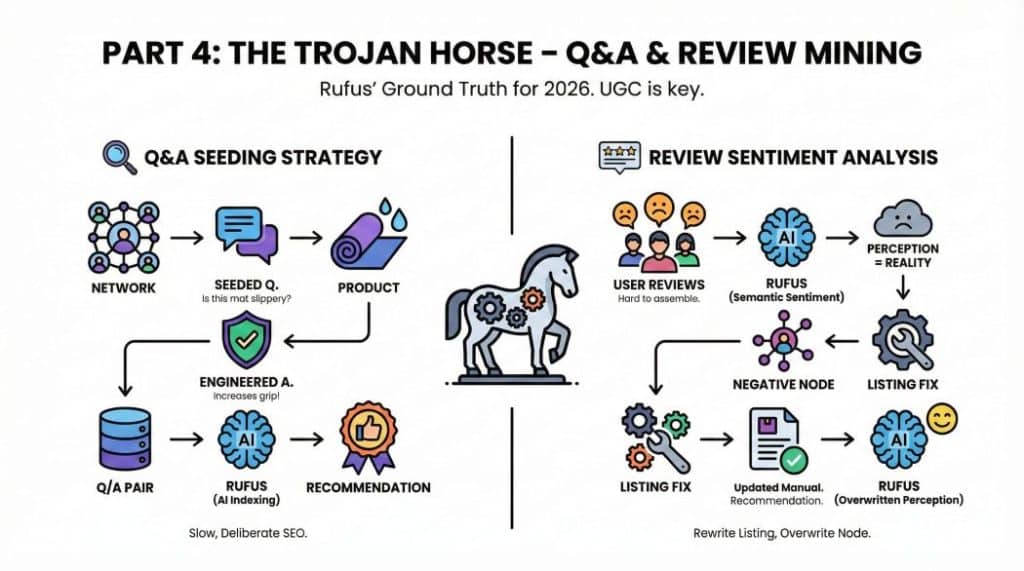
This is the most critical section for 2026. Rufus treats “User Generated Content” (UGC) as Ground Truth.
The AI trusts what other humans say about you more than what you say about yourself. When generating an answer, Rufus often cites reviews: “Users report that this item runs small…”
You cannot edit your reviews, but you can engineer your Q&A.
The “Customer Questions & Answers” section is now an SEO field. Rufus indexes it aggressively to find answers for edge-case queries. This is one of the few areas where sellers can still influence Rufus without changing the product itself.
The Tactic: Do not wait for customers to ask questions. Mobilize your network (friends, family, or loyal customers) to post the specific semantic questions that you want to rank for but can’t fit naturally into your title.
Why this is Genius: You have just created a perfect “Question/Answer Pair” in the database. When a real shopper asks Rufus about “sweaty hands,” the AI performs a vector search, finds this exact Q&A interaction, and synthesizes it into a recommendation: “This mat is recommended for hot yoga because its grip improves with moisture.”
This is slow, deliberate SEO; not a quick hack.
You must analyze your reviews not just for customer service, but for “Semantic Sentiment.”
If 50 people say your “Beige” blanket looks “Yellow,” COSMO effectively retags your product as “Yellow.” No matter what your title says, Rufus will warn users about the color discrepancy. At scale, perception becomes reality inside the Knowledge Graph.
Actionable Strategy: Use AI tools (like Helium 10 or Jungle Scout’s review analyzers) to find your top recurring negative phrases.
You are literally rewriting your listing to overwrite the “Negative Knowledge Graph Node” associated with your ASIN.
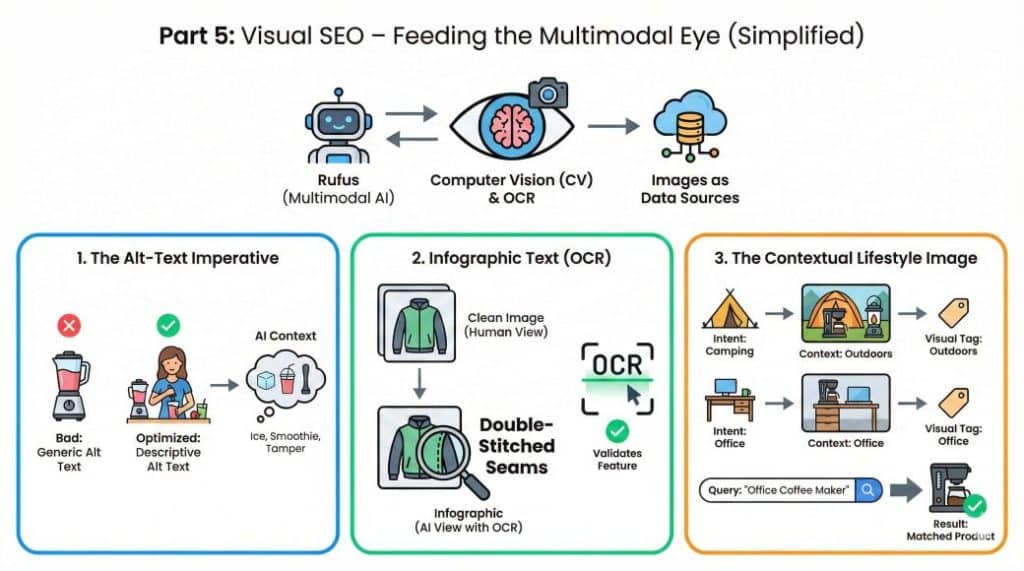
We often forget that Rufus is multimodal. It “sees” your images using Computer Vision (CV) and OCR (Optical Character Recognition).
In 2026, your images are not just for humans; they are data sources for the bot. If your image does not clearly prove the feature exists, Rufus treats the claim as weak.
For years, sellers ignored “Image Alt Text” in their A+ Content because it had minimal impact on keyword ranking. Today, it provides critical context for the AI.
This tells COSMO: This product is compatible with “Ice” and “Green Smoothies” and includes a “Tamper Tool.”
Rufus reads the text overlays on your images. If your main image is clean, your second image (Infographic) must be text-heavy (but designed well). Clean images help humans; descriptive images help Rufus.
The Strategy: Ensure your key “Noun Phrases” are printed clearly on your images.
You need images that show the product in the environment of the user’s intent.
This helps the Computer Vision model tag your product with environmental attributes (Setting: Office, Setting: Outdoors). If a user asks, “Best coffee maker for a small office,” Rufus looks for products with the Office visual tag.
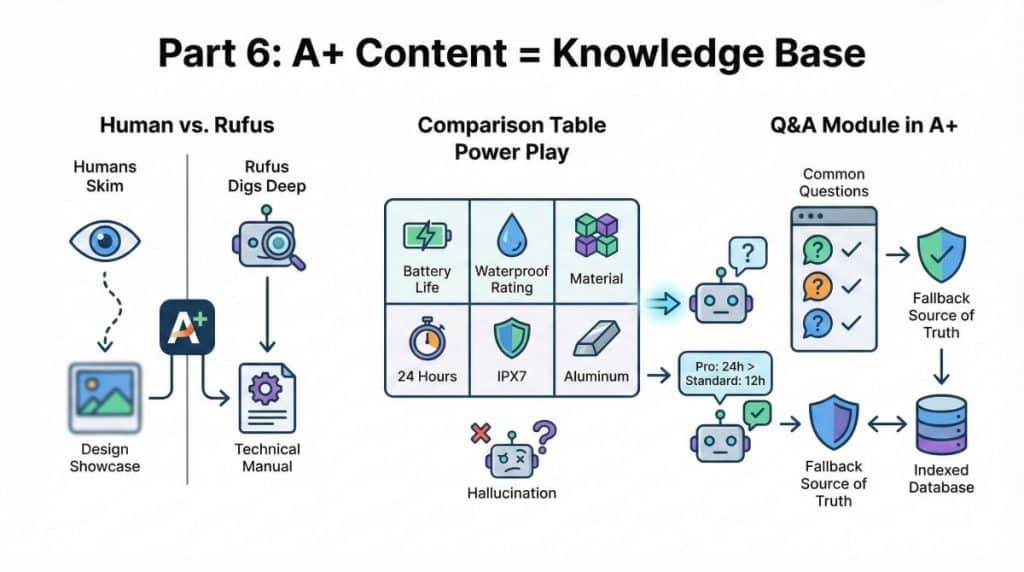
A+ Content (formerly EBC) is often treated as a design showcase. You need to treat it as a Technical Manual. Most sellers underuse this space because humans skim it—Rufus does not.
Rufus digs deep into the text modules of Premium A+ Content to find specs that aren’t in the bullets.
The “Comparison Table” module in A+ content is the single most effective way to teach Rufus about your product’s relative value.
Why: When a user asks Rufus, “How does this compare to the cheaper model?”, the AI looks directly at your comparison table structure to formulate the answer. “The Pro model offers 24-hour battery life compared to the Standard model’s 12 hours.”
If you don’t provide this structured comparison, Rufus might hallucinate or simply say, “I cannot find a direct comparison.”
Add a standard text module in your A+ content titled “Common Questions.” Paste your top 5 technical FAQs here. This text is indexed. It reinforces the Q&A section data and ensures the AI has a “fallback” source of truth if the user-generated Q&A is messy.
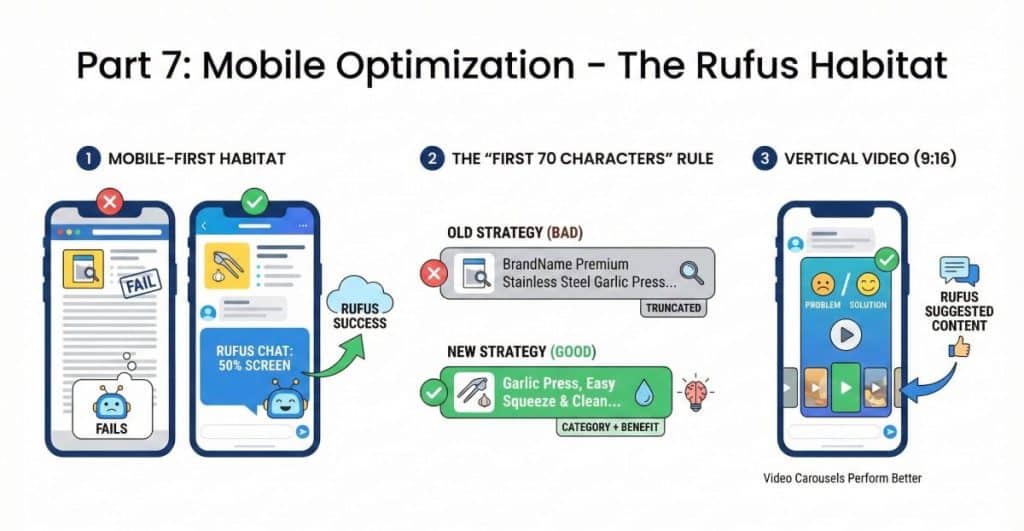
If your listing fails on mobile, it fails in Rufus by default. Rufus is a mobile-first experience. The chat interface takes up 50% of the screen on the Amazon App.
If your listing is optimized for desktop (huge blocks of text), you are failing.
On mobile, titles are truncated.
You need the user (and the AI) to see the category and benefit immediately.
Rufus responses often include video carousels. Vertical videos (9:16 aspect ratio) perform significantly better in the mobile chat stream than horizontal ones. Ensure your listing has at least one vertical video demonstrating the “Problem/Solution” arc. This video is more likely to be pulled into a Rufus “suggested content” bubble.
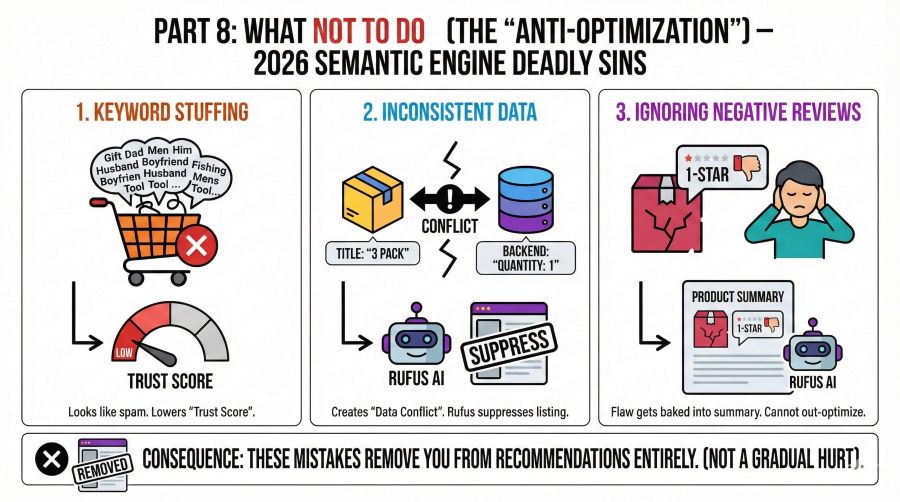
To wrap up, let’s cover the three deadly sins that will get you de-ranked by the Semantic Engine in 2026.
These mistakes do not hurt gradually; they remove you from recommendations entirely.
Optimizing for Rufus is, in many ways, harder than the old SEO. You can’t fake it. You can’t just find a high-volume keyword and jam it in.
You have to build a listing that is structurally sound, semantically rich, and factually verifiable.
But here is the good news: Most sellers are lazy. They are still using 2023 SOPs. They are still obsessed with “Search Volume” instead of “Intent Volume.”
By following the steps in this guide—auditing your attributes, seeding your Q&A, rewriting for noun phrases, and optimizing your visual data—you are doing more than just “ranking.” You are teaching the world’s most powerful shopping AI that your product is the Correct Answer.
Visibility now belongs to products that can explain themselves. And in the world of Search, being the Answer is infinitely more profitable than just being a Result.
Yes, but less than before. The 249 bytes of backend search terms are still used for basic indexing, especially for misspellings and Spanish terms. However, Rufus relies more heavily on the visible content (Bullets, Description, A+) and structured attributes to understand context.
Unlike the A9 algorithm which could react to keyword changes in 24 hours, the COSMO knowledge graph updates are more complex. It can take 7-14 days for semantic changes (like rewriting bullets for intent) to fully propagate and alter how Rufus recommends your product in chat.
Yes, but with strict prompting. Do not ask ChatGPT to “Write an Amazon listing.” Ask it to “Extract the top 5 semantic user intents from these reviews and write bullet points that address each intent using natural language.” You need to guide the AI to write for the Amazon AI.
Absolutely. Rufus is value-conscious. If a user asks for a “good value” or “budget” option, Rufus compares your price per unit against the category average. However, if you optimize your listing to explain why you are premium (e.g., “3x longer durability”), Rufus can justify a higher price point in its recommendation explanation.
There is no specific “Rufus Rank” tracker yet. The best proxy metrics are Mobile Session Percentage (if it goes up, you are likely in chat recommendations) and Search Query Performance (look for conversational/question-based queries entering your funnel).
No. Rufus is the new interface of Amazon. You cannot opt out of the search bar, and you cannot opt out of the AI. Your only choice is to optimize for it or vanish.
Yes. Amazon uses OCR (Optical Character Recognition) to extract text from your images. Ensure your infographics use clear, standard fonts. Avoid cursive or overly stylized text that the bot might misread.
If your listing is sparse or contradictory, Rufus might “hallucinate” details to answer a user’s question, or more likely, simply refuse to recommend you to avoid the risk. Dense, accurate data is your insurance policy against this.
Largely, yes. Both Alexa and Rufus rely on Natural Language Processing (NLP). Optimizing for conversational noun phrases (“How to remove red wine stains”) helps you win both the Rufus chat and the Alexa voice answer.
Critical. The ITK classifies your product in the massive Amazon browse tree. If this is wrong, COSMO looks for you in the wrong “neighborhood” of the Knowledge Graph. Always verify your ITK is as granular as possible (e.g., “running-shoes” vs just “shoes”).
18 February 2026
TweetLinkedInShareEmailPrint 8 min read By Rick Wong Updated Feb 18, 2026 TL;DR Is AMC free and availab...
18 February 2026
TweetLinkedInShareEmailPrint 8 min read By Rick Wong Updated Feb 18, 2026 TL;DR What is it? It’s a re...

15 February 2026
TweetLinkedInShareEmailPrint 8 min read By Rick Wong Updated Feb 16, 2026 TL;DR I’m launching a b...