22 March 2026
The 25-Month AMC Lookback: 3 Custom Audiences SMBs Should Build Today
TweetLinkedInShareEmailPrint 8 min read By Rick Wong Updated Mar 22, 2026 TL;DR What is the 25-month lo...

 9 December 2025

Amazon Standard Ads (Sponsored Products, Sponsored Brands, Sponsored Display) are Cost-Per-Click (CPC) tools designed to capture active intent within the Amazon search results. Amazon DSP (Demand Side Platform) is a programmatic Cost-Per-Mille (CPM) solution used to generate brand awareness and retarget shoppers across the entire web, not just on Amazon.
While Amazon Standard Ads support basic video, Amazon DSP is the exclusive gateway to premium programmatic inventory. This includes Streaming TV (STV) ads on Prime Video and Twitch, Online Video (OLV) on third-party sites, and Audio Ads that run on Amazon Music and Alexa-enabled devices.
Standard Ads are strictly for brands that sell physical products on Amazon (Endemic). Amazon DSP is available to both Amazon sellers and Non-Endemic brands (e.g., insurance, automotive, services) that do not sell on Amazon, allowing them to link ads directly to their own external websites.
Standard Ads are accessible to everyone with a Seller Central account and have no minimum spend. Amazon DSP is an enterprise-level tool; accessing it generally requires a managed service commitment: typically a minimum of $50k/month.
There are 4 major Amazon Ad types, they are: Sponsored Products, Sponsored Brands, Sponsored Display, and Amazon DSP. This wide range of choice can create confusion, especially for inexperienced Amazon PPC users. While many sellers understand the difference between keyword-based ads (Sponsored Products) and display ads, the line often blurs when comparing Amazon Sponsored Display (SD) and Amazon DSP. Both appear effectively as “banner ads,” and both can appear off-Amazon. However, treating them as interchangeable or not understanding the difference between them can be a costly mistake.
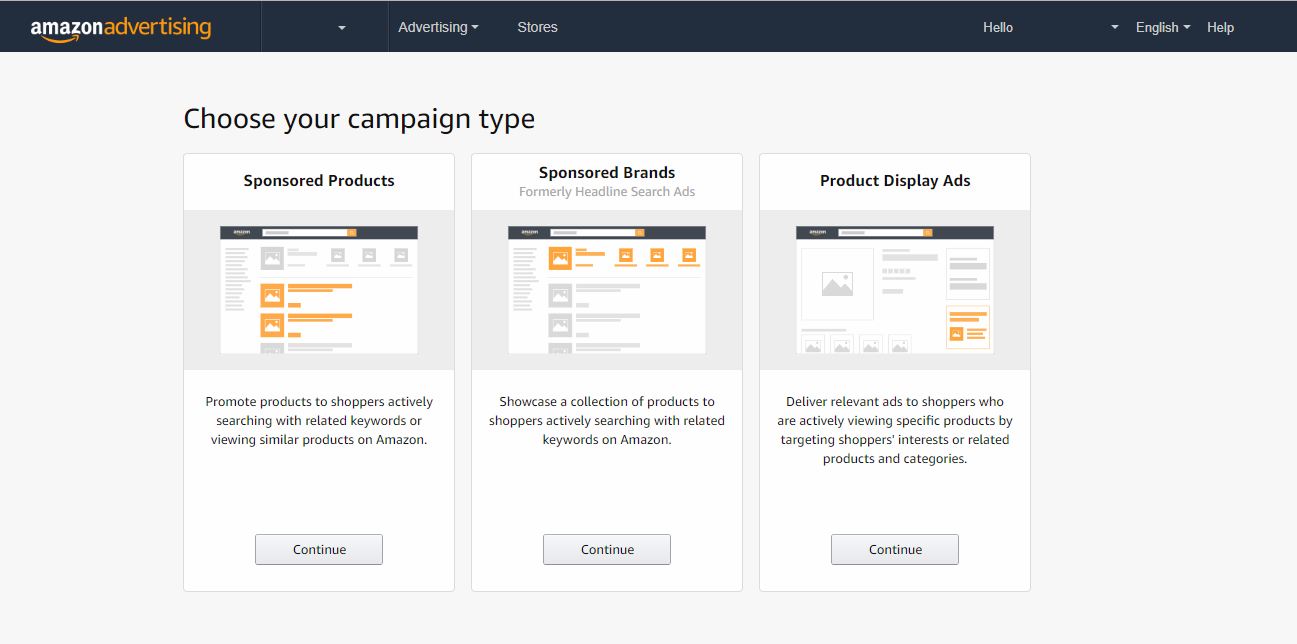
Let’s briefly recap the three standard Amazon ad types, before diving into Amazon DSP advertising in a lot more detail.
Sponsored Products ads are ads that show up mostly on the Amazon search result page. If you see the first 2-3 results with the “sponsored” tag on the search page and also in the middle of the product listing then it is sponsored product ad. Out of the Amazon ad types, this one allows you to use both keywords and product targeting options. It also allows for both automatic and manual targeting types.
Amazon Sponsored Brands Ads (formerly Headline Search Ads,) are ads that appear both in the search results, product pages (via product attributed targeting), and other places such as the checkout page. These ads normally show up as long rectangular banners in both horizontal and vertical formats. With Sponsored Brands you get 3 Ad Format types. There are Product Collection, Store Spotlight, and Video. On top of that, you get the option of keywords and product targeting option as well.
Because of the relatively low inventory compare to Sponsored Products, Sponsored Brand ads on average runs on a higher CPC (cost per click). We advise you to run any Sponsored Brands ads after your Sponsored Products campaign is matured.
Amazon Sponsored Display Ads are an ad format that appears on the Amazon product listing page and off Amazon. It is a small rectangular or square banner that appears under the listing bullet points. The banner shows the main product image of the ASIN you are advertising for.

There are two types of targeting options, 1) Views remarketing 2) Product targeting. The views remarketing is more automatic, while the product targeting is manual and requires you to give the list of ASIN/Bid information into the campaign.
Now let’s dive into Amazon DSP (demand-side platform), Amazon DSP enable the advertiser (sellers) to programmatically buy display & video ad placement off the Amazon retail platform. DSP can reach an audience in the following Amazon own media properties and partners:
For example, a customer goes to Amazon and searches for a product but did not purchase, in the next step the customer then goes to IMDB, sees video ads of the same product he was browsing for, then returns to Amazon to make the purchase. What I described was the successful use case for remarketing a customer using Amazon DSP advertising.
Another thing to add is that DSP offers a lot less control compared to the Sponsored ad types, since it is 100% programmatic bidding, not self-service, and priced using CPM (Cost per mile) instead of CPC (Cost per click). The average conversion can get very expensive, but the potential audience can be massive. Another important thing to note! Sellers need to commit $3000 a month to start with Amazon DSP advertising. This makes this the very last Amazon advertising ad type you want to go with.
Think of Sponsored Display as the “retail-aware” version of display advertising. It is accessible, automated, and designed strictly for conversion within the Amazon ecosystem. It uses a Cost-Per-Click (CPC) model, meaning you only pay when a shopper clicks. It is democratized access to display inventory, but it comes with guardrails: you have limited creative control, and you can generally only target audiences based on shopping behaviors directly on Amazon (like viewing your product or a competitor’s).
Amazon DSP, by contrast, is a holistic programmatic advertising console. It is not just about “retail” but about the entire media funnel.
To truly master Amazon DSP, you must understand the inventory you are buying. Unlike standard ads which are static, DSP offers a rich media ecosystem. If you are wondering “Video ads purchased on Amazon DSP includes which of the following formats?” or where your audio ads actually run, here is the technical breakdown.
Video Ads via Amazon DSP Amazon DSP allows you to buy video inventory programmatically across the web. These generally fall into two distinct categories:
Audio advertising is one of the most underutilized assets in the DSP console. When you purchase Audio Ads through Amazon DSP, you are not just buying a slot on a radio station; you are accessing Amazon’s premium audio ecosystem.
Your 10-to-30-second audio creatives can run across:
The “superpower” of Amazon Audio ads is that they are companion-banner enabled. When an ad plays on an Echo Show or a Fire TV (via Amazon Music), a clickable banner image appears on the screen, bridging the gap between passive listening and active shopping.
Amazon DSP advertising features four different types of ad creative formats that differ significantly from the standard Amazon ad products. These are:
Leveraging these formats allows for more creative control and this can be beneficial for brand building purposes.
In general, there are several scenarios that justify using Amazon DSP ads. The most common ones include:
DSP puts your brand in front of a much broader, but also less relevant audience. Placements on fire TV, editorial sites, audio platforms help you broaden awareness for your brand. This is particularly helpful if you have strong, branded assets (i.e. celebrity endorsed) and want to introduce new product lines, push seasonal campaigns, or reposition your brand.
As advertisers reach efficiency frontiers, spending more on the same type of ads does not make sense any more. With a sufficient ad budget saturation is eventually reached and the law of diminishing returns (aka incremental ROAS) kicks in. Use a layered approach to maximize overall campaign efficiency:
This is a classic remarketing scenario that aims at reaching potential buyers beyond the Amazon marketplace. DSP uniquely re-targets users based on real purchase signals, such as:
These ads then appear across third-party apps, publisher sites, and streaming platforms—reconnecting shoppers deeply engaged with your funnels
If you have strong creatives, standard Amazon ads can be quite limiting in deploying them. If you want to combine display, video, and audio ads, then DSP is your all-in-one hub to execute more complex campaigns. Use lightning-fast audience targeting, frequency caps, and consistent, custom creatives across multiple formats.
Video (OLV/STV) and audio ads shine are great for products that depend on brand driven differentiation and value creation. Introducing fragrances, beauty products, or lifestyle brands requires strong branding to differentiate them from cheaper and more generic options available. The storytelling power of DSP ads helps engage customers emotionally and increases brand recall. This is something that simple product ads cannot deliver.
When you add DSP to your marketing mix, ensure success by:
Defining Clear Objectives:
Layering with Amazon Ad Funnels:
Audience Segmentation:
Creative Messaging:
Measurement & Attribution:
| Goal | DSP (Display, Video, Audio) | Sponsored Ads (PPC) |
| Awareness & Reach | Extremely scalable | Limited; only on Amazon |
| Funnel Stage | Top/mid-funnel | Mid to bottom (consideration → purchase) |
| Pricing Model | CPM-based (bigger budgets) | CPC-based (self-serve, micro budgets) |
| Creative Flexibility | Full-screen video/audio/display | Limited to product listings |
| Audience Targeting | Lifestyle/behavior, site retargeting | Keyword, ASIN, interest-based targeting |
| Creative Formats | Video, audio, interactive display | Banner/Carousel/product listing |
With the proliferation of Amazon PPC options, it is important for advertisers/sellers to know what exactly each Sponsored Ad type does, how it is targeted, and where the ad is placed. You need to make sure that you are using the right ad type for the right situation and product life cycle. For example, you will not need to use a hammer for a screw head as you will not be using Sponsored Brands campaigns if your objective is to make sales. Amazon DSP ads, also referred to as programmatic advertising are certainly a useful tool – but as outlined in this article only for huge brands with significant budgets for brand awareness building. Most sellers are better off with the more tactical standard ad formats that focus on reaching shoppers where they are most likely going to convert: the Amazon marketplace itself.
Our suggestion is to think and do some careful analysis on each Amazon ad type and plan out carefully on when and how to use these ad types.
Rick Wong is a veteran Amazon seller who is into all things Amazon FBA. Having sold his Amazon business, Rick writes and talks about this topic to share his passion for Amazon FBA business building. A data geek at heart, he is currently the Co-Founder of SellerMetrics, a software tool that helps Amazon sellers automate the tedious and manual work of Amazon PPC Optimization. Our tool has been knowing to bring down ad spend and increase sales at the same time, average user can expect a 25% increase in ROI immediately after use, sign up for our free trial to find out.
We are SellerMetrics, our Amazon PPC Software helps Amazon sellers, brands, KDP Authors and agencies navigate Amazon Advertising PPC via bid automation, bulk manual bid changes, and analytics.
The main difference is the buying model and reach. Sponsored Display is a self-service, Cost-Per-Click (CPC) solution focused on retail conversion. Amazon DSP is a programmatic, Cost-Per-Mille (CPM) solution that offers full-funnel targeting (including video and audio) and can link to destinations off-Amazon.
Amazon DSP video ads primarily include Streaming TV (STV) and Online Video (OLV). STV ads appear on connected TV devices (like Fire TV) and are non-skippable, while OLV ads appear on desktop and mobile browsers and can be In-Stream or Out-Stream.
Audio ads purchased via Amazon DSP run on the ad-supported tier of Amazon Music, on Alexa-enabled devices (during flash briefings), and across third-party apps and podcasts via Amazon Publisher Services.
No. This is a unique feature of DSP. “Non-endemic” brands (businesses that do not sell products on Amazon, such as insurance or automotive companies) can use Amazon DSP to target Amazon audiences and link the ads to their own external websites.
If you go directly through Amazon’s managed service, the minimum is typically $50,000/month.
Yes. DSP allows for highly granular conquesting. You can build audiences based on shoppers who viewed or purchased specific competitor ASINs, or even shoppers who are “in-market” for products in your competitor’s category.
They serve different goals. Sponsored Products are “bottom-of-funnel” and capture demand that already exists (people searching for keywords). Amazon DSP is “full-funnel” and is better for generating new demand (awareness) and retargeting users who viewed but didn’t buy. Most successful brands use both.
Yes. By using the Amazon DSP Pixel, you can attribute conversions on your own Direct-to-Consumer (DTC) website back to the ads you ran on Amazon DSP.
Lookalike Audiences are groups of people generated by Amazon’s algorithm who share similar behaviors and characteristics with your existing best customers. This allows you to scale your reach to new people who are statistically likely to be interested in your brand.
22 March 2026
TweetLinkedInShareEmailPrint 8 min read By Rick Wong Updated Mar 22, 2026 TL;DR What is the 25-month lo...
22 March 2026
TweetLinkedInShareEmailPrint 8 min read By Rick Wong Updated Mar 22, 2026 TL;DR Why can’t I just ...

9 March 2026
TweetLinkedInShareEmailPrint 18 min read By Rick Wong Updated Mar 10, 2026 TL;DR Why should new sellers...