
29 March 2026
Amazon Brand Referral Bonus 2026: Complete Guide
TweetLinkedInShareEmailPrint 10 min read By Rick Wong Updated Mar 29, 2026 TL;DR Why should I drive ext...

 30 March 2026
Competitors are likely using advanced AI algorithms to monitor the ecosystem and detect exactly when your daily ad budgets are exhausted. Once your ads vanish, their automated systems dramatically increase their own bids to scoop up the remaining evening traffic at a premium while you are no longer in the auction to drive up the CPC.
Rival brands are actively configuring their automated systems to execute a “Product Detail Page hijack”. They use Sponsored Display and Product Targeting campaigns to aggressively bid on your top-performing items, forcing their cheaper alternatives into the highly visible ad carousels directly beneath your Buy Box.
Yes, because the top search slots on Amazon (especially on mobile) are almost entirely monetized sponsored placements. If you leave your branded search terms undefended, competitor AI bots will bid massive amounts to place their ads above your organic results, easily stealing loyal customers who were actively looking for you.
You must implement strict “profit-aware guardrails” into your automated defenses to avoid an infinite, unprofitable bidding war. By feeding real-time Cost of Goods Sold (COGS) and FBA fee data directly to your AI agent, you can instruct it to immediately stop bidding the moment the cost per click exceeds your actual net profit margin.
Imagine this scenario: It is 3:00 AM on a crucial shopping weekend. You are asleep, resting up for the morning rush. Your Amazon Advertising campaigns are coasting on the budgets you set the previous afternoon. You feel confident because your top-selling ASIN has held the number one organic ranking for its primary keyword for six months. Your product detail page (PDP) is a conversion machine.
But while you are offline, a competitor’s automated workflow may still be active.
Using the newly released Amazon Ads Model Context Protocol (MCP) server connected to Claude Code, your competitor has instructed their AI to monitor your specific ASIN. The AI detects a slight dip in your Sponsored Products impression share; perhaps your daily budget is running thin. Instantly, the AI triggers a JSON API request. It quickly raises its own bids by 45% exclusively on your branded keywords and launches a hyper-targeted Sponsored Display campaign specifically aimed at the ad carousel directly beneath your Buy Box.
By the time you check performance at 7:00 AM, the impact is already visible. Your competitor has siphoned off dozens of your highest-intent buyers. They pulled in high-intent traffic, converted some of those shoppers, and put pressure on your conversion rate, which can affect organic performance over time.
Selling on Amazon in 2026 looks different from even a year ago. Agentic AI tools and MCP server workflows have changed how quickly competitors can react. In many cases, you are no longer competing only with human media buyers making occasional updates. You are also competing with automated systems that can monitor conditions and react almost immediately.
If you do not have a clear protection strategy in place, your listing presence is easier for competitors to pressure. That kind of shift does not always happen in one dramatic sweep. In many accounts, it shows up first as a small drop in branded visibility or a late-day rise in CPC.
At SellerMetrics, we have spent the last several months analyzing these exact AI-driven pressure points. We have watched highly competitive brands use natural language prompts to dismantle legacy sellers who were too slow to adapt. In this guide, we will look at how these automated bidding systems work, where your product listings are most exposed, and what kind of structured response can help protect margin.
To respond well, you first need to understand how the system works.
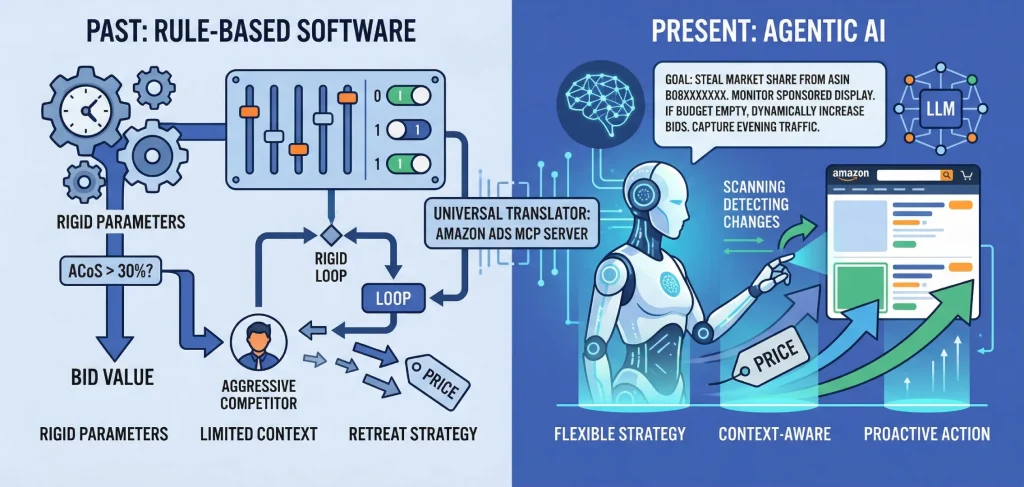
For years, Amazon sellers have used third-party PPC software to automate their bids. But legacy software was entirely “rule-based.” You had to manually set rigid parameters. For example: If ACoS goes above 30%, lower the bid by 10%. These tools helped with scale, but they were limited. They followed rules well, but they could not interpret context or adapt strategically. If a competitor made a highly aggressive move, the rule-based software would often just lower its own bids and retreat, surrendering the market share. For many sellers, the real issue is not whether automation exists. It is whether the automation is working from the right business limits.
The paradigm shifted entirely with the launch of the Amazon Ads MCP server. As we have discussed in our previous guides, the MCP server acts as a universal translator between Large Language Models (LLMs) like Claude Code and the Amazon Advertising API.
This marked the start of what many now call “Agentic AI.”
Your competitors are no longer setting rigid rules. They are giving their AI agents overarching strategic directives. A modern competitor can open their terminal and type a prompt like:
“Claude, your goal is to steal market share from ASIN B08XXXXXXX. Monitor their Sponsored Display placements on our category keywords. If their ads disappear, assume they have exhausted their daily budget. The moment this happens, dynamically increase our bids by up to $2.50 to capture all remaining evening traffic. Report your actions to me in the morning.”
The AI can parse that instruction, monitor the Amazon Ads API, detect a change, and react far faster than a person managing the account manually.
If you are still managing your Amazon PPC mainly through occasional manual checks, you are reacting far more slowly than competitors using automation. You must evolve your strategy to protect your digital real estate.
In the physical retail world, brands pay grocery stores massive “slotting fees” to ensure their products are placed at eye level on the aisle. Your “Digital Shelf” on Amazon operates on the same principle, but the real estate is infinitely more volatile.
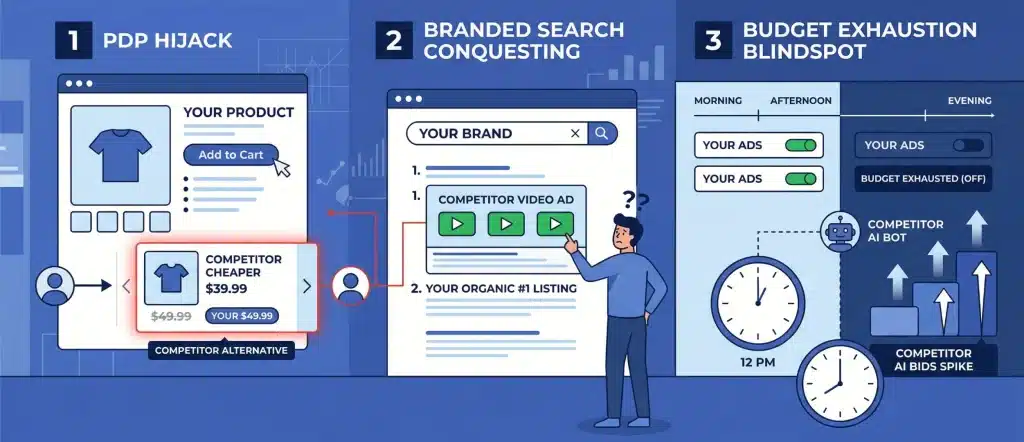
Your digital shelf is comprised of the search results page where you rank organically, your branded search terms, and the physical real estate on your own Product Detail Page (PDP). Automated bidding systems tend to focus on three specific vulnerabilities across this shelf.
The most aggressive and damaging attack vector is the PDP hijack. When a customer clicks on your organic listing or your Sponsored Product ad, they land on your detail page. You paid for that click. You earned that traffic.
However, just beneath your bullet points, and directly under your Buy Box, Amazon places highly visible ad carousels: “Products related to this item” and “4 stars and above.”
Competitor automated systems are often configured to target these carousels using Sponsored Display and Sponsored Products Product Targeting (PAT). They will instruct the AI to find your top-performing ASINs and bid heavily to place a cheaper, highly-rated alternative right next to your “Add to Cart” button. If your product is $49.99, their AI will ensure a $39.99 alternative is staring your customer in the face. This can reduce your conversion rate and pull shoppers away at a late stage in the buying process.
There is a pervasive, dangerous myth among legacy Amazon sellers: “I don’t need to bid on my own brand name because I already rank number one organically for it.”
In 2026, this mindset can become expensive very quickly. Amazon’s search engine results page (SERP) is heavily monetized. The top three to four slots on mobile are almost entirely sponsored placements.
If a customer types your specific brand name into the search bar, AI bidding bots will recognize the high purchase intent of that query. Competitors will bid massive amounts on your exact brand name. Because you are not defending it, their Sponsored Brand Video or top-of-search Sponsored Product ad will appear above your organic listing. The customer, inherently trusting the top result, clicks the competitor’s ad. You just lost a loyal customer who was actively trying to find you.
This is one of those areas where brands often assume organic rank is enough, until they see a competitor sitting above them on their own search.
AI bots are exceptionally good at finding chronological vulnerabilities. Human sellers typically set daily budgets that reset at midnight Pacific Time. If your campaigns are highly successful, they might run out of budget by 4:00 PM.
Competitor AIs use “Micro-Dayparting” algorithms to monitor the ecosystem. When the bot detects that your ads have vanished from the SERP, it knows your budget is exhausted. The bot then dramatically increases its own bids for the evening hours, buying up all the late-night shoppers at a premium because it knows the primary category leader (you) is no longer in the auction to drive up the CPC.
Now that we understand how competitors use these systems, the next step is to build a practical response. You cannot stop competitors from using AI, but you can make attacking your brand so mathematically expensive and structurally difficult that their AI algorithms determine the cost is not worth it and shift attention elsewhere.
This requires a multi-layered protection setup.
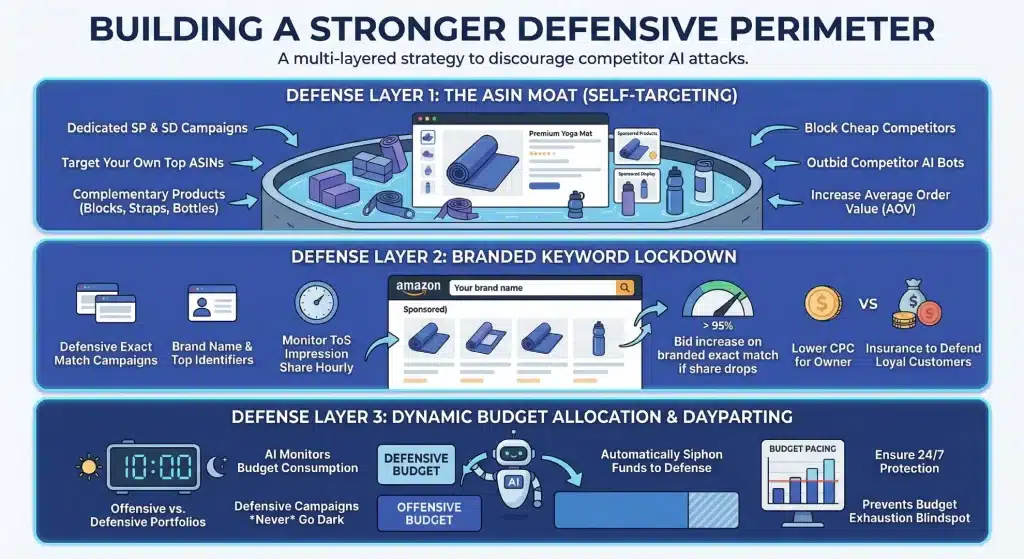
One of the most important steps in protecting your listing presence is building a “moat” around your own Product Detail Pages. You must actively buy the ad space on your own listings to block competitors from showing up.
The Strategy: You need a dedicated Sponsored Display campaign and a Sponsored Products (Product Targeting) campaign built specifically for brand protection.
If you sell a line of premium yoga mats, you do not want a competitor’s cheap yoga mat showing up under your Buy Box. Instead, you want to target your own ASINs with your other ASINs. You instruct your campaigns to display your yoga blocks, your stretching straps, and your premium water bottles directly on the PDP of your yoga mat.
The Execution: This is where automation becomes useful on your side as well. You can use your own MCP server integration (or partner with SellerMetrics to handle the infrastructure) to automate this defense.
You would prompt your AI agent: “Claude, create a Sponsored Display product targeting campaign named ‘DEFENSE_Brand_Moat’. The target audience is all of our top-20-selling ASINs. The ads to display are our highly-rated complementary products. Set the bids at a strong $2.00, and ensure this campaign has a daily budget that never exhausts. Our goal is 100% share of voice on our own detail pages.”
By doing this, you achieve two things. First, you physically block competitor AI bots from hijacking your page because you are outbidding them for the placements. Second, you dramatically increase your Average Order Value (AOV) because customers end up buying your yoga mat and your yoga blocks. You turn a defensive cost into a profitable cross-selling engine.
You should aim to control the search results page for your own brand name as consistently as possible. This matters even more now that agentic AI tools can move quickly on branded terms.
The Strategy: You need to create highly defensive Exact Match campaigns targeting your brand name, your brand name plus your top product identifiers, and common misspellings of your brand name.
The Execution: Because Amazon’s relevance algorithm heavily favors the actual brand owner (your product is highly relevant to your own brand name), your Cost Per Click (CPC) to win these top-of-search placements will be significantly lower than what a competitor has to pay to steal them.
You need a campaign structure that helps you maintain a strong Top of Search impression share.
Your automation prompt should look like this: “Claude, monitor our ‘Branded_Exact_Defense’ campaign. Pull an hourly report on the Top of Search Impression Share for these branded keywords. If our impression share drops below 95%, immediately increase the exact match bids by 15% and increase the Top of Search placement multiplier. Do not allow competitors to win our branded search terms.”
Yes, you are paying for clicks that you might have gotten organically. But consider this an insurance policy. It is vastly cheaper to pay a $0.30 CPC to defend your loyal customer than it is to let a competitor steal them and then have to pay a $3.00 CPC to acquire a net-new customer to replace them.
In practice, many brands do not need to dominate every branded variation at all hours. They do need to stay visible enough that competitors cannot take the easiest clicks.
To defend against the “Budget Exhaustion Blindspot,” you must ensure your defensive campaigns never go dark.
The Strategy: You cannot treat your defensive campaigns the same way you treat your offensive discovery campaigns. If your non-branded, generic keyword campaigns run out of budget at 5:00 PM, that is unfortunate but acceptable. If your Branded Keyword Lockdown or ASIN Moat campaigns run out of budget at 5:00 PM, competitors have a clearer opening to take those placements.
The Execution: You must separate your budgets into “Offensive” and “Defensive” portfolios within the Unified Campaign Manager.
Using advanced AI automation, you can implement dynamic budget shifting. You instruct your AI agent to monitor the budget pacing of your defensive portfolio. If your protection portfolio reaches 80% budget consumption by 3:00 PM, the AI should automatically siphon budget away from a lower-performing offensive campaign and inject it into the defensive portfolio to ensure it stays live until midnight.
This makes it much less likely that a competitor checking late in the day will find an easy opening.
While setting up an automated AI defense is mandatory, there is a massive, existential danger that you must avoid: The Infinite Bidding War.
When your AI bot goes head-to-head with a competitor’s AI bot over a specific keyword or a specific ASIN placement, neither AI has an ego. They simply follow their logic trees. If both bots are instructed to “Always win the top placement, regardless of cost,” they will rapidly bid each other up into the stratosphere.
Within minutes, a keyword that normally costs $1.50 per click can skyrocket to $15.00 per click. In that scenario, Amazon is usually the clear winner because rising CPCs increase ad spend for both sides.
To keep your protection setup from becoming unprofitable, your AI must have strict, profit-aware guardrails.
This is the exact problem we highlighted in our previous discussions about the MCP Blindspot. The basic Amazon Ads MCP server only sees ACoS; it does not see your actual profit margins or your Selling Partner API (SP-API) data.
If your AI does not know your True Net Margin, it doesn’t know when to surrender a battle to win the war.
You must feed real-time Cost of Goods Sold (COGS) and FBA fee data into your AI’s context window. Your defensive prompt must include a logical “walk-away” point.
The Profit-Aware Prompt Constraint: “Claude, fiercely defend ASIN B08XXXXXXX from competitor targeting. Continually increase bids to maintain the top Sponsored Display placement. HOWEVER, you must cross-reference our local sellermetrics_margin.json file. The maximum allowable CPC for this defense cannot exceed our True Net Profit per unit ($8.50). If the competitor’s AI pushes the required CPC to $8.51, immediately cease bidding, surrender the placement temporarily, and alert me. Do not bid at a net loss.”
By implementing this profit-aware constraint, you can stay active up to the point where defending that placement stops making financial sense. You let the competitor’s AI win the placement, but you force them to pay such an exorbitant CPC that they actively lose money on every unit they sell. This forces the competitor to absorb the cost of pushing the auction past a sensible limit. At that point, the challenge stops being campaign setup alone. It becomes a data and oversight problem.
Building this kind of profit-aware automation takes time, system access, and close oversight. It requires maintaining secure SP-API connections, managing local JSON data feeds, and writing prompts carefully enough that the automation does not make poor decisions or overspend.
For the vast majority of Amazon brands, trying to build this infrastructure in-house is a distraction from their core competency of product development and brand building.
This is exactly why sophisticated brands partner with an advanced data and advertising agency like SellerMetrics.
We do more than install automation. We help brands connect the data, campaign structure, and oversight needed to use these systems more responsibly.
The digital shelf is becoming more competitive. Your competitors now have tools that let them automate bid changes and campaign responses. If you rely on manual adjustments and older rule-based systems, it becomes harder to hold share against competitors using faster automation.
The better approach is to respond with automation that is grounded in margin data and clear operating limits.
Are your product listings currently bleeding sales to competitor AI bots? Contact SellerMetrics today for a comprehensive Digital Shelf Vulnerability Audit. We will show you where competitors are putting pressure on your listings and how to reduce that exposure.
In simple terms, an AI bidding bot is an automated system that watches Amazon ad conditions and reacts without waiting for manual updates. It can adjust bids, launch campaigns, and target competitor placements based on the logic it has been given.
Competitors use Sponsored Display and Sponsored Products Product Targeting (PAT) campaigns to bid on your specific ASIN. By bidding aggressively, they force their own product ads to appear in the highly visible carousels directly beneath your product’s title and Buy Box, stealing the customer right before they add your item to their cart.
If you do not bid on your own brand name, your competitors will. Amazon’s search results page places sponsored ads above organic rankings. A competitor can buy the ad space for your exact brand name, ensuring their product appears first when a customer searches for you, which steals highly loyal, high-intent traffic.
An ASIN moat is a defensive advertising strategy where you use Sponsored Display and Product Targeting to place ads for your other products on your own product detail pages. By taking up this ad real estate yourself, you physically block competitors from appearing there, while simultaneously encouraging customers to cross-shop your catalog.
You should separate your campaigns into “offensive” and “defensive” portfolios. Using AI automation or advanced agency management, you can set rules to dynamically shift remaining daily budget from lower-performing offensive campaigns into your defensive portfolio during the late afternoon, ensuring your branded terms and ASIN moats stay protected 24/7.
This usually happens when both sides are using automation with overly aggressive rules. Instead of stopping at a sensible limit, both systems keep pushing bids higher. This can drive the Cost Per Click (CPC) up to astronomical, highly unprofitable levels in a matter of minutes, draining your ad budget rapidly.
You must implement “Profit-Aware Guardrails.” By feeding your real-time Cost of Goods Sold (COGS) and Amazon FBA fees into your AI’s context (often via a tool like SellerMetrics), you can instruct the AI to cease bidding the exact moment the required CPC exceeds your net profit margin on that specific item.
Yes. The Unified Campaign Manager allows you to see both your Sponsored Ads and your Amazon DSP (Demand-Side Platform) campaigns in one view. This allows you to coordinate your defensive perimeter, ensuring you aren’t overlapping your own retargeting efforts and wasting money showing the same customer defensive ads across multiple channels.
To build a highly customized, profit-aware AI agent connecting to the SP-API and Ads API from scratch, yes, you need significant coding knowledge. However, partnering with a specialized Amazon Ads agency allows you to leverage their pre-built, sophisticated defensive architectures without having to write a single line of code yourself.
One clue is a sudden rise in CPC on branded terms. Another is a drop in conversion rate on top ASINs even when traffic stays steady (which indicates traffic is landing on your page but clicking away to a competitor’s ad in the carousel). Both are strong indicators of an active conquesting campaign.

29 March 2026
TweetLinkedInShareEmailPrint 10 min read By Rick Wong Updated Mar 29, 2026 TL;DR Why should I drive ext...

29 March 2026
TweetLinkedInShareEmailPrint 18 min read By Rick Wong Updated Mar 29, 2026 TL;DR Do I need an LLC or bu...

9 March 2026
TweetLinkedInShareEmailPrint 14 min read By Rick Wong Updated Mar 09, 2026 TL;DR What is Private Label ...