
1 July 2026
Amazon vs Walmart: What’s the Best Place to Sell in 2026?
TweetLinkedInShareEmailPrint As Walmart continues growing its marketplace, many US eCommerce brands start won...

 29 March 2026

No. You can legally open an Amazon seller account and start operating as a Sole Proprietor using just your Social Security Number. However, forming an LLC is highly recommended as your revenue grows to protect your personal assets from business liabilities.
If your business model relies on Online Arbitrage or Wholesale, a resale certificate allows you to purchase domestic inventory without paying local sales tax. More importantly, authorized, high-tier distributors will firmly refuse to open a wholesale account for you without one.
Fortunately, no. Thanks to Marketplace Facilitator laws, Amazon automatically calculates, collects, and remits sales tax on your behalf for orders shipped to customers in almost every US state.
If you choose to test the waters as a Sole Proprietor, you can simply use your Social Security Number for your Amazon tax interview. If you choose to form an LLC or Corporation, you will need to obtain a free federal EIN from the IRS to provide to Amazon and to open your business bank account.
If you are starting up your e-commerce journey, you are likely asking yourself a critical question: Do I actually need a business license to sell on Amazon? The short answer is no, you do not strictly need one just to open an account.
However, the days of the “Wild West” in online retail are long gone. E-commerce tax compliance, state regulations, and Amazon’s own terms of service have evolved significantly over the last few years, making it absolutely crucial to understand the 2026 legal landscape before launching a storefront.
Depending on your chosen business model, your physical location, and the specific products you plan to sell, skipping the right documentation could lead to missed wholesale opportunities, suspended accounts, or unexpected tax liabilities. Let’s dive into exactly what you need to stay fully compliant, protect your assets, and set your Amazon business up for scalable success this year.
In most cases, you don’t need a business license if you sell your items online. Consumers regularly sold on e-commerce platforms such as do not need to pay any fees or obtain any permits from the federal government.
Basically, Amazon does not prevent you from listing your product on their platform or use their services such as Amazon FBA.
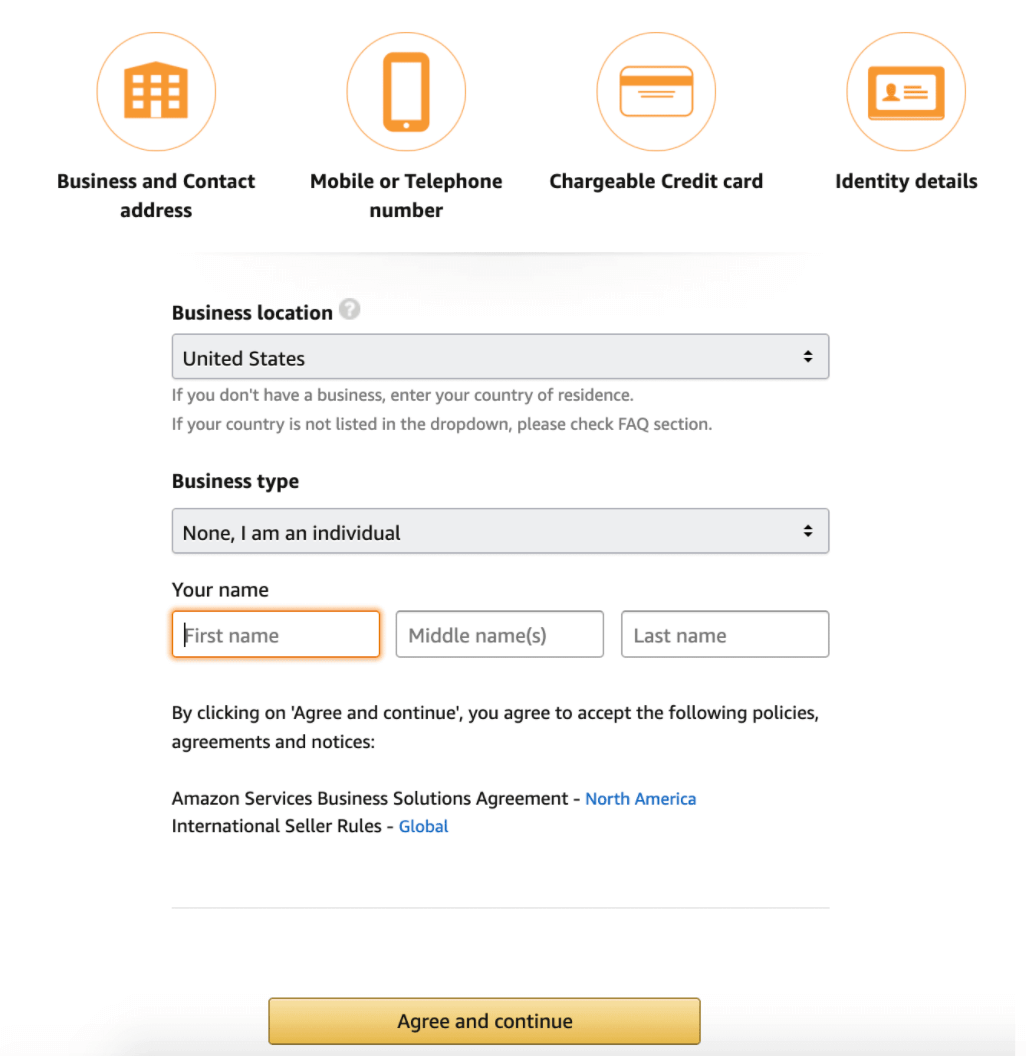
You can see that you don’t need an LLC nor a business license during the seller account registration. In step 5 of the registration, Amazon allows “None, I an individual” under the section Your business type. This basically allows you to go through the entire registration without a business license.
Others believe that business licenses for online sellers, as well as the procedure of obtaining one, are a needless hassle. As a result, it is frequently overlooked. But one fact that you don’t want to overlook is if your product is federally regulated. If your product falls under the following category and agencies then you will need a business license.
The following product category will require a federal business license:
The following product category will require a state and local business license:
You can see a complete list from the Consumer Product Safety site here.
When researching business licenses, most new Amazon sellers fixate entirely on federal regulations and state taxes, completely overlooking the laws of their own neighborhood. If you are launching your Amazon business from your living room or garage (particularly if you are utilizing the Fulfilled by Merchant (FBM) model or processing wholesale pallets at home) you must consider local municipal zoning laws.
Many cities and counties require what is known as a “Home Occupation Permit” to legally operate a commercial enterprise from a residential address. Local zoning boards are highly protective of residential neighborhoods. If your Amazon business involves daily freight deliveries, a surge in commercial shipping trucks pulling up to your driveway, or storing large quantities of inventory in a residential structure, you could quickly run afoul of local ordinances. Even if the state does not require a general business license to sell online, your local city hall might impose fines if you are operating without a Home Occupation Permit. Always check your city or county government website to review the specific zoning definitions for home-based e-commerce businesses.
Another reason for registering for a business license is the legality aspect of it. By forming an LLC, you are giving your company a legal foundation. Obtaining a business license will allow you to function and safeguard your company from any litigation. If your company’s popularity and sales are increasing, the chances of being sued are increasing as well.
Of course, you should want to prevent any litigation as much as possible. However, by creating an LLC, you can safeguard your identity from any legal proceedings taken against your firm. If someone decides to sue your company, they will sue the LLC rather than you. Not trying to scare you, but that is exactly how it will happen if you are doing business as an LLC with a business license vs as an individual.
In recent years, the federal government introduced the INFORM Consumers Act, a mandate designed to add transparency to online marketplaces and protect buyers from counterfeit or stolen goods. For Amazon sellers, this legislation changed everything regarding how accounts are verified.
Under this law, once you reach a certain threshold of sales, Amazon is legally obligated to collect and rigorously verify your bank account information, government-issued ID, tax identification numbers, and your physical business address. While you can technically pass this verification as an individual using your Social Security Number, the process is notoriously stringent. Any mismatch between your personal banking details, your home address, and your Amazon seller profile can trigger an automatic account suspension while Amazon investigates.
This is where forming an LLC and obtaining a formal business license becomes a massive operational advantage. By registering a formal legal entity, acquiring a federal EIN, and opening a dedicated business bank account, all of your documentation will match perfectly. Presenting Amazon with a unified, legally registered business profile drastically reduces the friction of the INFORM Act verification process, ensuring your storefront remains active and your payouts are never frozen.
So all the information in this article assumes that US-based sellers selling on the Amazon US marketplace. But if you want to branch out globally, other marketplaces have strict tax registration requirements. For example, to open a professional seller account on Amazon UK, you cannot simply operate under the radar. You must either form a UK Limited Company (LTD) or officially register with the UK government (HMRC) as a Sole Trader to obtain a Unique Taxpayer Reference (UTR) number.
If you want to get essential services for your business such as any government grants or loans you are required to have a business license and LLC. Amazon selling is a cash-intensive business, and getting a loan allows you to scale out your business. Obviously, the first thing a bank or financing company will need is your LLC registration, they cannot offer you a business loan without it. For registering your LLC, consider taking legal advices or services from registered agents such as LegalZoom or Northwest Registered Agent for business’s countinues growth.
As your Amazon business scales, your liability scales with it. To protect consumers, Amazon’s Terms of Service explicitly require all sellers to obtain a commercial general liability insurance policy the moment their gross proceeds exceed $10,000 in a single month. This policy must cover up to $1 million per occurrence and explicitly name Amazon as an additional insured party.
While hitting the $10,000 a month milestone is an exciting indicator of growth, it presents a sudden hurdle for sellers operating without formal business documentation. Top-tier commercial insurance carriers are highly hesitant to underwrite million-dollar liability policies for sole proprietors operating out of their personal checking accounts. Establishing an LLC, securing an EIN, and holding the appropriate state-level business licenses legitimizes your operation in the eyes of insurance underwriters. Without these foundational business structures in place, you will likely face exorbitant insurance premiums or outright rejections, which in turn puts your Amazon seller account at risk of suspension for violating the insurance mandate.
While a general business license grants you the right to operate within a specific jurisdiction, a reseller’s license (often referred to as a resale certificate or wholesale license) serves a very different, highly lucrative purpose. If your Amazon business model revolves around Wholesale or Online Arbitrage, obtaining this document is absolutely critical.
A resale certificate allows you to purchase inventory from domestic wholesalers, distributors, and manufacturers without paying local sales tax on those items. Because the end consumer will eventually pay the sales tax when they purchase the item on Amazon, state tax authorities do not require you to pay tax on the initial inventory acquisition. This exemption instantly improves your profit margins and frees up vital cash flow that can be reinvested into sourcing more products. In addition, if you plan to scale a wholesale business, you will quickly discover that authorized, high-tier distributors will firmly refuse to open an account for you unless you can provide a valid resale certificate. It is the gold standard of B2B credibility.
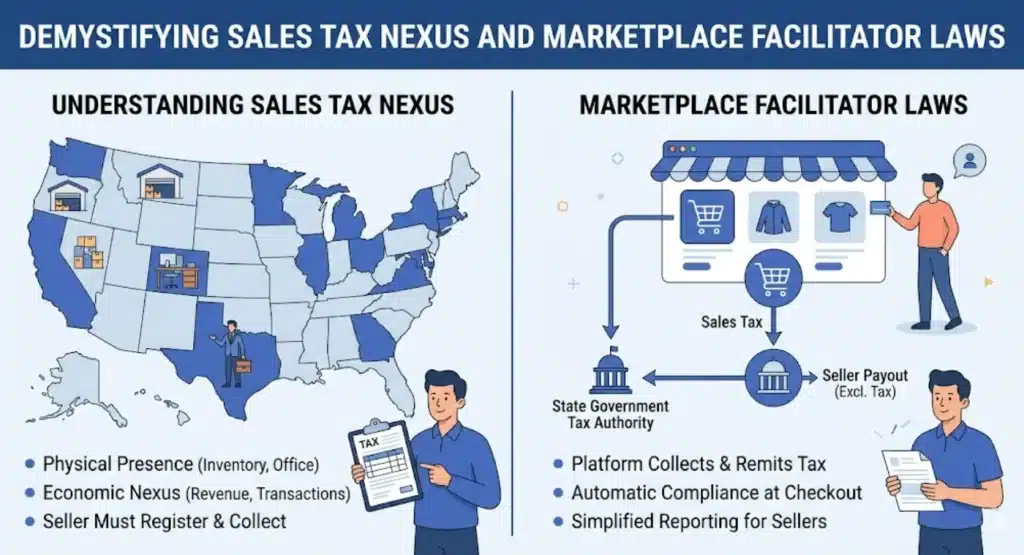
The landscape of e-commerce sales tax has shifted dramatically, and understanding your obligations in 2026 is vital to avoiding steep penalties. Historically, sellers were paralyzed by the complexities of collecting and remitting sales tax across dozens of different states. Fortunately, the introduction of Marketplace Facilitator laws has simplified the process.
As a designated Marketplace Facilitator, Amazon automatically calculates, collects, and remits sales tax on your behalf for orders shipped to customers in almost every US state. This relieves you of the massive administrative burden of filing monthly tax returns in states where your customers reside. However, this does not mean you are entirely off the hook.
You must still be aware of “Sales Tax Nexus.” A nexus is established when your business has a significant physical or economic presence in a specific state. For Amazon FBA sellers, simply storing your inventory in an Amazon fulfillment center creates a physical nexus in that state. Even though Amazon remits the actual tax revenue, certain states still legally require you to hold an active sales tax permit and file periodic “zero-dollar” returns to maintain compliance. Always consult with a certified CPA to ensure your nexus obligations are fully met.

As mentioned, you can start your entire online business without establishing a legal entity. The basic goal is to safeguard yourself in case something bad happens. Although the likelihood of things going wrong and being sued is low, it is possible.
You can operate as a sole proprietorship if you’re just starting out. When you file your taxes, all of your sales will be included with your income tax. It makes the tax filling much easier than the next option.
The next structure you should think about is forming your company as an LLC (Limited Liability Company). If your company is growing and you need to hire more employees, an LLC is a good option.
It also gives your company a legal identity apart from you, ensuring that you are not personally liable for your firm’s responsibilities.
Another advantage is that it will readily differentiate between business and non-business spending. This will ensure operational discipline.
Choosing to operate as a Sole Proprietorship might seem like the path of least resistance when you are just launching your Amazon storefront, but upgrading to a Limited Liability Company (LLC) unlocks tier-one advantages that go far beyond basic liability protection.
From a financial perspective, an LLC offers tremendous tax flexibility. By default, the IRS treats a single-member LLC as a “pass-through” entity, meaning the business itself pays no corporate taxes; the profits simply pass through to your personal tax return. As your Amazon revenue scales, you even have the option to elect S-Corporation tax status for your LLC, which can dramatically reduce your self-employment tax burden while still avoiding the double taxation associated with traditional C-Corps.
Beyond the tax code, an LLC establishes undeniable professional credibility. When you reach out to major brands to negotiate exclusive wholesale contracts or request approval to sell gated products, suppliers will look up your corporate structure. Presenting an LLC backed by a federal EIN signals that you are a legitimate, long-term retail partner rather than a fleeting hobbyist.
If you choose to safeguard your Amazon business by forming an LLC, there is one non-negotiable legal requirement you must fulfill: appointing a Registered Agent. A registered agent is an individual or a third-party service officially designated to receive legal correspondence, tax documents, and compliance notices on behalf of your company.
Every state mandates that your registered agent must have a physical street address (P.O. boxes are strictly prohibited) within the state where your LLC is formed, and they must be available during standard business hours. While you are legally permitted to act as your own registered agent, doing so means your personal home address will become part of the permanent public record. For Amazon sellers who value their privacy and want to ensure they never miss critical legal notices while traveling or sourcing products, hiring a professional registered agent service is a small, worthwhile investment.
Depending on your overarching brand strategy, you may need to register a “Doing Business As” (DBA) name, also known in some states as a fictitious business name or trade name. A DBA is legally required if you plan to operate your Amazon storefront under a name that is different from your official legal entity name.
For example, if you register your formal legal company as Smith Holdings LLC, but you want your Amazon store, customer service emails, and product packaging to be branded as Cozy Home Essentials, you must register Cozy Home Essentials as a DBA with your state or county government.
Registering a DBA goes far beyond the aesthetics of your Amazon seller profile; it is a strict financial and legal requirement. If you attempt to open a business checking account, cash a vendor refund check, or apply for a business credit card under your consumer-facing brand name without a registered DBA, banks will reject the application. Furthermore, maintaining a clear paper trail that officially links your corporate LLC to your storefront brand is highly beneficial when you eventually file for a trademark and enroll in Amazon Brand Registry.
A Sales Tax ID (frequently referred to by individual states as a Seller’s Permit, Sales Tax License, or Department of Revenue ID) is a state-issued number that grants your business the legal authority to collect sales tax on items sold within that jurisdiction.
At this stage, many new sellers get confused. They ask: “If Amazon acts as a Marketplace Facilitator and automatically collects and remits sales tax for me, why do I need my own Sales Tax ID?”
The answer comes down to your physical home state and your long-term business strategy. Even though Amazon is handling the transaction tax at checkout, your business still has a physical nexus in the state where you live and operate. Most states legally require any retail business operating within their borders to hold an active Seller’s Permit, regardless of whether a third-party platform is remitting the actual funds. In these cases, you will simply use your Sales Tax ID to file periodic “zero-dollar” tax returns, proving to your state that Amazon handled the tax liabilities on your behalf.
Furthermore, if you ever plan to sell on a platform that does not automatically remit taxes (like your own Shopify store), or if you want to apply for a Wholesale Resale Certificate to buy inventory tax-free, holding an active Sales Tax ID is a strict prerequisite.
This is probably the most important part. A federal tax identification number used to identify an LLC is known as an Employer Identification Number (EIN). So you’ll need an EIN if you want to register a business banking account for your LLC or for import/export.
If your using a company registration service they will probably register an EIN for you. But you can also register via one of 3 ways.
But let’s be honest no one using the internet will be using the last two options anymore.
It’s also worth noting that obtaining an EIN as a sole owner is completely optional, although you are still allowed to do so. As a sole proprietor, you can use your social security number for tax fillings.
Navigating the legal and tax requirements of an e-commerce business can feel daunting, but it should never stop you from launching your brand. The landscape is indeed maturing; 2026 brings stricter supplier expectations and tighter compliance rules, making an LLC and a Resale Certificate more vital than ever if you want to land lucrative wholesale accounts and protect your personal assets.
However, the fundamental beauty of the Amazon platform remains unchanged: the barrier to entry is still remarkably low enough for anyone to get started. You can absolutely launch your storefront today as a sole proprietor, test the waters, and upgrade your legal entity as your revenue scales. The secret to long-term success is simply to start smart, stay informed on the latest compliance guidelines, and build a foundation that is ready to grow.
Still have questions?If you are unsure about which business structure is right for your Amazon model, or if you need help navigating the 2026 legal landscape, we are here to help. Contact our team of e-commerce experts at hello@sellermetrics.app, and let us guide you through the process of setting up your storefront for success!
About the author: Rick Wong is a Senior Amazon PPC Strategist at SellerMetrics with seven years of experience managing Amazon advertising campaigns across CPG, electronics, and home goods categories. He has overseen more than $50M in cumulative Amazon ad spend and specializes in Sponsored Brands and DSP strategy for mid-market brands scaling on Amazon.
No, you do not need an LLC to start selling on Amazon. You can legally open a seller account and operate as a Sole Proprietor using your Social Security Number. However, forming an LLC is highly recommended to protect your personal assets from business liabilities.
Yes. During the Amazon Seller registration process, you can select “None, I am an individual” under the business type section. This allows you to sell without a formal company structure.
A resale certificate allows you to buy inventory from wholesalers without paying sales tax. If you use the Online Arbitrage or Wholesale business models, you will need this document to purchase goods tax-free and to open accounts with major suppliers.
Yes. Under Marketplace Facilitator laws, Amazon automatically calculates, collects, and remits sales tax on your behalf for orders shipped to customers in almost all US states.
A sales tax nexus is a physical or economic connection to a state. If you use Amazon FBA, storing your inventory in an Amazon warehouse creates a physical nexus in that state, which may require you to hold a sales tax permit there.
While not strictly required if you are a sole proprietor, opening a dedicated business bank account is crucial for clean bookkeeping, accurate tax filing, and establishing a clear separation between personal and business finances.
Amazon requires a taxpayer identification number. If you operate as a Sole Proprietor, you can use your Social Security Number. If you form an LLC or a Corporation, you will need to provide Amazon with your free federal EIN.
Yes. While standard consumer goods do not require a federal license, if you sell highly regulated items falling under categories like agriculture, aviation, or commercial fisheries, you must obtain the appropriate federal licensing.
Yes. Non-US residents can form a US LLC, obtain an EIN, and open a US business bank account. This is a common strategy for international sellers looking to access the Amazon US marketplace smoothly.
Absolutely. You can start selling as an individual to test the waters. Once your sales grow, you can form an LLC, retake Amazon’s tax interview inside Seller Central, and update your legal entity information without losing your account history.

1 July 2026
TweetLinkedInShareEmailPrint As Walmart continues growing its marketplace, many US eCommerce brands start won...

8 May 2026
TweetLinkedInShareEmailPrint 8 min read By Rick Wong Updated May 09, 2026 TL;DR Can I use AI tools like...

8 May 2026
TweetLinkedInShareEmailPrint 9 min read By Rachel Go Updated May 08, 2026 TL;DR Why is operating exclus...