9 March 2026
The Complete Guide to Amazon PPC Product Targeting
TweetLinkedInShareEmailPrint 18 min read By Rick Wong Updated Mar 10, 2026 TL;DR Why should new sellers...

 6 December 2025
When you’re working hard to win more sales on Amazon, it’s tempting to focus only on what happens inside the marketplace. You refine product titles, optimise images, run ad campaigns, and test pricing. Yet there is a powerful lever many sellers overlook entirely: Amazon backlinks. When used correctly, backlinks can open new streams of traffic, strengthen your listing’s authority, and deliver sustainable growth.
In this guide, you’ll learn why Amazon backlinks matter, how they interact with Amazon’s ranking mechanics, how to build and measure them ethically and effectively, and how they can strengthen your overall Amazon SEO Strategy.
Article of Contents
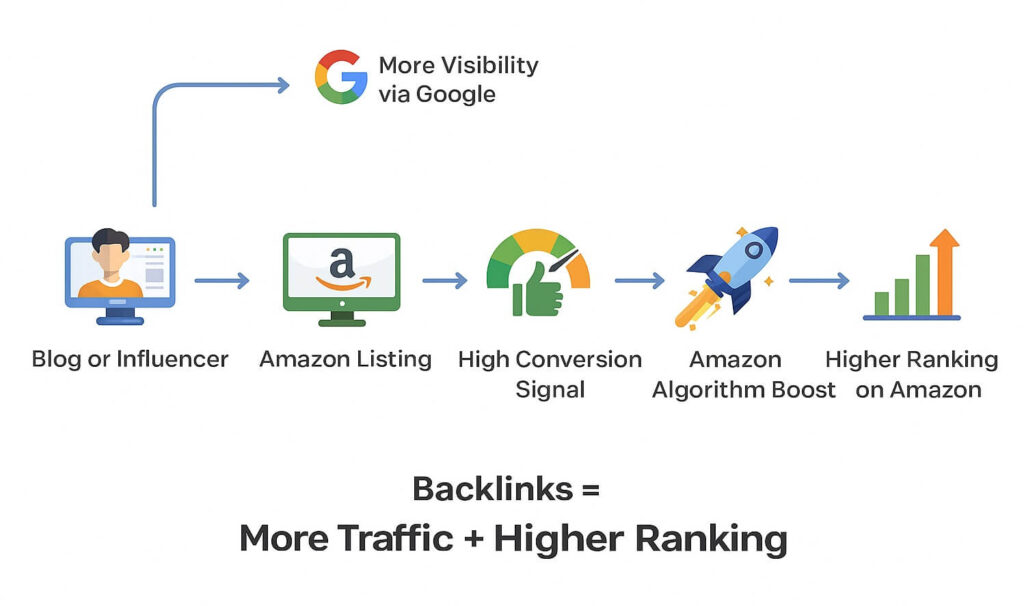
Most sellers concentrate on keywords and internal optimisation. They’re right to do so. But when you plant high-quality external links pointing towards your listing, you activate a hidden growth pathway.
Here’s how the logic works:
In short, Amazon backlinks serve as a bridge between what happens on the open web and what happens in Amazon’s search environment. They boost your footprint beyond Seller Central and create meaningful external demand.
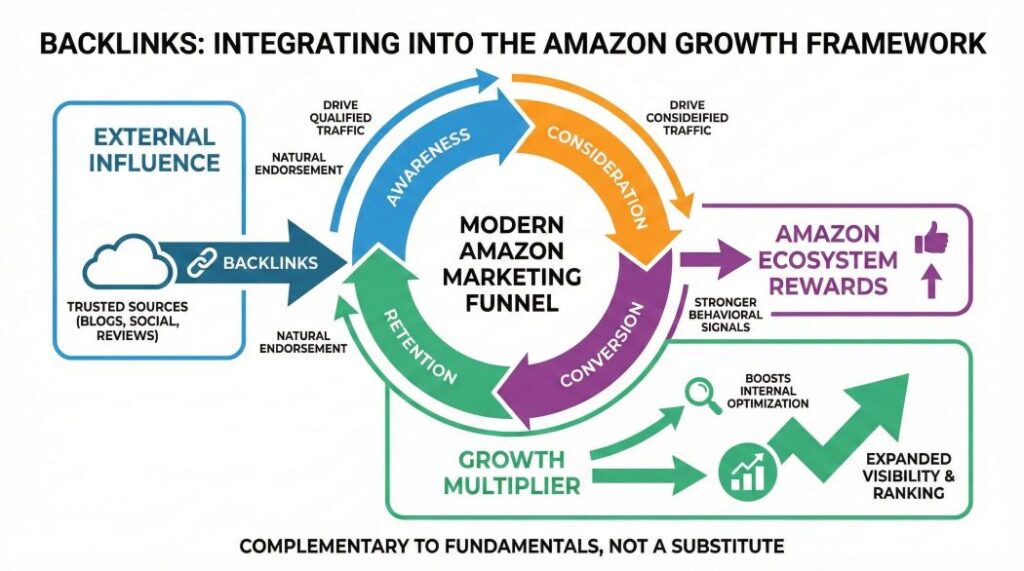
To make backlinks part of your growth playbook, you need to see where they sit within your broader funnel and operational strategy. Think of your selling process as a loop rather than a linear path.
Backlinks feed this funnel by increasing awareness and consideration while directly influencing conversion. If your product appears across the web in places your target audience trusts, you create a natural endorsement. That endorsement drives qualified clicks, and this is exactly the kind of behaviour the Amazon search ecosystem rewards.
Backlinks, therefore, complement internal optimisation such as your Amazon Search Term Optimization but also stretch beyond it. They become growth multipliers rather than a substitute for the fundamentals.
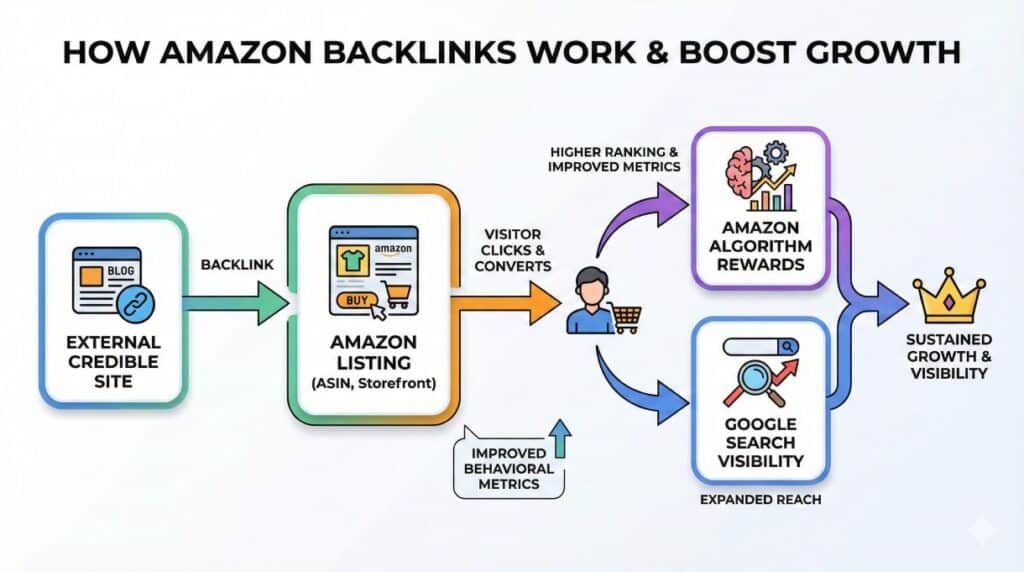
A backlink is simply a link from one website to another. In the context of Amazon, it’s usually a hyperlink that points to one of the following:
Many sellers mistakenly believe backlinks do nothing for Amazon. But the truth is that credit goes not to the link itself but to the qualified traffic and the resulting conversion behaviour that these links deliver.
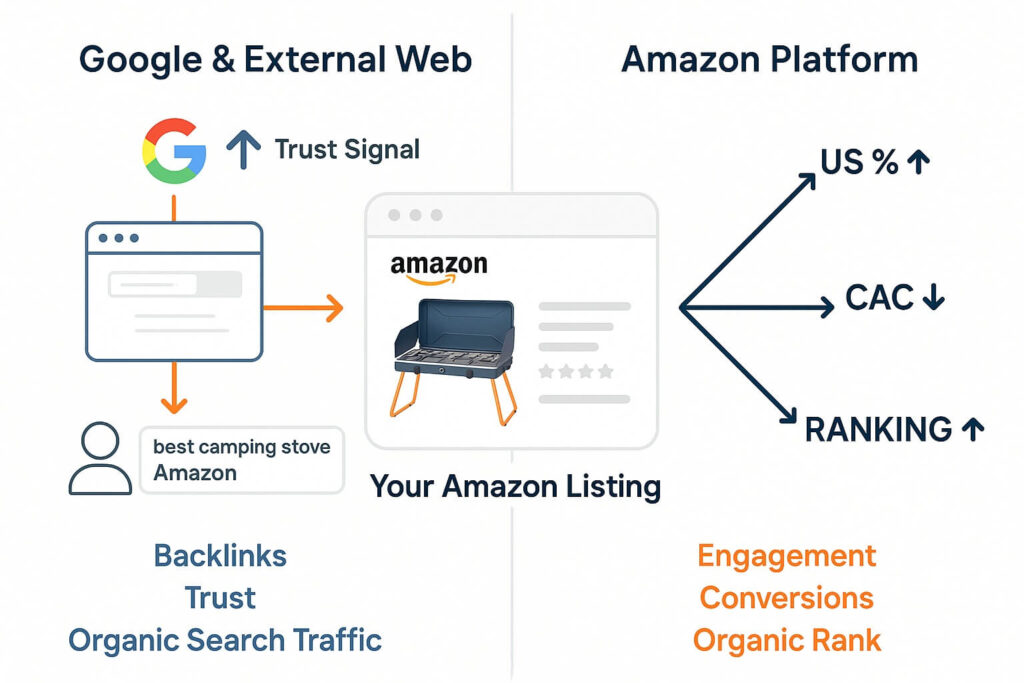
Backlinks deliver value in two places simultaneously: on Google (or the open web) and inside Amazon. Let us break this down.
When your listing earns backlinks from recognised sites, Google views this as a signal of trust and relevance. Your listing may start ranking for broader search queries like “best camping stove Amazon” or “affordable wireless earbuds Amazon” and send new visitors through.
While Amazon doesn’t publicly disclose that backlinks are a ranking signal, sellers and third-party research show that listings with strong external traffic often demonstrate:
Backlinks fill a gap many sellers ignore. You might be excellent at listing optimisation (through your Amazon Listing Optimization Services) and great at running ads, but if you neglect the external side, you’re still operating in a narrower lane. When you combine internal excellence with smart external linking, you widen your reach, diversify your traffic sources, and build a more resilient sales engine.
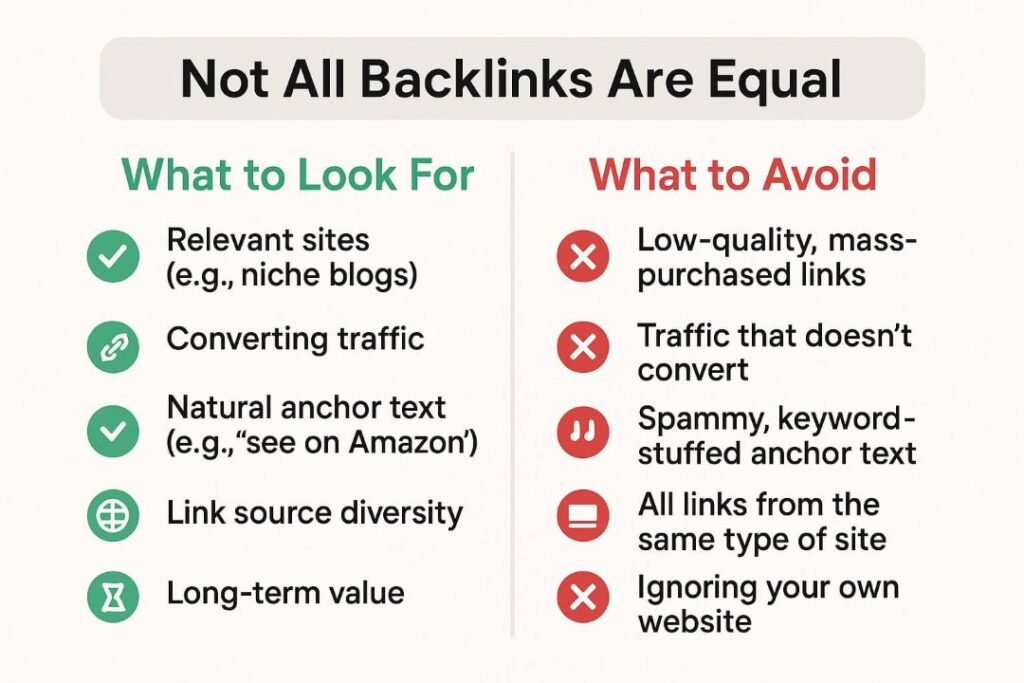
Not all backlinks are created equal. In fact, poor‐quality links can waste resources or even damage your standing on Google without delivering value on Amazon. So how do you tell which links count?
Focusing on link quality over quantity saves time, money, and risk. It also aligns precisely with what moves the needle for Amazon listings.
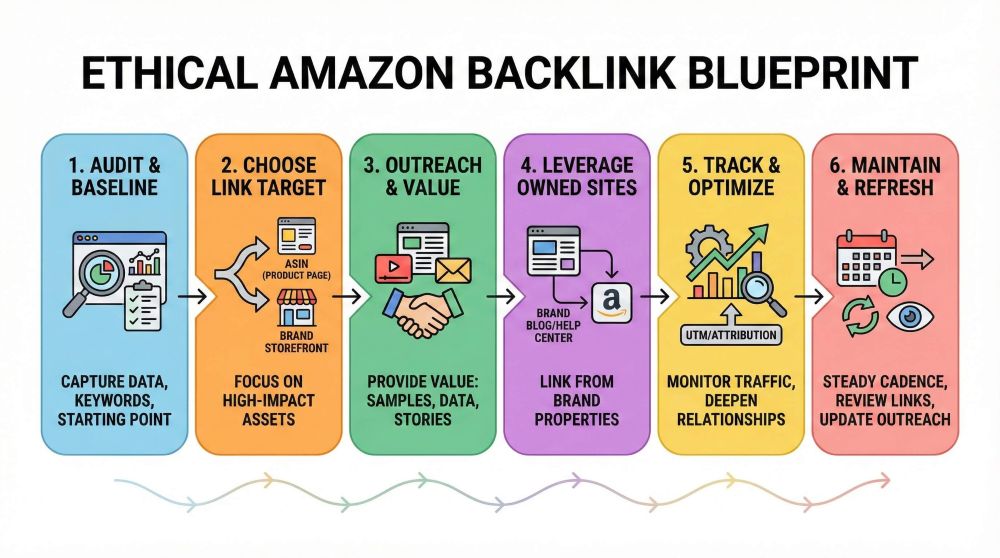
Here’s a practical blueprint for building backlinks that move the needle – rather than relying on tricks or shortcuts. Below is the step-by-step blueprint:
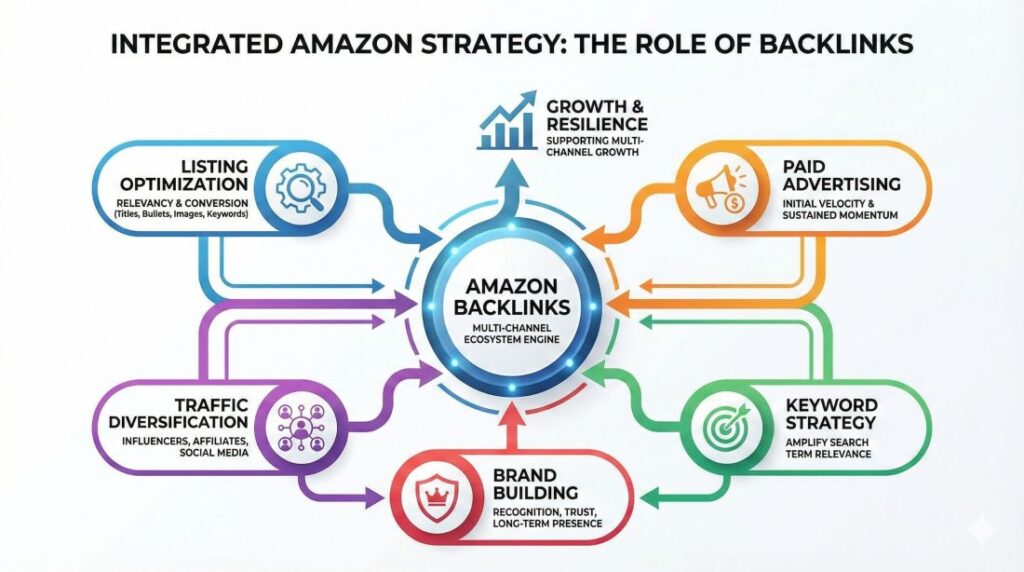
Backlinks are not standalone. They complement many other tactics and integrate within your broader seller growth plan.
When you align backlinks with your core internal strategy (listing optimisation, keywords, PPC) you create a multi-channel ecosystem that supports growth and resilience.
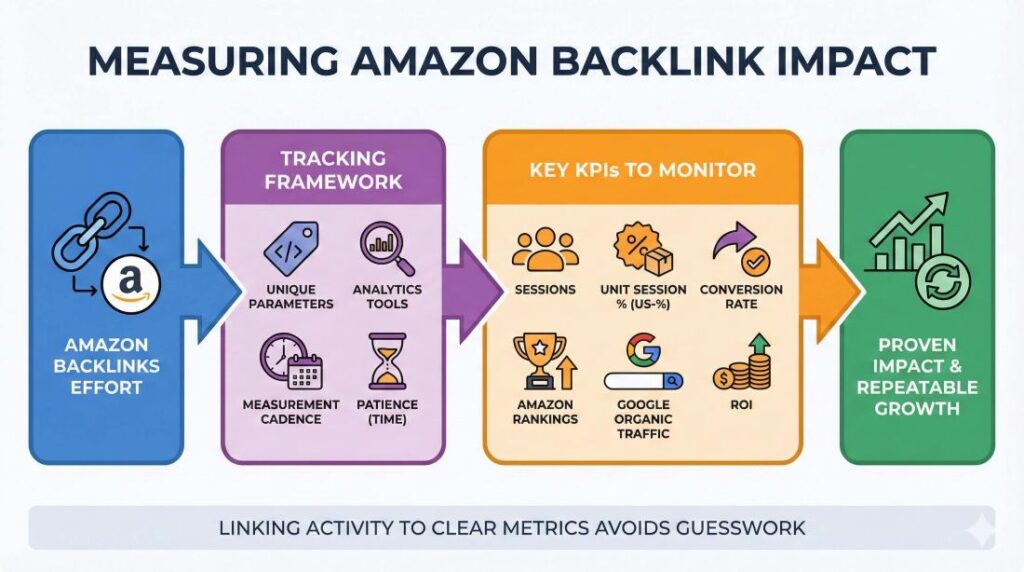
Building links is one thing. Proving their value is another. Here are the metrics and methods you’ll want to track to evaluate your effort.
By linking your backlink activity to clear performance metrics, you avoid guesswork and build a repeatable approach.
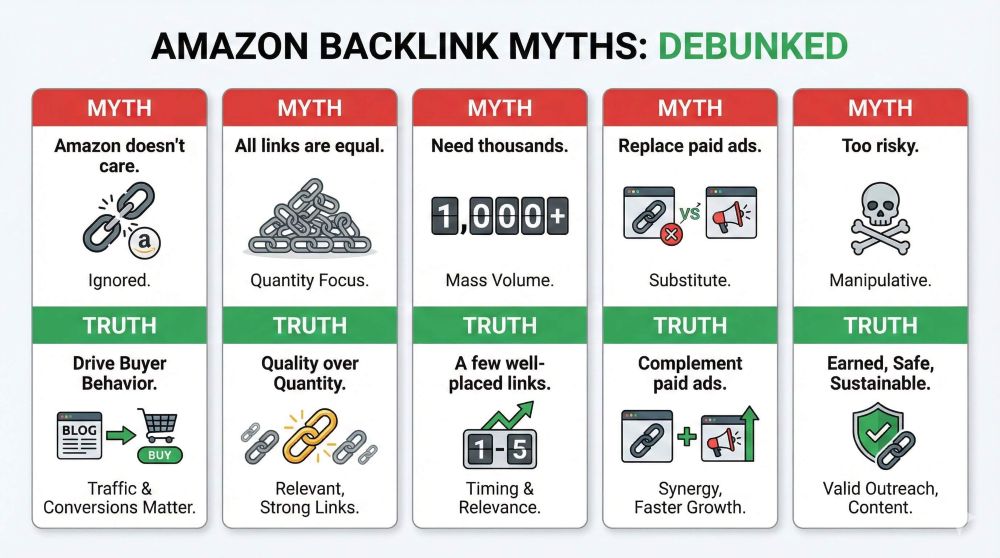
Let’s clear up some of the most persistent misconceptions that hold sellers back.
Myth 1: “Amazon doesn’t care about backlinks at all.”
Truth: Amazon may not treat backlinks as a direct ranking factor, but the buyer behaviour they drive matters deeply.
Myth 2: “All backlinks are equal.”
Truth: Quality matters far more than quantity. A few strong, relevant links outperform dozens of weak mentions.
Myth 3: “You need thousands of links to see results.”
Truth: In many niches, a handful of well-placed links can move the needle if they convert. Timing and relevance count more than volume.
Myth 4: “Backlinks will replace paid ads.”
Truth: They complement paid ads. The fastest growth comes when both channels work together.
Myth 5: “Backlink campaigns are too risky for Amazon sellers.”
Truth: Risk arises only when you use manipulative link schemes. Earned links via valid outreach and content remain safe, valuable, and sustainable.
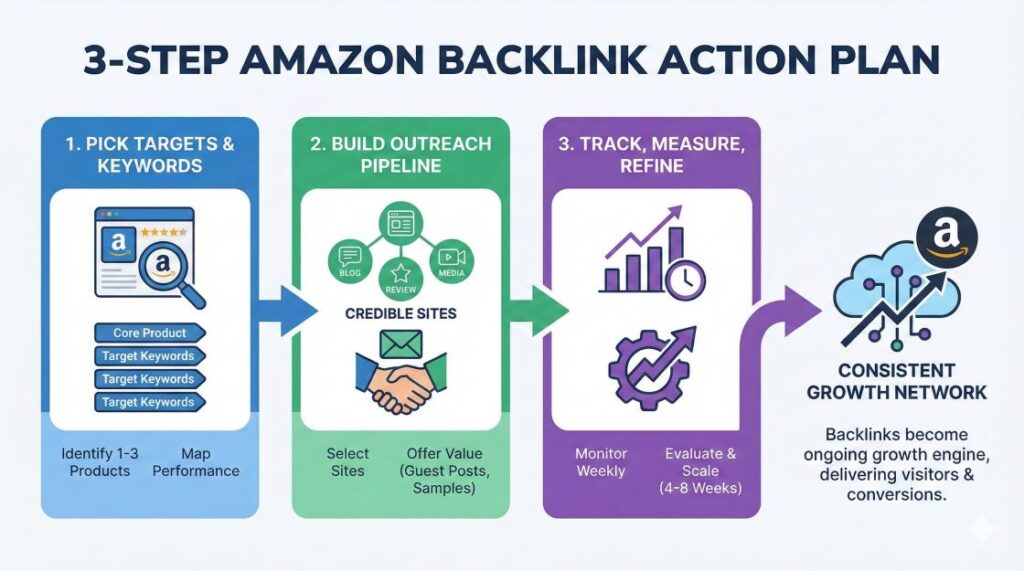
If you’re ready to make backlinks part of your growth engine, here’s a clear three-step action plan:
Over time, you’ll build a network of external references that consistently deliver visitors, conversions, and improved listing performance. Backlinks become part of your ongoing growth mix, not a one-off experiment.
As Amazon becomes more competitive and advertising costs rise, you need levers that work beyond just bidding higher. That means building visibility far outside the marketplace. Backlinks help you do exactly that: they send traffic, build authority, and move conversion metrics you can’t buy forever.
They also integrate perfectly with your long-term brand building on Amazon. If you think about how to drive external traffic to Amazon, backlinks let you reach buyers before they even hit the storefront. That’s a shift in mindset from “get the listing found in Amazon” to “get the listing talked about, shared, linked to, and trusted outside Amazon”.
In a marketplace where internal competition is fierce and ad costs keep rising, using Amazon backlinks smartly offers you a sustainable edge. You’re not just optimising inside Amazon anymore. You’re building visibility everywhere your buyer goes.
Treat backlink campaigns as the external leg of your strategy while you continue refining your internal levers. Use them to bring in qualified, ready-to-buy visitors from outside Amazon. Monitor their impact. And integrate them with your overall optimisation efforts, including your Amazon marketing funnel and paid traffic initiatives.
When done well, backlinks deliver layered benefits: external referral traffic, stronger listing behaviour, improved rankings, and greater visibility both on Amazon and via search engines. That is how you move from plateau to momentum.
Ready to move beyond just listing optimisation and build external authority that translates into Amazon sales? At SellerMetrics, we specialise in strategic growth for Amazon sellers, and our link-building services are designed to deliver high-quality backlinks that drive traffic, conversion, and ranking for your listings. Book your free consultation today and start building the growth engine your Amazon business deserves.
Amazon backlinks are links from external websites (blogs, media, influencers, your own brand site) that point to your Amazon product pages or storefront. Their value comes from driving qualified traffic and conversions, not simply link count. Over time, they build signals of demand and relevance that help your listing perform better.
No. Backlinks do not directly alter Amazon’s algorithm. What matters is the behaviour they generate – clicks, conversions, session quality – and how your listing performs internally. External links are most effective when your listing is already optimised for conversion.
There is no fixed number because every category and niche differs. In many cases, just a handful of high-quality links (from sites your audience trusts) can outperform many low-value mentions. Focus first on relevance, then scale based on performance.
Not at all. Even nofollow links can have value if they drive qualified visitors who convert. Since Amazon cares about the outcome (sales and conversion behaviour) more than link attributes, traffic from any credible source can benefit your listing.
Yes. You can use your brand website, write guest posts for niche blogs, collaborate with influencers, and create content that naturally references your Amazon listing. The most effective strategy is one where the link adds value to the audience, not just your sales efforts.
Track sessions and conversions with tools like Amazon Analytics and, where available, Amazon Attribution. Monitor listing metrics like unit session percentage, sales rank, and organic traffic from Google. Compare performance before and after your backlink placements to identify trends.
Risk exists only when links come from low-quality or spammy sources, or when the content appears manipulative. Focus on earned, relevant coverage, maintain natural link profiles, and avoid shady schemes to keep your approach safe and effective.
Backlinks work best when aligned with your internal efforts: listing optimisation, keyword strategy (including your Amazon SEO Services), paid advertising campaigns and external traffic generation. They strengthen your external reach, support your internal conversion efforts and help you create a cohesive growth engine.

9 March 2026
TweetLinkedInShareEmailPrint 18 min read By Rick Wong Updated Mar 10, 2026 TL;DR Why should new sellers...

27 February 2026
TweetLinkedInShareEmailPrint 8 min read By Rick Wong Updated Feb 27, 2026 TL;DR What is the optimal len...
18 February 2026
TweetLinkedInShareEmailPrint 8 min read By Rick Wong Updated Feb 18, 2026 TL;DR Is AMC free and availab...