
1 January 2025
Amazon Kindle Advertising Strategy: The Complete Guide for 2026
TweetLinkedInShareEmailPrint You have spent your blood sweat and tears writing your shelf-published e-Book/pa...

 29 March 2026

Margins depend on format and pricing strategy. eBooks priced strategically between $2.99 and $9.99 qualify for a massive 70% royalty tier. For physical paperbacks, authors earn a flat 60% royalty on the list price, minus the fixed cost of printing the book.
Yes, through the Kindle Unlimited (KU) program. If you grant Amazon exclusive digital distribution, you are paid a recurring fraction of a cent (roughly $0.004) for every single page a subscriber reads (KENP). Many top earners generate up to 70% of their monthly income purely from page reads rather than direct sales.
Uploading a document to KDP is free, but launching a profitable catalog requires business investments. To convert browsers into buyers and protect your algorithmic momentum, you must pay upfront for professional editing and premium cover design ($100–$500). Furthermore, successfully scaling visibility almost always requires a dedicated budget for Amazon PPC campaigns.
Attempting a “churn and burn” strategy with unedited, bulk-generated AI text is a massive liability in 2026. Amazon has implemented strict quality safeguards and mandatory AI-disclosure policies. To avoid immediate account suspension and build a sustainable asset, your catalog must rely on high-quality, human-led content and professional formatting.
Are you tired of shrinking FBA margins, constant supply chain headaches, and hefty storage fees? If you are an Amazon seller navigating the 2026 eCommerce landscape, you already possess the keyword research and PPC skills required to dominate a completely different, zero-inventory marketplace: Kindle Direct Publishing (KDP).
While many view KDP simply as a creative outlet for aspiring novelists, treating it like a scalable digital product business unlocks a highly profitable, recurring revenue stream. Let’s strip away the fluff and break down the exact math, royalty structures, and realistic earning potential of Amazon KDP for modern sellers.
KDP refers to Kindle Direct Publishing. Amazon launched KDP in 2007 and with it they took on a massive undertaking. Self-publishing has existed since the beginning of the written word. That part is nothing new.
Amazon put the power of publishing into the hands of the authors themselves, thereby allowing writers to explore how much can they earn from Kindle Direct Publishing. Amazon KDP is a powerful platform where DIY authors can publish eBook and print books. It offers a level playing field for aspiring wordsmiths and you can see your own books alongside authors of renown.

In the same year, Amazon was about to start a new trend all by itself. The first Amazon Kindle hit the market in 2007 and revolutionized the eBook, leading to questions about how much can you earn from Amazon KDP.
Again, eReaders weren’t new. However, Amazon put a great deal of effort into acquiring a vast library of free eBooks, so when the first Kindle sold in November of 2007, readers could acquire a lot of books and see the potential of a library in their pocket.
That first round of Kindles sold out within hours of its launch. The “iPod of reading” was a hit, making many wonder how much they can make from Amazon KDP.
That’s twice Amazon reinvented the wheel in 2007.
The traditional publishing landscape was like a fortress and the Big 5 publishers were the gatekeepers. Would-be authors would have to navigate a world of literary agents, query letters, and rampant rejection just to entertain a dream.
Now, anyone anywhere can publish a book and distribute it around the world with Amazon KDP and it’s completely free to use.
KDP and the Amazon Kindle created a perfect storm for early publishers on that platform.
So, is there still any money to be made in Kindle publishing and if so, how much? These are the questions we hope to answer.
If you are accustomed to the traditional Amazon FBA model, KDP might initially seem like a completely different world. However, the underlying mechanics (keyword optimization, conversion rate tracking, and PPC advertising) are exactly the same. KDP simply offers a different, highly scalable vehicle for those skills.
We wouldn’t even consider this if we had to navigate the traditional publishing route of querying agents and facing rampant rejection. Thanks to Amazon KDP, you take matters into your own hands. You can brainstorm an idea, conduct keyword research for a proof of concept, publish the content professionally, and instantly sell it on one of the biggest eCommerce sites in the world.
As an established seller, you shouldn’t just look at KDP as a hobby. It is a massive opportunity to build an inventory-free revenue engine. If you want to scale your current operations, KDP offers distinct strategic advantages:
Let’s put this into a real-world perspective. Say two of the products you sell most via FBA are physical coloring books and journals. Instead of sourcing these items from overseas, dealing with minimum order quantities (MOQs), and paying FBA storage fees, you can migrate these products to KDP. You create the digital asset once, and Amazon handles the printing on-demand whenever a customer orders. You only pay for printing when a sale is made, earning royalties up to 70%.
Furthermore, Amazon’s marketplace spans multiple international websites. Your books can reach readers in the UK or Australia while you’re sipping coffee in New York. Whether you are publishing low-content print books, traditional text eBooks, or expanding into audiobooks, your KDP catalog can be listed alongside bestsellers while millions of global customers peruse Amazon’s digital shelves.
To truly understand your earning potential on Amazon KDP, you need to master the math behind the platform’s royalty structures. Amazon doesn’t just hand you a flat percentage of every sale; your margins are determined by the format of your book, the file size, and the price point you choose.
| Book Format | Royalty Rate | Pricing Requirements | Hidden Costs & Deductions |
|---|---|---|---|
| eBook (70% Tier) | 70% | Must be priced between $2.99 and $9.99 | Amazon deducts a delivery fee based on file size (MB) |
| eBook (35% Tier) | 35% | Priced under $2.99 or over $9.99 | None |
| Print (Paperback/Hardcover) | 50% or 60% (Tiered) | Variable. Books priced at $9.99+ earn 60%. Books under $9.99 earn 50%. Minimum price must cover print costs. | Printing costs (based on page count, ink type, trim size) deducted from your 60% share |
As the table shows, your eBook strategy dictates your royalty tier. While the 70% option is highly lucrative, pricing a short promotional novella at $0.99 or a comprehensive guide at $14.99 automatically bumps you down to the 35% tier. You must also watch out for the 70% tier’s hidden “delivery fee” (if you publish heavily illustrated, large-file eBooks, Amazon charges a few cents per megabyte, which quickly eats into your margins).
Print royalties are slightly more complex due to physical production costs. To see how the tiered math works in the real world, imagine you sell a 300-page black-and-white paperback for $14.99 (which qualifies for the 60% tier). Amazon calculates your 60% royalty ($8.99) and then subtracts the physical printing cost (roughly $4.45). This leaves you with a net profit of $4.54 per copy. Grasping this specific formula is the difference between pricing a book for profit and accidentally selling it at a loss.
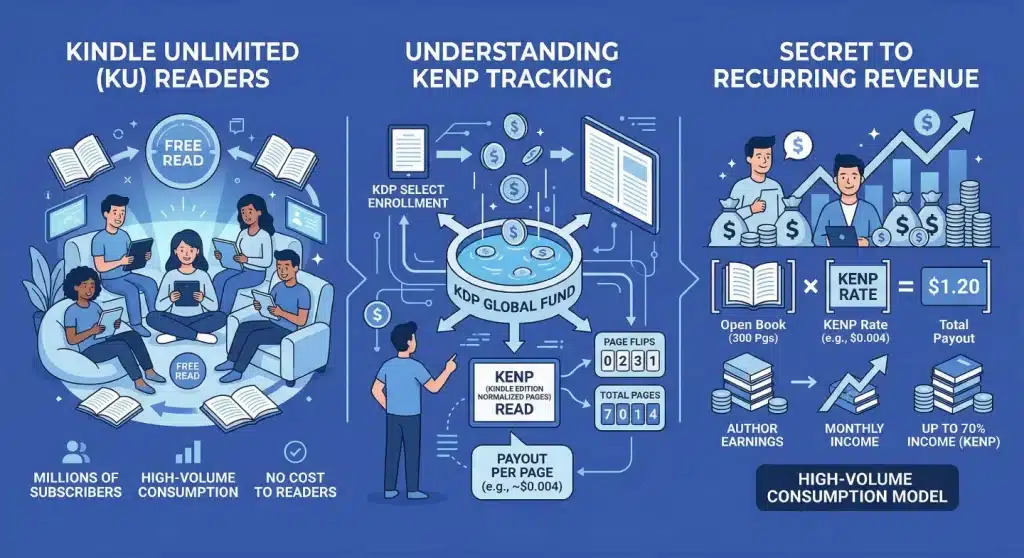
If you only look at direct book sales, you are missing out on one of the most lucrative revenue streams available to self-published authors: KDP Select and the Kindle Unlimited (KU) program. When you enroll your digital book in KDP Select, you grant Amazon exclusive distribution rights for your eBook. In exchange, your book becomes available to millions of Kindle Unlimited subscribers who can read your work for free.
But “free” to the reader doesn’t mean free to you. Amazon compensates KDP Select authors through the KDP Global Fund, a massive pool of money that is distributed based on Kindle Edition Normalized Pages (KENP) read. Every time a subscriber reads a page of your book, you earn a fraction of a cent. While the exact payout fluctuates monthly based on the size of the fund and total global readership, it generally hovers around $0.004 per page.
This means if a reader finishes your 300-page thriller on Kindle Unlimited, you earn roughly $1.20. While that might sound small compared to a direct sale, the frictionless nature of Kindle Unlimited means readers are far more likely to take a chance on an unknown author. Many top-earning publishers find that up to 70% of their monthly income is generated entirely through KENP page reads. It transforms publishing from a pure sales game into a high-volume consumption model.
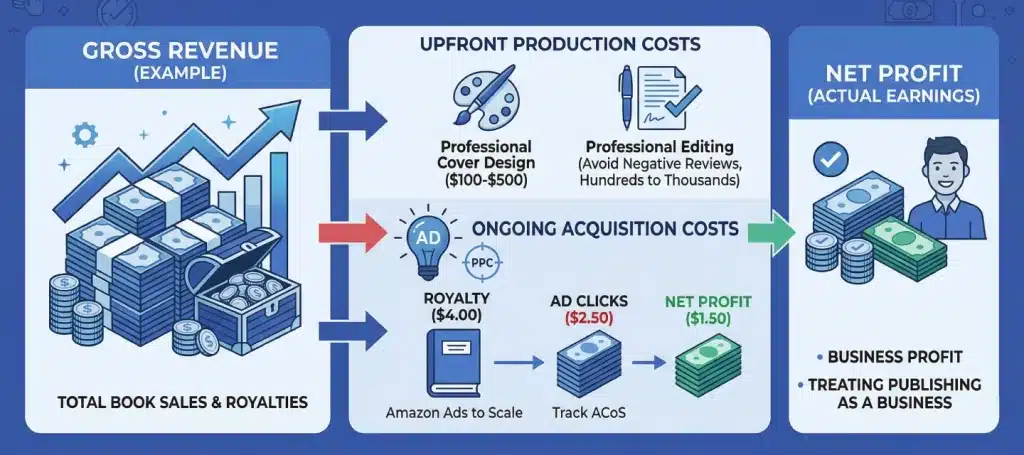
Seeing top authors boast about making $10,000 a month on Amazon KDP is inspiring, but it’s crucial to separate gross revenue from net profit. Publishing a book that actually sells requires treating your catalog like a business, which means making upfront investments and managing ongoing operational costs.
First, there are the production costs. In a hyper-competitive marketplace, readers judge books by their covers. A professional, genre-specific cover design can cost anywhere from $100 to $500. Additionally, skipping professional editing is the fastest way to accumulate negative reviews that will kill your book’s algorithmic momentum. Depending on word count, developmental and copy editing can run an author several hundred to a few thousand dollars.
Then comes the ongoing cost of customer acquisition: Amazon Ads (PPC). Organic reach on Amazon is fantastic, but scaling your earnings almost always requires running sponsored product campaigns. If you make $4.00 in royalties per book sale, but it costs you $2.50 in ad clicks to acquire that customer, your actual net profit is $1.50. High-earning publishers meticulously track their Advertising Cost of Sales (ACoS) to ensure their marketing spend isn’t cannibalizing their royalties. When calculating your earning potential, always budget for these variables; they are the investments that separate hobbyists from professionals making a full-time living.
We touched a bit on royalties and how they work previously. Now it’s time to figure out how that results in deposits into your bank account.
Amazon KDP has its own reporting system and it’s not more user-friendly than your seller dashboard. You can review sales, estimated royalties and more using that system.

KDP will also send you some cryptic emails about “Remittance Advice”, but they never include amounts. It’s just and indicator that you’ve sold books for the month.
When you set up your Amazon KDP account, you will input your bank account information at that time. Bank transfers (EFT) or check are the only methods of payment depending upon your location.
Payments happen like clockwork – every month, around 60 days after the end of the month in which the sales occurred, contributing to your Amazon KDP revenue. So, for sales in January, you’ll see those royalties hit your bank account in March.
As an Amazon seller, you’re already familiar with how taxes work. You’ll be required to fill out or submit a W9 form when you set up your account.
Amazon will issue you a 1099 at the end of each year and you’ll be responsible for paying your own income tax on your Amazon KDP income.
Generating KDP earnings sounds interesting, but executing a profitable launch requires a distinct set of skills. Just like launching a physical FBA product, you need to optimize your listings for the Amazon A9 search algorithm while actively driving high-converting traffic. Here is the exact five-step playbook to maximize your discoverability and sales.
To see if your book idea is profitable, your research must start on Amazon itself. Avoid broadly saturated markets. For example, romance is fiercely competitive; to succeed, you must niche down into sub-genres like paranormal romance or historical romance. Check the Best Sellers Rank (BSR) of top competitors in your target categories and download a few of their books. Monitoring these trends ensures you are riding the waves of established reader interest rather than guessing what the market wants.
You can no longer jump the fence and churn out mediocre books. In recent years, KDP has been flooded with low-effort, AI-generated content. In response, Amazon has implemented strict quality safeguards and mandatory AI-disclosure policies. Any attempt at a “churn and burn” strategy using unedited, bulk-generated text will likely result in immediate account suspension. Today, success requires professional editing, formatting, and a commitment to high-quality, human-led content. If you aren’t willing to invest in a premium publication, a low-quality book will simply be a waste of your time and ad spend.
People will judge your book by its cover. Just like your main product images for FBA, your book cover is your primary click-through mechanism. If an amateur cover fails to earn the click, your masterful writing will never be seen.
Once you earn the click, your pricing must close the deal. Pricing is a delicate balance on KDP. If you set your price too low, it implies low quality. At the same time, you must strictly adhere to the royalty tiers: to command the 70% eBook royalty, you must price between $2.99 and $9.99. Price competitively based on a deep analysis of your specific sub-genre’s averages.
As a seller, you already know that Amazon is primarily a search engine. Metadata is just a fancy term for the backend data that feeds this engine: your title, subtitle, author name, book description, and backend keywords.
You also must choose your categories carefully. Landing in the wrong category to “game the system” can result in the suspension of your KDP account. You can choose up to 3 categories, and they must be highly specific. If you write fantasy romance, categorize it precisely under “Paranormal Romance” rather than broad “Fiction.” This helps your book stand out in a sea of titles and connects you with readers who crave exactly what you’re offering.
In 2026, relying solely on Amazon’s internal search is leaving money on the table. Amazon’s algorithm heavily rewards listings that drive external traffic to the platform. Platforms like TikTok (specifically the #BookTok community) have become the most powerful free marketing engines for self-published authors.
Create dedicated author profiles on TikTok and Instagram to share visual hooks, behind-the-scenes writing processes, and aesthetic character teasers. Engaging with these highly active reader communities isn’t just for brand awareness; it is a direct driver of algorithmic momentum on your KDP listings. Combine this external social traffic with an email newsletter and a dedicated ARC (Advanced Reader Copy) team to ensure every new book launches with the required 15+ positive reviews to be considered “retail ready”.
The earning potential on Amazon KDP is virtually uncapped, but as we’ve explored, top-line revenue is only half the story. The authors generating $10,000+ per month in 2026 aren’t just uploading documents and hoping for the best; they are treating their catalogs like private label brands. They meticulously manage their cover design investments, optimize for Kindle Unlimited page reads, and ruthlessly track their Amazon PPC ACOS.
As an Amazon seller, you already have a massive advantage. You understand keyword intent, listing optimization, and the power of the Amazon algorithm. By applying these eCommerce principles to digital publishing, KDP becomes a highly viable, inventory-free path to expanding your business. If you are ready to explore self-publishing, we highly recommend immersing yourself in the strategies shared by industry leaders like Kindlepreneur and Self-Publishing with Dale to accelerate your learning curve.
We are SellerMetrics, our Amazon PPC Software helps Amazon sellers, brands, KDP Authors and agencies navigate Amazon Advertising PPC via bid automation, bulk manual bid changes, and analytics.
Earnings vary wildly based on catalog size and marketing. While many beginners make under $100 a month, authors who treat self-publishing as a business and utilize Amazon Ads frequently earn between $1,000 and $10,000+ per month.
KDP offers a 35% or 70% royalty on eBooks depending on your pricing strategy and geographic market. For print books (paperbacks and hardcovers), KDP utilizes a tiered system: you earn a 60% royalty on books priced at $9.99 or higher, and a 50% royalty on books priced below $9.99. In both cases, physical printing costs are deducted from your share.
Kindle Unlimited is a subscription service for readers. Authors who enroll their eBooks in KDP Select are paid from the KDP Global Fund based on the number of pages read (KENP), typically earning around $0.004 per page.
No, creating an Amazon KDP account and uploading your manuscript is completely free. However, successful authors invest money upfront for professional editing, cover design, and Amazon PPC advertising.
Amazon KDP pays royalties on a monthly basis, approximately 60 days after the end of the calendar month in which the sales or page reads occurred.
Yes, thousands of independent publishers make a full-time living on Amazon. Doing so requires publishing multiple high-quality books in profitable niches, mastering Amazon Ads, and building an email list of dedicated readers.
While highly competitive, low-content books like specialized journals, planners, and logbooks can still be profitable. Success in this category now requires exceptional interior design, premium covers, and highly targeted niche research.
Amazon KDP will provide you with a free, basic ISBN for your print books, which can only be used within the Amazon ecosystem. For eBooks, an ISBN is completely optional.
If your eBook is priced between $2.99 and $9.99, you should almost always select the 70% royalty option. If you are pricing a short promotional read at $0.99, you are required to choose the 35% royalty tier.
Print costs are deducted directly from your royalty share (which is 60% for books priced $9.99+ and 50% for books under $9.99). For example, if you sell a $14.99 paperback, your 60% royalty is $8.99. If the print cost is $4.45, your final take-home profit is $4.54 per book.

1 January 2025
TweetLinkedInShareEmailPrint You have spent your blood sweat and tears writing your shelf-published e-Book/pa...

23 November 2021
TweetLinkedInShareEmailPrint Alright, the manuscript has been written and you are excited to publish your new...

28 May 2021
TweetLinkedInShareEmailPrint Great! Now that you have finished writing your book and performed the final edit...