5 April 2026
The MCP Blindspot: How to Feed Real-Time FBA Margins into Claude Code
TweetLinkedInShareEmailPrint 20 min read By Rick Wong Updated Apr 05, 2026 TL;DR Why is my AI ad tool d...

 23 November 2025

Article of Contents
When you dig into how the Amazon marketplace functions, it becomes clear that success is not just about keywords, images, or price alone. What separates the listings that truly dominate from the ones that wobble is the combination of social proof and algorithmic trust: how many people have reviewed the product, and what average rating do those reviews reflect.
Many sellers underestimate how strongly reviews influence every step of a shopper’s decision. Shoppers use reviews as quick shortcuts since they cannot test the product. Reviews are social proof and quality signals rolled into one.
From a scientific standpoint, we can think of review count as a signal of popularity and historical demand, and average rating as a signal of quality and buyer satisfaction. Together, they influence how Amazon’s search algorithm treats your listing, how many people click through from the results page, and ultimately how many convert once they get to your detail page.
Let’s examine each of those three phases (visibility, CTR, conversion) in turn, bringing in data where available, and then pool the implications into a strategic takeaway for Amazon sellers.

Amazon uses a complex algorithm commonly called the A9 (or its successor variants) to decide which listings to show in search results and in what order. While Amazon does not publish its exact formula, numerous industry analyses, seller surveys, and research point clearly to customer feedback (reviews and ratings) being a meaningful factor. This is why a new product with zero reviews often struggles, even with strong keywords.
Review count matters.
Sources show that Amazon listings with more reviews have a stronger competitive position. One data point: a study of Indian books on Amazon.in found that the number of reviews had a significant positive effect on sales rank (used as a proxy for ranking/visibility). Specifically, in both ‘bestseller’ and ‘recent’ categories, the regression analysis found that higher numbers of reviews improved the sales‐rank outcome.
Another benchmark: Across Amazon’s U.S. catalog, the average product has about 40 reviews; many successful listings push beyond 50+ reviews.
Average rating matters.
The same studies show that higher average star ratings (and a higher proportion of five-star reviews) correlate with better outcomes. In the Indian books study, the average star rating and share of five-star reviews positively influenced sales (and thus rank) in both categories. Further commentary from marketplace-analysis content notes that Amazon’s algorithm “penalises low ratings” and de‐prioritises listings with weak review performance.
Mechanism of influence.
From an algorithmic perspective, Amazon seeks to surface listings that are likely to convert and maintain customer satisfaction. Amazon’s business model rewards sales and repeat business.
When a listing has many reviews and a high average rating, it signals that many buyers have purchased and been satisfied. That historical performance helps the algorithm trust that future customers will also buy and be satisfied. Thus, the listing is more likely to appear higher in search results, for more relevant keywords, and earlier in the buying funnel.
Additional nuance: review velocity and recency.
While review count and average rating are the headline numbers, secondary factors matter. For example, how quickly reviews are being added (“velocity”), and how recent the reviews are, may also signal freshness and ongoing relevance. Shoppers trust products that look active, not abandoned. A steady stream of new reviews signals that real buyers continue to pick your product.
One study of Amazon’s review system argued that review time-decay (older reviews losing relevance) and reviewer credibility are significant factors in review usefulness. Thus, a listing that grew to 300 reviews two years ago but has had zero new reviews recently may underperform relative to one that continues to accumulate new reviews.
Summary for visibility.
In sum: more reviews + higher average rating → stronger historical performance signal → algorithm trusts the listing and gives it more visibility. Conversely, a low review count or poor rating may limit visibility even if other listing elements are solid.
Once your listing gets positioned in search results, the next crucial step is whether shoppers click through to the product page. The review count and rating affect this stage in several measurable ways.
Social proof at the results level.
When a shopper scans Amazon search results, many listings display star ratings (e.g., 4.6 out of 5) and review count (e.g., 1,234 reviews). These are quick heuristics for credibility. A listing with “4.8 (1,200)” reviews is psychologically more appealing than one with “3.9 (23)”. The mere presence of many and mostly positive reviews triggers the “safe buy” instinct. Most buyers decide within seconds which listings to ignore. Buyers scroll fast, so listings with weak ratings rarely get a second look.
Quantitative data.
A market study by PowerReviews found that 96% of consumers read reviews on Amazon. In a separate survey of Amazon review data by Traject Data, they reported that a one-star increase in average rating correlated with a 26% boost in sales. A small rating change can shift buyer behaviour more than most sellers expect.
While that is sales, sales are the end result of conversion, which begins with clicks; thus, it strongly implies CTR and conversion improvements.
Another study indicated that 82% of respondents reported changing their purchase decision based on reviews.
Mechanism of influence on CTR.
At the search results page, a higher rating and a large review count act like endorsements. Shoppers scanning results are more likely to click the listing that appears “crowd-approved.” That means your listing is not just positioned well politically (via algorithm) but visually stands out in the list of results.
A higher CTR further signals to Amazon that your listing is engaging users in a measurable way, which reinforces ranking. In effect, the review metrics have a dual role: direct influence on shopper behavior and indirect influence via algorithmic feedback.
Additional nuance: review count thresholds and review count as a differentiator.
While there is no publicly published Amazon threshold for reviews, marketplace practitioners often observe that the difference between 20 and 200 reviews is immense in terms of consumer trust and CTR lift. The “number of reviews” functions as a trust marker: at low levels, the listing looks new or unproven; at high levels, it looks mainstream and safe. One benchmark study noted that 65% of consumers preferred products with 51+ reviews.
Summary for CTR.
Once visible, your listing’s ability to attract clicks is strongly influenced by the review count and average rating. Higher ratings and more reviews raise perceived legitimacy, which increases CTR, which in turn further boosts algorithmic ranking because Amazon sees more clicks relative to impressions.
The final stage is conversion: when a shopper lands on the product detail page and makes a purchase. Here, review count and average rating arguably have their strongest measurable impact. At this point, the shopper wants reassurance, not more features.
Impact on purchase decision.
The underlying psychology is straightforward: shoppers purchasing online cannot physically inspect the product, so they rely heavily on other buyers’ experiences. A high average rating (4.5–5 stars) and decades of reviews mitigate perceived risk. Research shows that positive review sentiment correlates with purchase intent. In the Indian books study, the average star rating and share of five‐star reviews had positive statistical significance for sales.
Additionally, a survey found that 79% of U.S. consumers use Amazon reviews to inform purchasing decisions.
Impact in high competition.
Because many entrants may have comparable pricing, keywords and images, reviews become a key differentiator. A listing with better review metrics outperforms competitors even when features are similar. The more reviews you have, the more “evidence” of quality you provide, and the better your conversion rate tends to be.
Quantitative benchmarks for conversion.
While Amazon does not publicly disclose conversion rates by review tiers, industry benchmarks show that average conversion rates on Amazon might lie in the 10-15% range (depending on category). Sellers who optimize review metrics often report conversion rate lifts of 15-25% through review-driven listing improvements.
Mechanism of influence on conversion.
Review count and average rating affect conversion through multiple pathways:
Review extremes and negative rating risks.
On the flip side, listings with low average ratings (e.g., under 3.5 stars) often see conversions drop sharply. Industry commentary notes that Amazon’s algorithm may penalize low-rated listings and push them down in search or deprioritize them for deals. Even a few negative reviews among many positives can disproportionately affect perception. One sharp negative review can slow down your sales momentum if it echoes a real issue.
Summary for conversion.
Review count and average rating are among the most potent levers for conversion on Amazon. When done well, they dramatically reduce friction in the buyer’s decision process, boost trust, increase purchase probability, and reduce churn (returns), all of which enhance both immediate sales and long-term ranking.
Strong review metrics create a snowball effect that works in your favour. To maximize listing performance, you must treat review count and average rating as foundational metrics that propagate through all three stages:
Consider this hypothetical chain: a listing with 300 reviews at 4.7 stars will likely rank higher than a similar listing with 30 reviews at 4.0 stars. Because it ranks higher, it gets more impressions. Because shoppers trust it more, it obtains a higher CTR. Because it is trusted, it converts at a higher rate. Those conversions feed Amazon’s algorithm, reinforcing ranking and creating a virtuous cycle.
The converse chain is equally true: a listing with few reviews and a mediocre rating may struggle to break into higher ranking slots, attract fewer clicks, and struggle to convert, trapping it in a low-visibility loop.

Treat reviews like long-term assets, not a launch-only task. Here are strategies for how you should manage review count and average rating:
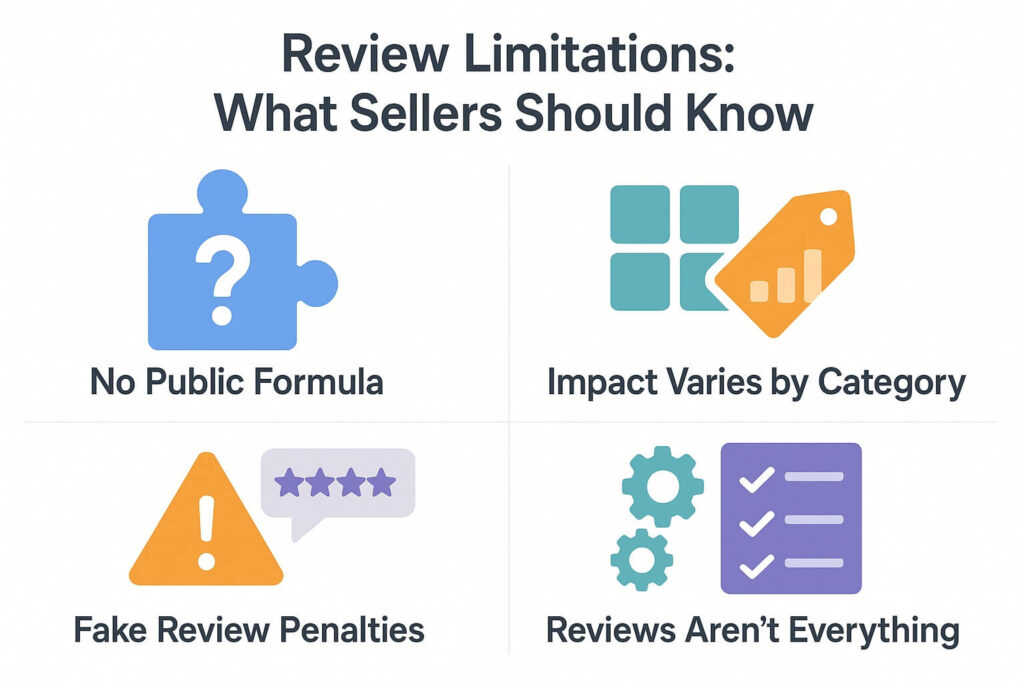
In the hyper-competitive Amazon marketplace, review count and average rating are more than cosmetic metrics. They are foundational signals that influence ranking, click behaviour, and conversion. The scientific research and industry data support a model where higher review volumes and better average ratings correlate with improved performance in all three stages of the funnel: visibility, CTR, and conversion.
In competitive categories, reviews often decide the winner between two similar products. For serious sellers, this means building a review strategy early, maintaining quality and momentum over time, and treating reviews as key infrastructure — not an afterthought.
Not directly in the way keywords or bids do, but the correlation is strong. Amazon’s algorithm rewards listings that consistently convert. Higher review counts and better average ratings increase conversion rates, which in turn lift organic visibility. Studies analyzing Amazon book sales and consumer behaviour (e.g., ResearchGate, 2022) found that both review volume and average rating had statistically significant positive effects on sales rank, the practical proxy for visibility.
There’s no universal threshold, but across most categories, listings with at least 50 verified reviews begin to see noticeable ranking improvement. Red Stag Fulfillment’s 2023 data showed that the average Amazon product had 40 reviews, while top-performing listings often had 200 or more. The competitive benchmark depends heavily on category maturity. In electronics or home goods, for instance, top listings often exceed 1,000 reviews.
They work together but serve different roles. Review count establishes popularity and purchase history; average rating signals satisfaction and trustworthiness. A large count with a low rating hurts conversions, while a high rating with too few reviews limits credibility. The most effective combination is both volume and quality: a minimum of 4.5 stars across a statistically credible sample size.
Yes, indirectly. A lower average rating reduces click-through rate and conversion, which the algorithm interprets as weakening buyer intent. Internal studies by pattern-tracking agencies such as Momentum (2023) show that every 0.1-point drop in star rating correlates with a measurable decline in Best Seller Rank stability, indicating that the algorithm reacts quickly to falling satisfaction signals.
The visible star rating and review count on the search results page act as social validation. When two similar listings appear side by side, the one with a higher star average and more reviews attracts more clicks. A PowerReviews study found that 96% of shoppers consult reviews before purchase, while behavioral heat-map testing shows that users’ eyes gravitate toward review stars more than titles or prices. High review metrics can increase CTR by 15-30% according to aggregated marketplace analyses.
While Amazon has never confirmed this directly, empirical evidence suggests it does. Listings with a steady inflow of new reviews tend to sustain better rankings than those whose last reviews are months old. Velocity signals current relevance, and fresh reviews indicate ongoing buyer activity, both of which support conversion predictability, a core input to Amazon’s ranking model.
Across categories, conversion rates climb steeply until around 4.7 stars and then plateau. Products rated below 4.0 often see conversion rates drop by half relative to those above 4.5. SalesDuo’s 2024 benchmark report estimates that moving from 3.5 to 4.8 stars can produce a 12-18% conversion rate lift depending on category and price point.
A few balanced critiques can actually enhance credibility. However, when negative sentiment outweighs positive sentiment, conversion declines sharply. The key is ratio: shoppers are tolerant of up to 10-15% critical reviews if the rest are consistently positive and specific. What hurts most are patterns — repeated complaints about the same issue. Addressing these through improved product quality or transparent responses can mitigate long-term damage.
No, not anymore. Amazon’s detection algorithms and enforcement policies (enhanced since 2022) now identify suspicious review patterns, remove fake reviews, and penalize sellers with suppressed listings or even suspensions. The 2025 CMA–Amazon compliance report confirmed that manipulated review profiles are actively being purged. Authentic, verified-purchase reviews remain the only sustainable path.
Use Amazon Business Reports and Brand Analytics to monitor unit session percentage (conversion) and sessions (traffic) over time. Correlate changes in these metrics with fluctuations in review count and rating. If you observe that incremental reviews coincide with sustained improvements in conversion, your hypothesis is validated. For external insight, tools like Helium 10 or DataHawk can model correlation between review trends and keyword ranking shifts at the ASIN level.

5 April 2026
TweetLinkedInShareEmailPrint 20 min read By Rick Wong Updated Apr 05, 2026 TL;DR Why is my AI ad tool d...

4 April 2026
TweetLinkedInShareEmailPrint 8 min read By Rick Wong Updated Mar 30, 2026 TL;DR What is the difference ...

31 March 2026
TweetLinkedInShareEmailPrint 8 min read By Rick Wong Updated Mar 30, 2026 TL;DR What exactly is the Uni...