9 March 2026
The Complete Guide to Amazon PPC Product Targeting
TweetLinkedInShareEmailPrint 18 min read By Rick Wong Updated Mar 10, 2026 TL;DR Why should new sellers...

 12 January 2026
Amazon has shifted from a “Keyword” engine to an AI-driven “Answer Engine” (Rufus). The algorithm now prioritizes “Persona Signals”—such as visual context, review sentiment, and return rates—over simple text matching. You must optimize for who the buyer is, not just what they type.
The new “Predictive Pacing” algorithm now spends aggressively during predicted high-conversion hours (usually mornings). To fix this, do not just raise your budget; instead, use “Intraday Budget Rules” to artificially cap morning spend or boost bids specifically for the evening rush (6 PM – 10 PM).
Switch from keyword-only targeting to “Persona Portfolios” using the Amazon Marketing Cloud (AMC). By targeting behavioral signals—like “Competitor Cart Abandoners” or “Window Shoppers”—you can reach buyers before they search, often achieving higher ROAS than expensive keyword battles.
My click-through rates are dropping. What should I change?
If you are reading this, you likely just survived the most volatile Q4 in Amazon’s history. For many sellers, Q4 2025 was the first time Amazon PPC felt unpredictable, even with strong listings and proven keyword structures in place.
We all saw it coming, but few were truly prepared for the sheer scale of the shift. In November 2025, during the “unBoxed” conference in Nashville, Amazon didn’t just announce new features, they effectively deprecated the strategy that has powered our businesses for a decade. The era of “Keyword Dominance” is officially over. The era of “Signal-Based Marketing”—or as the seller community has started calling it, Persona Targeting—has begun.
This shift caught many experienced advertisers off guard because it changed how Amazon decides who sees ads, not just which ads appear.
I’ve spent the last eight weeks inside the war rooms of 7-figure and 8-figure brands. I’ve watched daily budgets vanish by 10:00 AM EST due to the new “Predictive Pacing” algorithms. I’ve seen Cost-Per-Clicks (CPCs) on “exact match” terms skyrocket while conversion rates flatlined. But I’ve also seen a new breed of seller emerge: one who abandoned the old “text-match” religion and embraced the “Video-First” and “Persona-First” reality.
This isn’t just another “tactic” update. This is a fundamental rewriting of the Amazon A9 algorithm (now effectively the “Rufus” algorithm). If you are still structuring your campaigns primarily around what people type rather than who they are, you are fighting a war with weapons from 2024.
This guide is your manifesto for 2026. We are going to break down exactly what changed, why your “Exact Match” campaigns are bleeding money, and how to build the new “Persona Portfolios” that will define the winners of Q1.
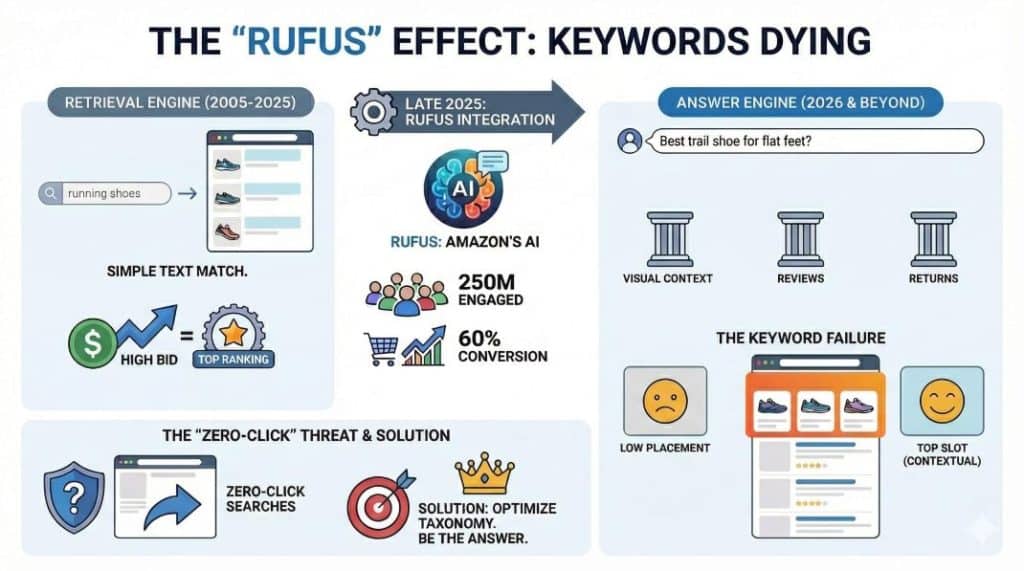
To understand why your ads are failing, you have to understand how the Search Engine Results Page (SERP) changed in late 2025.
For twenty years, Amazon was a “Retrieval Engine.” A user typed “running shoes,” and Amazon retrieved a list of products containing the text string “running shoes.” Simple.
With the full integration of Rufus (Amazon’s generative AI assistant) into the mobile app and desktop experience, Amazon has become an “Answer Engine.”
According to data released in Amazon’s Q3 2025 report, over 250 million customers have now engaged with Rufus. More importantly, shoppers who use Rufus are 60% more likely to convert. Why does this matter to you?
Because Rufus doesn’t care about your keyword density.
When a shopper asks Rufus, “What is the best trail running shoe for someone with flat feet?”, the AI does not simply look for the keyword “flat feet” in your title. It analyzes:
Rufus evaluates shopper behavior, content signals, and engagement patterns before it considers keyword relevance. Exact match keywords still matter, but they no longer control reach on their own.
If you are bidding $5.00 on the keyword “trail running shoe” but your backend signals don’t align with the “flat feet persona,” Rufus will simply ignore you. Your ad impression won’t serve, or worse, it will serve in a low-visibility placement at the bottom of the page while the “Rufus Recommended” carousel steals the top slot.
We are seeing a massive rise in “Zero-Click Searches”—instances where a customer gets their answer from the AI summary and never clicks a product listing. In these cases, visibility now depends on whether your product helps Amazon answer the shopper’s question, not whether you outbid competitors. The only way to penetrate this shield is to be the source of the answer.
In 2026, Context is King. You can no longer brute-force your way to the top with high bids. You must optimize your “Taxonomy” (how Amazon understands your product) to match the “Persona” of the buyer.
This is the most critical shift for your 2026 strategy.
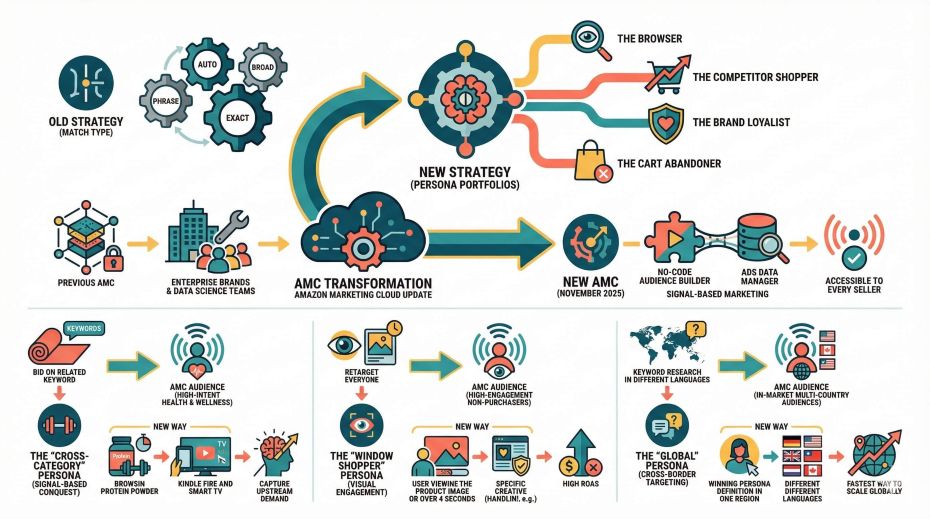
In the past, we structured campaigns by Match Type: Auto, Broad, Phrase, Exact. Now, the top sellers are structuring campaigns by Persona: “The Browser,” “The Competitor Shopper,” “The Brand Loyalist,” and “The Cart Abandoner.” This change forces advertisers to rethink campaign structure from a buyer-centric view instead of a keyword list.
This was made possible by the massive update to the Amazon Marketing Cloud (AMC) in November 2025. Previously, AMC was a tool for enterprise brands with data science teams. But with the release of the “No-Code Audience Builder” and “Ads Data Manager,” every seller can now access “Signal-Based Marketing.” These tools reduce the technical barrier that once limited advanced audience targeting to large brands.
A Persona Portfolio is a collection of ad campaigns (SP, SB, and SD) that target a specific behavioral signal rather than a keyword.
Here are the three “Personas” you need to build immediately:
Clear persona labels help teams align creative, targeting, and budget decisions.
If you haven’t audited your creative assets since October 2025, your listings are likely invisible.
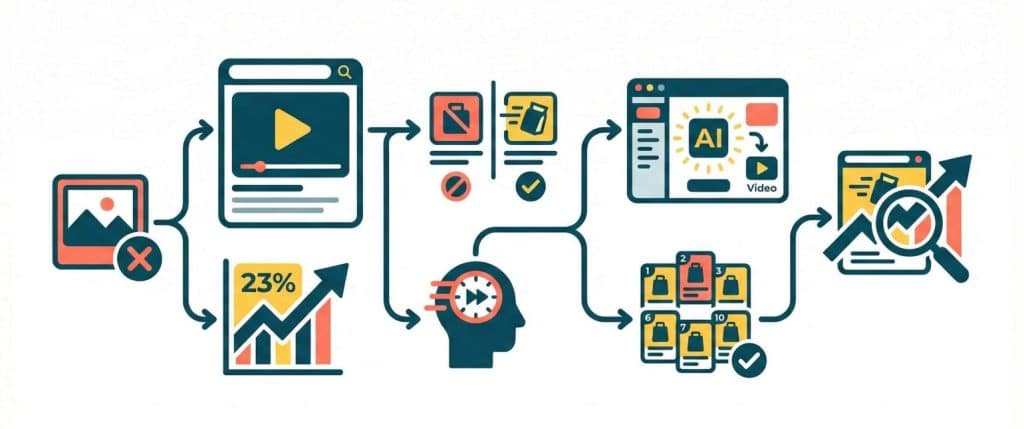
The launch of Sponsored Products Video (SPV) at unBoxed 2025 was the final nail in the coffin for static imagery. Listings without short, motion-focused video assets are already seeing reduced visibility in competitive search results.
Previously, “Video Ads” were banner ads (Sponsored Brands). Now, Sponsored Products Video integrates directly into the main search results.
Early beta tests from December 2025 showed a staggering 23% increase in Click-Through Rate (CTR) for SPV listings compared to static images. Higher engagement signals also improve ad eligibility across placements.
However, there is a catch. You cannot just use your old “lifestyle” videos.
Amazon’s new creative guidelines favor “High-Motion Product Demonstrations.”
Shoppers in 2026 have “TikTok Brain.” Their attention span is less than 2 seconds. If your product isn’t moving in the search results, it’s dying.
Action Item: You need to identify your top 10 selling ASINs. For each one, use the Amazon Video Generator (the AI tool updated in June 2025) or your creative team to produce a 6-second “Active Use” loop. Upload this as your primary SPV asset. This is not optional anymore; it is the baseline for visibility.
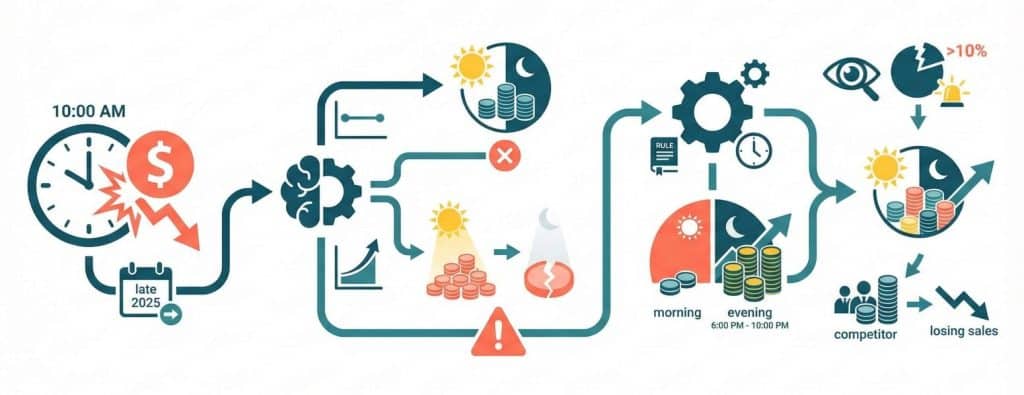
Let’s address the elephant in the room: The 10:00 AM Budget Crash.
Starting in late 2025, Amazon shifted its budget pacing algorithm from “Even Pacing” to “Predictive Conversion Pacing.” Many sellers first noticed this shift when campaigns exhausted daily budgets before midday with no manual changes applied.
The AI predicts when your specific customer is most likely to buy. If you sell coffee makers, the AI knows that 80% of your conversions happen between 7:00 AM and 11:00 AM.
If your budget is too low, you will run out of money by 10:00 AM. This leaves you invisible for the rest of the day, missing out on the “Second Wave” of evening shoppers.
You cannot fight the algorithm, but you can guide it.
Rules help rebalance spend without fighting Amazon’s automated systems directly.
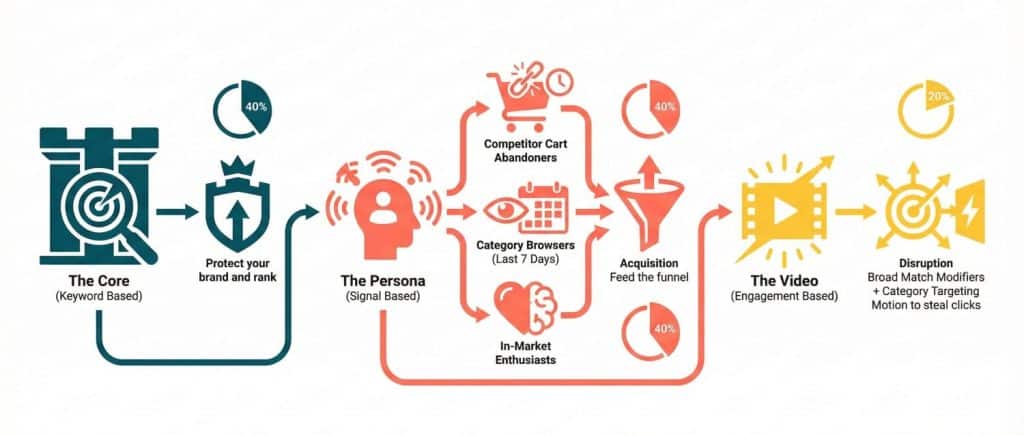
So, how do you put this all together? You cannot abandon keywords entirely; they still capture high-intent search traffic. But you must layer the new “Persona” strategies on top. A blended structure allows you to protect existing demand while creating new demand through behavioral signals.
Here is the recommended “Hybrid Structure” for a healthy US Amazon account in 2026:
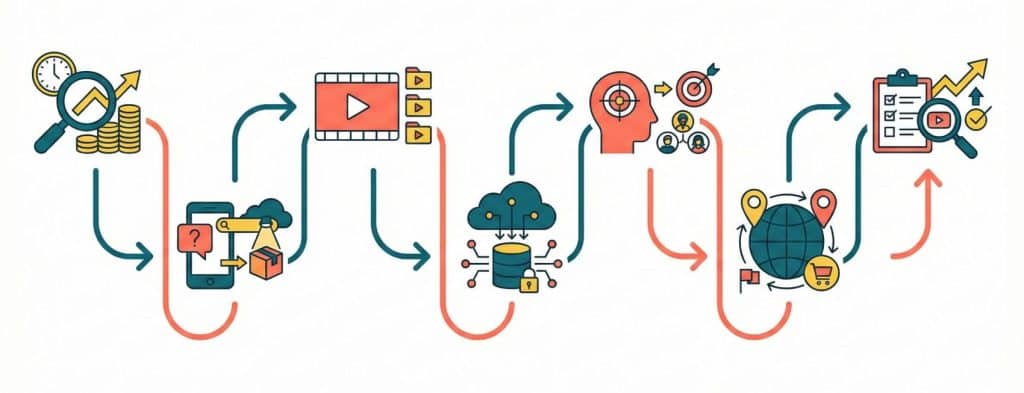
Information without action is just entertainment. Here is exactly what you need to do over the next week to “2026-Proof” your Amazon business.
I don’t say this lightly: The gap between the “Haves” and the “Have-Nots” on Amazon is widening faster than ever.
The “Haves” are the sellers who understand that Amazon is now an AI-driven Signal engine. They are feeding the beast with video, structuring around personas, and using AMC to snipe customers that their competitors don’t even know exist.
The “Have-Nots” are still downloading Search Term Reports, adding negative keywords, and wondering why their ACOS (Advertising Cost of Sales) keeps creeping up every month.
The tools are there. The “No-Code” AMC builder has democratized data that used to cost $50k/month to access. The Video Generator has democratized creative production. You have no excuses left.
Sellers who adapt early gain efficiency, while those who delay face rising costs with declining control.
The algorithm has evolved. Have you?
No, there is no specific “Rufus Campaign” type yet. However, Rufus pulls data from your organic listing details and your Sponsored Product relevance. The best way to “target” Rufus is to ensure your listing text answers specific natural language questions (e.g., “Is this dishwasher safe?”) and that you are running Sponsored Products on broad, problem-solution based keywords.
Not necessarily. If you just increase the budget, the new “Aggressive Pacing” algorithm might just spend that extra money by 11 AM. Instead, use “Intraday Budget Rules” to artificially cap spend in the morning or boost bids in the evening. This forces the system to pace itself better.
Placement and Intent. Sponsored Brands Video (SBV) usually appears as a banner at the very top of the page. It is great for Brand Awareness. Sponsored Products Video (SPV) appears in the search results, mixed with organic listings. SPV is much better for driving direct clicks and conversions because it catches the shopper in “browse mode.”
As of November 2025, yes, you need it. Amazon released a “No-Code” interface that makes it as easy as using Facebook Ads Manager. If you aren’t using AMC, you are missing out on the ability to target “Cart Abandoners” and “High-Intent Browsers.” Your competitors are using it to retarget your traffic.
It is a strategic term for grouping your campaigns by “Who the buyer is” rather than “What they typed.” For example, instead of a “Running Shoes” campaign, you might have a “Marathon Runner Persona” portfolio that targets specific behaviors (buying energy gels, viewing Garmin watches) using AMC audiences.
Yes, Amazon explicitly allows and encourages this. Their “Video Generator” tool (found in the creative console) can turn your product images into short motion clips. However, human-shot “User Generated Content” (UGC) generally still performs better for conversion because it looks more authentic.
It allows you to take an audience segment from the US (e.g., “Camping Enthusiasts”) and target that same behavioral profile in another country like Germany. Amazon matches the signals (browsing similar category items), so you don’t have to rebuild the audience from scratch in the local language.
This was likely due to the widespread adoption of “Performance+” campaigns (announced at unBoxed). These AI-driven campaigns bid aggressively on high-conversion placements. If you are still manual bidding, you are often being outbid by these automated systems during peak conversion moments.
No, but its role has changed. Exact Match is now for protection (defending your brand and core terms). It is no longer the best way to grow. For growth, you need Broad Match (to feed Rufus signals) and Persona Targeting (to find new audiences).
“New-To-Brand (NTB) ROAS.” With the market becoming saturated, simply recycling the same customers isn’t enough. You need to use AMC to track how efficient you are at acquiring new customers. If your NTB ROAS is dropping, your business will eventually shrink.

9 March 2026
TweetLinkedInShareEmailPrint 18 min read By Rick Wong Updated Mar 10, 2026 TL;DR Why should new sellers...
27 February 2026
TweetLinkedInShareEmailPrint 8 min read By Rick Wong Updated Feb 27, 2026 TL;DR What is the optimal len...
18 February 2026
TweetLinkedInShareEmailPrint 8 min read By Rick Wong Updated Feb 18, 2026 TL;DR Is AMC free and availab...