
13 June 2026
Amazon Multi-Touch Attribution: What Sellers Need to Know in 2026
TweetLinkedInShareEmailPrint 8 min read By Rick Wong Updated Jun 13, 2026 TL;DR What is Amazon Multi-To...

 5 April 2026
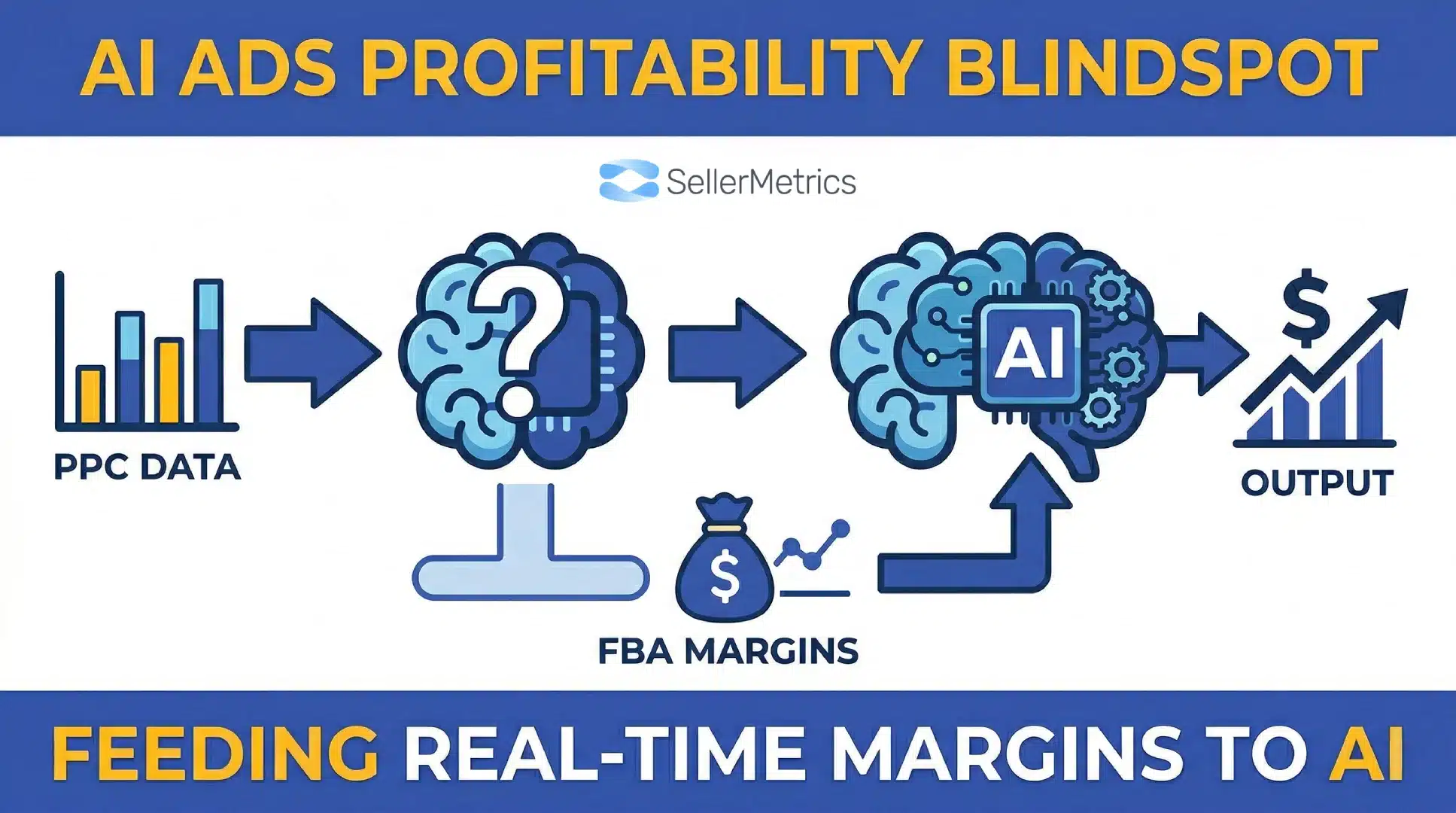
Most AI ad tools only look at surface-level advertising data, completely ignoring your actual fulfillment costs, storage fees, and true cost of goods. Because of Amazon’s highly dynamic fee structure, a campaign that looks incredibly successful on an ad dashboard might actually be eroding your real profit margins behind the scenes.
It absolutely can if left unchecked. An AI optimizing purely for sales will aggressively increase bids on your top-performing products, entirely unaware of your dwindling warehouse inventory or delayed freight shipments. Pushing a low-stock product too hard accelerates stock-outs, which can severely damage your organic search rankings and long-term visibility.
You must ground the AI in your actual business reality by giving it access to a local data file containing your true inventory levels and profit margins. By using highly structured, “profit-aware” prompts, you can force the AI to calculate against your actual breakeven points before it makes a single adjustment.
Not at all. The smartest automation strategy utilizes a “human-in-the-loop” safeguard. You can instruct the AI to do the heavy lifting of data analysis and output a structured execution proposal, allowing you to manually review and approve the bid changes before they are pushed live to Amazon.
Amazon PPC (Pay-Per-Click) is evolving fast, especially as it becomes more connected with broader strategies like Amazon SEO Strategy, Services, the relationship between Amazon SEO and PPC, and how the Amazon A9 algorithm ranks products.
Tasks that used to take hours, like downloading reports, reviewing spreadsheets, and uploading bulk files, can now be handled using artificial intelligence (AI), including tools like ChatGPT Amazon listing optimization. What once required manual work can now be completed in seconds, impacting workflows like Amazon Listing Optimization Services.
With Claude Code connected to the Amazon Ads MCP (Model Context Protocol) server, sellers can analyze campaigns, identify inefficiencies, and adjust bids using simple prompts. What used to be a manual workflow is now handled through natural language commands and direct API (Application Programming Interface) execution.
While this may feel revolutionary, it has created one major constraint. The AI can only work with the data it has access to, similar to emerging Amazon rufus optimization strategies that rely on structured data inputs.
The MCP server communicates directly with Amazon Advertising API, so it has access to advertising metrics such as click-throughs, spend, CTR, conversions (benchmarks like What is a good CTR for Amazon Ads), and average cost of sale (ACoS), including metrics such as Click Through Rate.
However, it cannot access the data that determines actual profitability, such as current inventory, cost-of-goods, shipping costs via Fulfillment By Amazon (FBA), or even real-time margin per SKU, which often leads to costly Amazon FBA mistakes when decisions are made without full data visibility.
This is where the blindspot becomes a problem. AI can optimize campaigns based on ad performance across different formats, including Amazon Kindle Advertising Strategy, while making decisions that negatively impact the business underneath, like scaling products that are close to running out of stock or pushing spend on low-margin ASINs.
It can even improve ACoS while quietly reducing profit, which highlights the real risk of agentic Amazon advertising, similar to evolving strategies in Amazon ads & Amazon DSP. Fast execution does not matter if the system is optimizing against incomplete data.
In this guide, we break down how this blindspot works and how to fix it by feeding real-time profitability data into Claude Code, so your automation drives actual profit instead of surface-level performance.
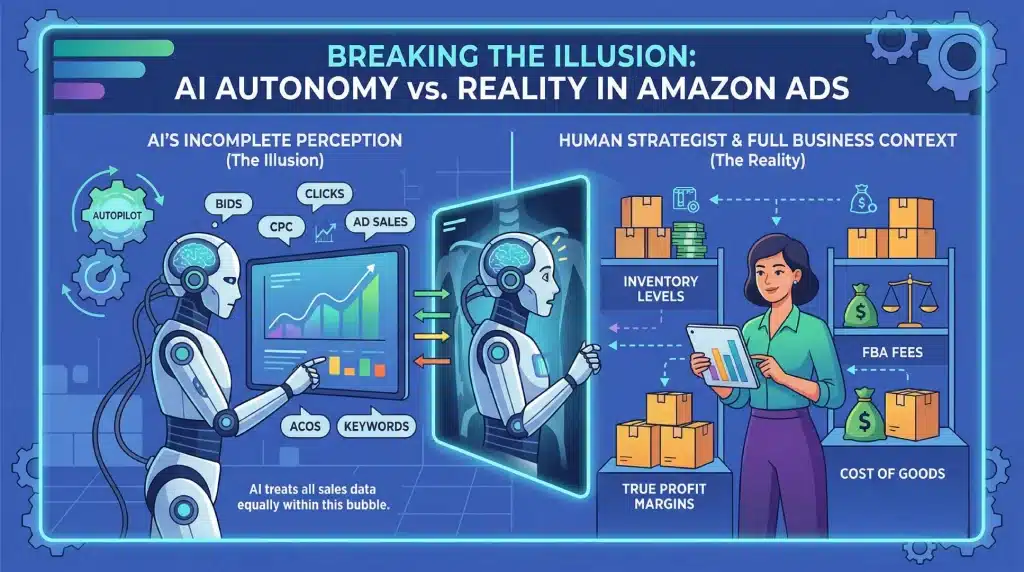
There’s a growing misconception in the Amazon seller space that AI can fully take over PPC management, replacing traditional advertising management workflows and even advanced Amazon PPC Software. Tools like Claude Code move quickly, so it’s easy to assume campaigns can run on autopilot.
When Claude Code connects to the Amazon Ads MCP server, it pulls in advertising data such as campaigns, keywords (including insights from Reverse keyword search Amazon), bids, clicks, CPC, ad-attributed sales, including formats like sponsored video ads, and strategies such as Amazon Search Term Optimization.
A human strategist approaches this differently by looking at advertising data alongside inventory levels, FBA fees, and actual profit margins before making decisions. That added context allows for better control and more accurate decisions.
AI does not do this on its own unless it is explicitly given access to that information. If margin and operational data are missing, the system treats every sale as having the same value, and that’s where problems start.
This is where the illusion starts to break. The AI may appear autonomous, but it is only optimizing within a limited and incomplete view of the business.
To eliminate this weakness, it’s necessary to understand how Amazon works with data (see full Amazon Abbreviation List for key terminology). Amazon does not store all your data in just one location; therefore, you cannot view all of the information about you through a single application.
Each of Amazon’s APIs serves a specific purpose and comes with its own limitations. There are two which we care most about now: The Amazon Advertising API and the Selling Partner API (SP-API).
Claude Code connects to the Advertising API through the Amazon Ads MCP server. That’s what lets it manage campaigns, adjust bids, and look at performance metrics like clicks, spend, conversions, and ACoS.
At that point, it looks complete, but it isn’t.
The data that actually affects profit sits somewhere else, inside the SP-API. That’s where inventory levels, FBA fees, shipment status, pricing, and other operational details live. These are the parts that actually determine whether a product is profitable.
There’s no built-in connection between these systems. Claude Code can’t pull that data on its own, so it ends up working with an incomplete view of the business.
That’s the gap.
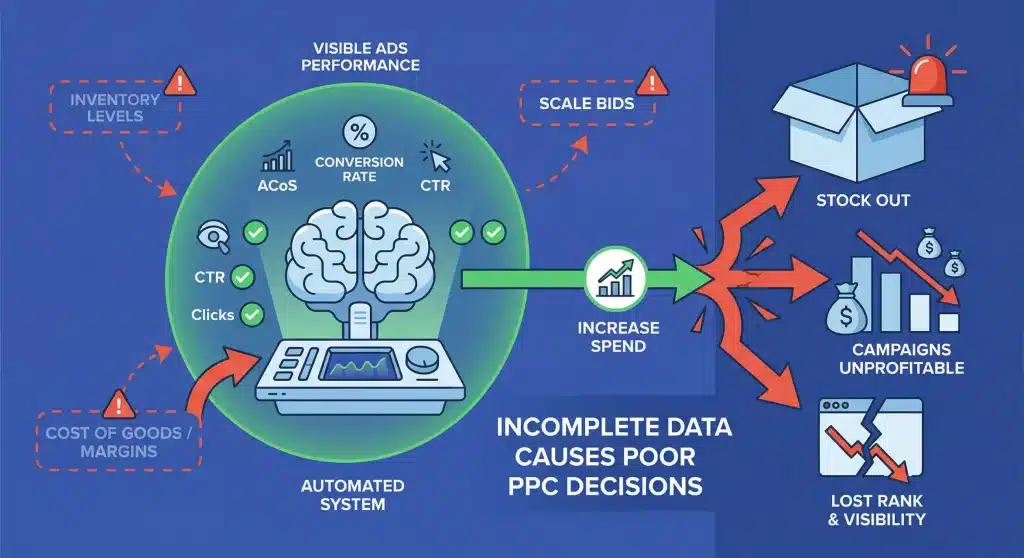
The risk increases once automation becomes part of your PPC strategy. Once an automated system executes an action like bid changes, that decision is based only on the data it can see. The logic may be sound, but the outcome can still be wrong due to missing business data.
You have a high-performing garlic press. Your ad metrics show a very small ACoS, excellent conversion rates, and decent CTRs, along with hidden ranking factors like Backend search terms Amazon. With these great numbers, this product seems worth scaling.
If you instruct Claude Code to increase bids on top-performing ASINs, it will follow that direction based on the available data, without factoring in rising costs like Amazon CPC online advertising. From its perspective, increasing spend will likely generate more profitable sales.
What it cannot see is your inventory situation, especially if you only have limited stock remaining and your next shipment is delayed. That decision can accelerate a stock-out and create long-term damage beyond just lost sales.
Stock-outs affect your organic rankings, visibility through Amazon Posts, reduce your Best Sellers Rank and ad performance, and force you to spend more on advertising just to recover your previous position. The AI executes correctly within its scope, but the business impact is negative.
The same issue applies to margins, since the AI has no visibility into your actual cost of goods or sudden increases in landed costs. It may treat a 25% ACoS as acceptable based on general benchmarks, even if your true breakeven point is lower.
Without that context, the system can optimize efficiently on the surface while gradually pushing your campaigns into unprofitability.
The MCP blindspot becomes even more dangerous because the fundamentals of selling on Amazon have changed significantly. ACoS used to be a more reliable metric (especially when compared to broader metrics like TACoS) when fees were simpler and more predictable.
That is no longer the case today. Amazon’s fee structure has evolved into a dynamic system where costs shift depending on inventory levels, logistics decisions, and sell-through rates.
If you are training AI to optimize toward a flat ACoS across your catalog, you are ignoring the factors that actually determine profitability.
Previously, costs were more stable, which made it easier to estimate margins and rely on ACoS as a performance metric.
But today, all of that has changed. Today sellers are forced to deal with costs that can change depending on a variety of business operations. Therefore, even if two products have the same ACoS value; there is no guarantee that they will generate the same amount of profit at one point in time or another.
Therefore, using just ACoS does not give you an accurate picture of a product’s real financial health.
Amazon now applies multiple layers of fees that change depending on how you manage inventory and logistics, increasing the overall advertising cost. These fees are not static, which means your actual margin per SKU is constantly shifting.
In addition to Ad Performance, the profitability of your product is impacted by: how inventory is placed; how fast it sells; and how long it sits in an Amazon warehouse.
Two SKUs can have completely different margins within the same week, which is one of the most overlooked Amazon FBA mistakes sellers make.
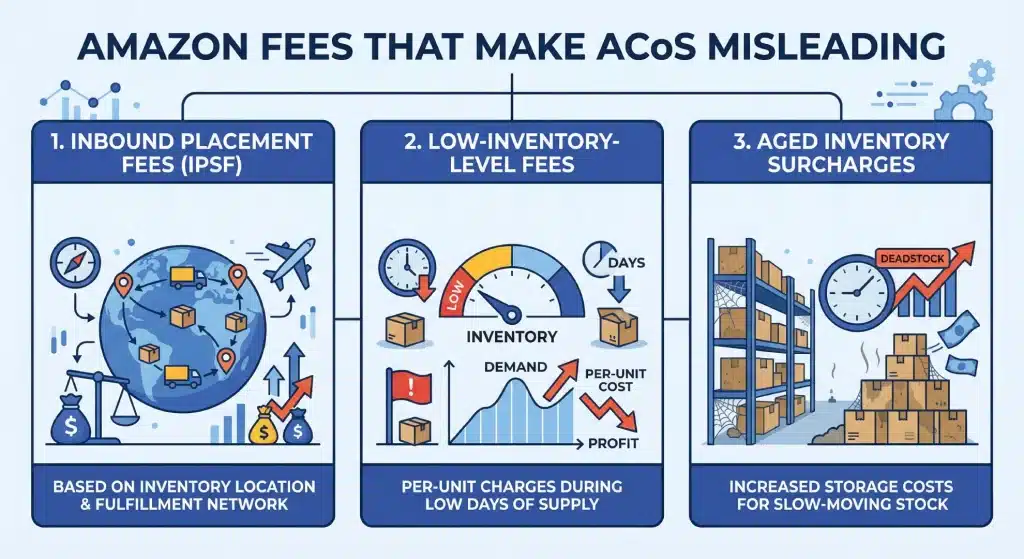
The first major shift in cost comes from Inbound Placement Fees (IPSF). IPSF allows Amazon to charge you based on where the inventory is placed throughout their fulfillment network. This will affect what you pay as a seller in terms of fulfillment for your products and will be based on how shipments are routed.
Secondly, low-inventory-level fees create an added level of complexity. For example when your Days of Supply fall under a specified number or level that Amazon has set; they apply additional charges per unit to each of your products. As such, your product becomes less profitable during periods of time when consumer demand is greatest.
Finally, aged inventory surcharges cause further reductions in profitability. If inventory levels remain high and there is a corresponding decrease in sale through rates, then this will increase storage costs and ultimately reduce margins.
Claude Code and similar third-party tools pull campaign data from the MCP server, which gives them a basic view of performance. If a campaign spends $100 on ads and generates $500 in sales, the system reads that as a strong 20% ACoS within the Amazon advertising auction environment. From an advertising standpoint, that looks efficient and worth scaling.
The issue with ACoS is that it only reflects two numbers, ad spend and revenue. It doesn’t include additional costs like dynamic fees or real-time margin changes. Additionally, if your product is experiencing low inventory fees, higher inbound freight costs, and similar expenses, then your profit after ad spend can be negatively impacted quite significantly.
Since the AI can’t view these additional costs, it views this campaign in terms of being profitable, therefore the AI will continue to increase spend. Therefore, what appears to be a very successful campaign may quietly erode the margin, or could potentially result in a loss.
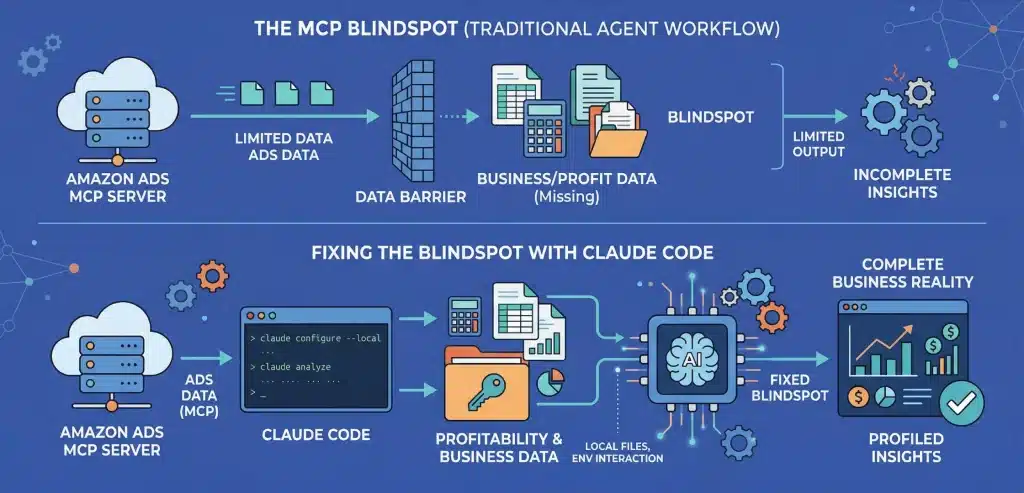
To fix the MCP blindspot, you need to understand how Claude Code actually operates. Unlike a browser-based AI, Claude Code runs locally through a command-line interface and interacts directly with your working environment.
This means it is not limited to MCP server data alone, unlike traditional workflows managed by an Amazon Seller Agency. It can read local files, execute commands, and use external data sources stored within your machine.
This is where the opportunity comes in, especially for sellers not relying on full-service Amazon account management services. Instead of relying only on the Amazon Ads MCP server, you can give Claude access to a second source of truth that contains your business and profitability data.
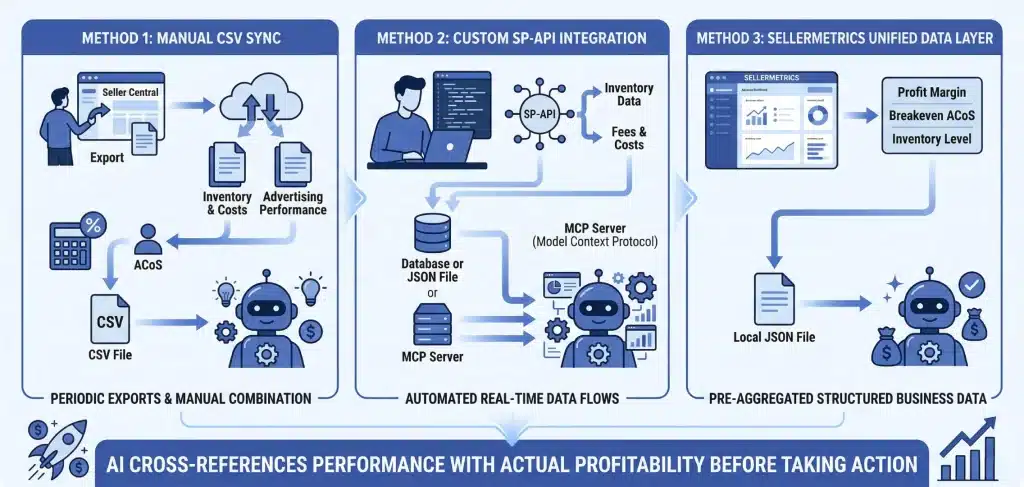
Claude Code can read local files stored in the same directory where it runs. This allows you to provide structured data that includes inventory levels, costs, and real margins.
By combining this local data with advertising data from the MCP server, you create a system where decisions are no longer based on ads alone. The AI begins to cross-reference performance with actual profitability before taking action.
This transforms Claude from a reactive bidding tool into a system based on business reality and long-term strategies on how to increase sales on Amazon.
Manual data syncing is one of the simplest ways to implement this system. Exporting all the relevant information from Seller Central on a periodic basis (inventory, fees, etc.), importing all your campaigns’ performance, then combining both together in a singular spreadsheet.
Then by using a formula you will determine your breakeven point ACoS, and save everything to a CSV file within your Claude work folder. Once you have done so, simply tell Claude to refer to that file prior to making any adjustments to bids.
Because this method includes business logic into the decision making process, it has value; however, due to its limitations of having to update the data manually and becoming outdated immediately after changes occur to the variables being tracked, this method quickly becomes less efficient.
A much more robust method is to build an integration directly into the Selling Partner Application Programming Interface (SP-API). With this type of implementation, developers create automated scripts which continue to collect inventory, fees, and other data into some type of database or JSON file.
From here, the developer makes this data accessible to Claude Code either via a file stored locally or via their own custom-made Content Provider Server (MCP).
With this method, Claude can access business data in conjunction with advertisement performance data simultaneously. While very effective, it does require a significant amount of technical expertise and resources. It’s also difficult to maintain the connections required when utilizing SP-API. Due to these factors alone, many sellers and agencies are unlikely able to successfully develop and sustain these types of systems.
An even more feasible option would be to utilize a tool like advanced Amazon PPC Software that already integrates both performance and profitability data sources.
Rather than developing your own system, you may import structured data from Seller Metrics into a local JSON file. This JSON file could contain critical business metrics including your current profit margin, your breakeven point ACoS, and your current inventory levels.
Once you have a system in place, whether you use Manual PPC or Automated PPC, to feed margin and inventory data into Claude, the next step is learning how to guide its decisions. The data alone is not enough if the AI does not know how to prioritize or use it correctly.
Claude will always default to the easiest path based on the available data, often ignoring safeguards like Negative keywords Amazon if not explicitly defined. Without clear instructions, it will optimize purely for advertising performance and ignore the business context you worked to provide.
Prompting matters because you need to define how the AI should process and prioritize data through a clear workflow, so it analyzes the right information at the right time and avoids unnecessary risk.
A profit-aware prompt is not just a request. It is a set of rules, constraints, and sequential steps that control how the AI thinks before it takes action.
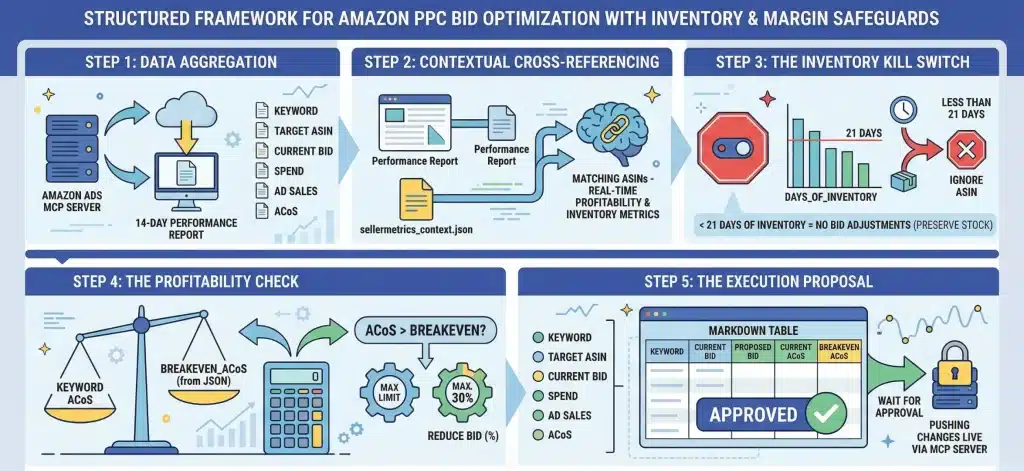
Below is a structured prompt designed to ensure Claude cross-references advertising data with real-time margin and inventory data before making any bid adjustments.
Do not simplify this logic. Each step acts as a safeguard against incorrect automation.
“Claude, you are acting as a Senior Amazon PPC Strategist. I need you to optimize keyword bids and strategies like Amazon PPC product targeting across my North America Sponsored Products campaigns. However, you must strictly adhere to the following business constraints based on sellermetrics_context.json file to locate its current profitability and inventory metrics.”
“Use your Amazon Ads MCP server tools to request and download a 14-day performance report for all exact match keywords currently active in the account. Extract the Keyword, Target ASIN, Current Bid, Spend, Ad Sales, and ACoS.”
“For every single keyword in the advertising report, identify its target ASIN. You must then cross-reference this ASIN with the sellermetrics_context.json file to locate its current profitability and inventory metrics.”
“If the JSON file indicates that the ’Days_of_Inventory’ for an ASIN is less than 21 days, you must completely ignore that ASIN. Do not increase or decrease bids, regardless of how profitable the ACoS is. Your absolute priority is to preserve stock on low-inventory items.”
“For all the remaining ASINs (>21 days of inventory) for this keyword, take the current ACoS of this keyword and compare it to the “breakeven_ACoS” in the JSON file. Calculate the percentage increase from breakeven ACoS if the keyword ACoS is greater than the breakeven ACoS. Reduce the bid by that percent, or until you reach a 30% maximum.”
“Do not execute any API calls to update the bids yet. Output a highly readable markdown table showing the keyword, Target ASIN, Current Bid, Proposed Bid, Current ACoS, and the Breakeven ACoS used for your calculation. Wait for my explicit command of ‘APPROVED’ before using the MCP server to push these bid changes live to Amazon.”
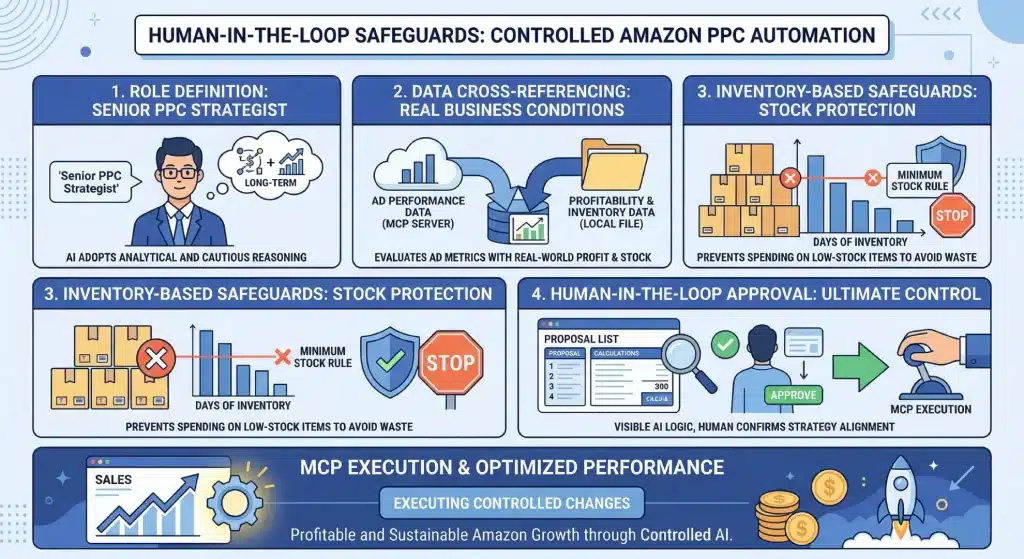
This isn’t just about formatting prompts. It’s about controlling how the system makes decisions. The way you structure prompts determines how safely the system operates and stays under control to automate your Amazon PPC campaigns.
Each component of the structure is designed to give direction as to how the AI is going to process the information it receives and what factors it will use to make its decisions. If you do not provide structure then the system will fall back to using the advertising metrics that you input as the only factor for optimization, leading to less than optimal, and sometimes detrimental results.
The first layer of control comes from the role definition. By assigning Claude the role of a senior Amazon PPC strategist, you influence how it approaches the task, encouraging more analytical and cautious reasoning instead of basic execution.
The second layer requires cross-reference of data before the AI makes any decisions. The ad data is drawn from the MCP server and must be connected with profitability and inventory data from your local file to ensure performance metrics are evaluated in real business conditions.
This step was critical because it closes a gap between ad performance and actual profitability. Without this step, the AI would have continued making efficient-looking decisions on the surface but may not have been sustainable.
The third layer provides an inventory-based safeguard that is strictly enforced. By establishing non-negotiable rules around minimum days of inventory, you prevented the AI from increasing spend on products close to running out of stock.
You protected organic rankings, avoided wasted ad spend and reduced risk associated with additional costs related to low inventory levels. You ensured growth decisions were aligned with operational capacity rather than just demand signals.
The final layer is the human-in-the-loop approval process which serves as the ultimate control point. Instead of allowing the AI to execute changes instantly, it generates a structured proposal for review before taking action.
This gives you visibility into how the AI interprets data and applies logic. You can verify calculations, confirm constraints were followed and ensure the strategy aligns with overarching business goals.
Once approved, the AI can immediately execute changes using tools available through the MCP system. This allows you to combine the speed of automation with the reliability of human oversight, creating a system that is both efficient and controlled.
The integration of the Amazon Ads MCP server with AI tools like Claude Code represents a major shift in how Amazon PPC is managed. Tasks that once required hours of manual work can now be executed in seconds through structured prompts and automated workflows.
That speed is powerful, but it does not replace strategy. Execution alone does not drive results if the system is optimizing against incomplete data.
The MCP server operates entirely within advertising metrics, with no visibility into inventory levels, fulfillment costs, or true profit margins. This creates a disconnect where campaigns may look efficient based on ACoS but still produce unprofitable outcomes.
Relying on this data introduces risk. AI can move quickly, but without the context needed to make financially sound decisions.
To make automation effective, you need a complete view of your business. This means integrating data from the Selling Partner API, including inventory, costs, and margin calculations, into the AI decision-making process.
A unified data layer supports this by combining advertising and operational data in one place. Platforms like SellerMetrics allow you to feed accurate, up-to-date profitability metrics in your workflows, so Claude Code can execute efficiently by staying aligned with real business outcomes.
The goal is not to replace strategy with automation, but to combine both alongside tools like an Amazon listing audit and external traffic sources such as Google or TikTok Ads for Amazon.
The MCP blindspot exists because the Amazon Ads MCP server only has access to advertising data. It cannot see your inventory, FBA fees, or product costs from the Selling Partner API.
Because of this, the AI makes decisions based only on ad performance like ACoS, without understanding your actual profitability.
ACoS does not reflect your true profit because it does not include Amazon’s dynamic fees. A product can show a “good” ACoS but still lose money due to high costs.
If Claude only sees ACoS, it may increase bids on products that are not actually profitable.
No, it cannot. The MCP server only accesses advertising data such as campaigns, keywords, and ad performance.
Inventory data is stored in the Selling Partner API, which MCP server cannot access.
SellerMetrics connects both your advertising data and business data in one place. It calculates real profit, including fees and costs.
This allows you to feed accurate profitability data into Claude so it can make better decisions.
Vibe coding means using simple, natural language to tell AI what to do instead of writing code.
For example, you can ask Claude to pause underperforming keywords, and it will handle the technical steps automatically.
No. You can use a simple CSV file with your inventory and margin data.
You just need to place it in the same folder as Claude and instruct the AI to use it before making decisions.
When your inventory is running low, Amazon will charge you additional fees for each sale. This reduces your profit per sale.
If the AI doesn’t know your inventory is low, it may keep increasing bids and push you into losses.
It is not recommended. The safer approach is to let Claude suggest changes first before applying them.
No. It cannot. The MCP server only shows ad sales, not your total revenue.
To calculate TACoS, Claude needs to access your full sales data from the Selling Partner API.
A kill switch is a rule or mechanism that does not allow the AI to make decisions with significant risk.
For example, you can tell Claude not to increase bids if inventory is below a certain level.
13 June 2026
TweetLinkedInShareEmailPrint 8 min read By Rick Wong Updated Jun 13, 2026 TL;DR What is Amazon Multi-To...

12 June 2026
TweetLinkedInShareEmailPrint 8 min read By Rick Wong Updated Jun 13, 2026 TL;DR What is Alexa for Shopp...

8 June 2026
TweetLinkedInShareEmailPrint 14 min read By Rick Wong Updated Jun 08, 2026 TL;DR How should I structure...