9 March 2026
The Complete Guide to Amazon PPC Product Targeting
TweetLinkedInShareEmailPrint 18 min read By Rick Wong Updated Mar 10, 2026 TL;DR Why should new sellers...

 13 January 2026
The Agent inflates its performance by over-spending on Branded Keywords (targeting your own name). This cannibalizes organic sales you would have made anyway. You must use Gemini to audit your search terms and separate “Branded” vs. “Prospecting” performance to see the true cost.
Driving high ad traffic to products with low stock (<28 days of supply) lowers your inventory health metrics, triggering expensive Amazon fees. You must audit your inventory levels and throttle ads for low-stock items, as the Agent ignores these fees and will happily spend budget to trigger a penalty.
The “Rufus” AI assistant now answers these questions directly in the search results, meaning users get the info without clicking your product. You should identify and negate “Informational” terms to stop paying for “research” traffic that no longer converts into sales.
Proceed with caution. While they generate high Click-Through Rates (CTR), they often suffer from low Conversion Rates (CVR) because they lack persuasive context. If you see high clicks but low sales, disable “Auto-Creative” permissions and switch back to manual, human-edited video assets.
The integration of the “Ads Agent” into Amazon’s Unified Ads Console marks a significant shift in how campaign management is approached in 2026. For US-based sellers, the promise of an AI-driven, full-funnel optimization tool is theoretically appealing, particularly given the increasing complexity of the advertising ecosystem. The consolidation of Sponsored Products, Sponsored Brands, Display, and Streaming TV into a single automated workflow offers potential time savings.
However, for a seasoned operator focused on net margin and unit economics, blind reliance on Amazon’s native automation presents a fundamental conflict of interest. If you have run seven-figure Amazon accounts, you already know that Amazon automation improves speed but often hides margin erosion behind polished dashboards.
Amazon’s algorithms are optimized for platform-wide liquidity and revenue maximization (Gross Merchandise Value). Conversely, a seller’s objective is Net Contribution Margin. These two goals rarely align perfectly. The “Ads Agent” prioritizes budget utilization and blended Return on Ad Spend (ROAS), often obscuring inefficiencies that a human analyst would immediately flag. This matters most for sellers managing large catalogs where small issues can scale quickly.
This article outlines a comprehensive, data-driven methodology for using Gemini to audit the performance of Amazon’s Ads Agent. This audit framework exists because experienced sellers cannot afford to treat Amazon’s internal AI as a neutral advisor.
By leveraging Large Language Models (LLMs) to process granular campaign reports, sellers can detect branded cannibalization, identify low-intent “Rufus” traffic, and prevent ad spend on geographically constrained inventory. This is not a rejection of automation, but a protocol for verification, ensuring that algorithmic decisions serve your profitability, not just Amazon’s revenue.
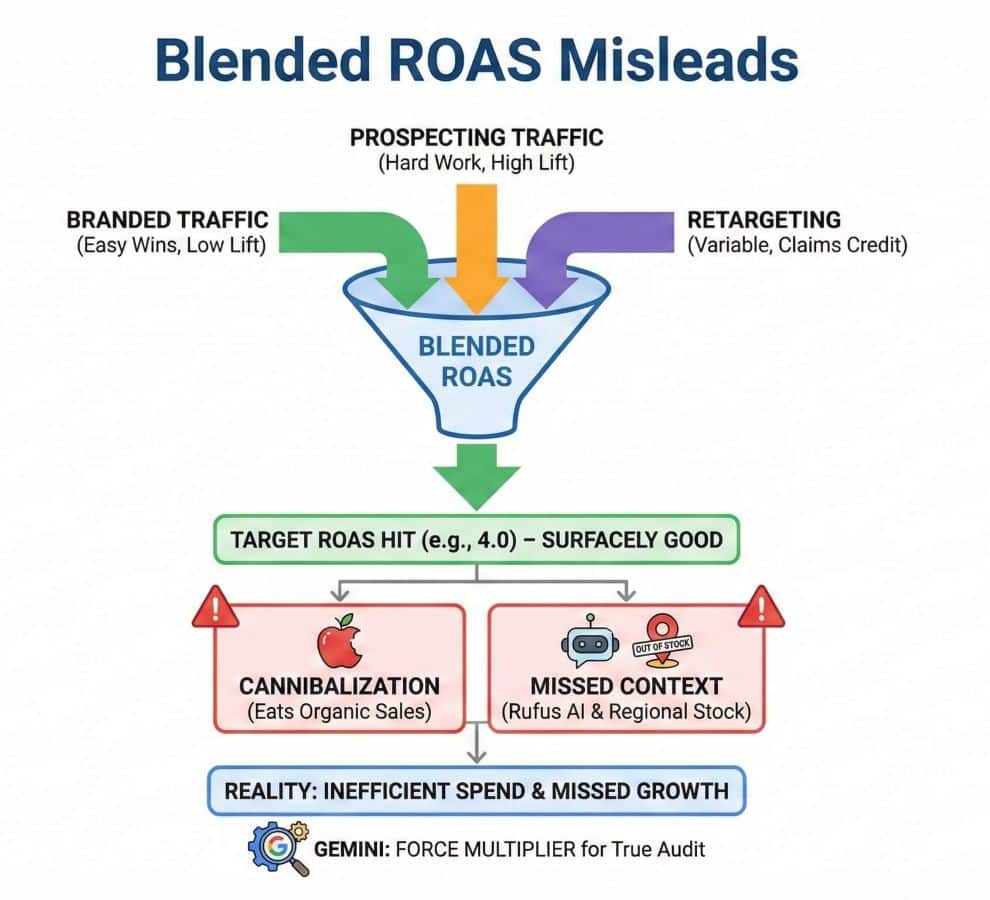
To effectively audit the Ads Agent, one must first understand the metrics it uses to justify its decisions. In late 2025, the Unified Ads Console shifted its primary reporting focus from purely ad-type specific ACOS (Advertising Cost of Sales) to a “Blended ROAS” model.
Blended ROAS works well for executive reporting, but it fails at the operator level where every dollar of spend must justify incremental profit. While useful for high-level executive summaries, Blended ROAS is a dangerous metric for operational management because it aggregates distinct traffic types with vastly different economic profiles.
The algorithm does not distinguish between revenue quality and revenue convenience.
The Ads Agent is programmed to achieve a target ROAS (e.g., 4.0). The most efficient computational path to this number is to over-index on Branded Traffic and Retargeting, as these segments yield the highest mathematical return with the lowest risk. However, this strategy often results in “cannibalization,” where ad spend is deployed to acquire customers who were already highly likely to purchase organically.
Furthermore, the 2026 landscape introduces variables the Agent struggles to contextually analyze:
A manual audit of these variables across thousands of keywords is impossible. This is where Gemini serves as a critical force multiplier.
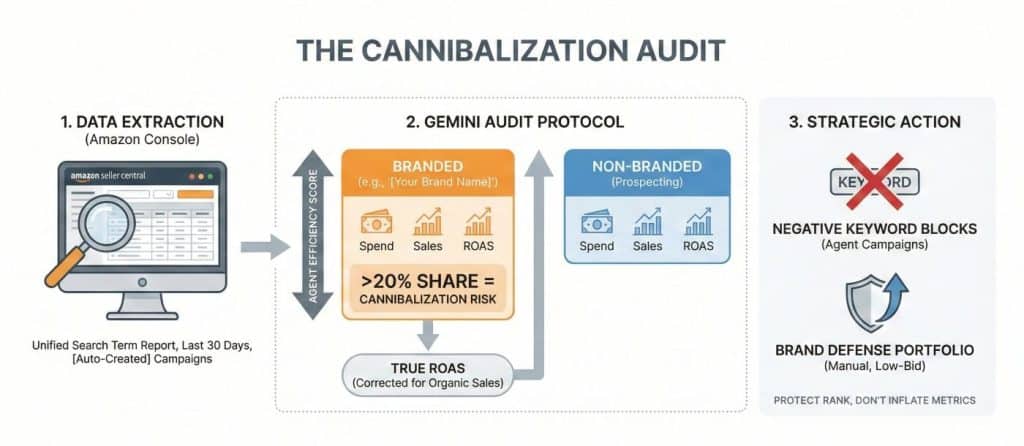
The first and most critical step is determining the extent to which the Ads Agent is inflating its performance metrics by targeting your own brand keywords. “Incremental Sales” is the only metric that truly matters for growth; paying for organic traffic is a direct reduction in net margin. In real accounts, branded spend inflation is rarely obvious unless you separate search terms manually or with an external model like Gemini.
Data Extraction Requirements: Navigate to the Measurement & Reporting tab in the Unified Ads Console.
The Gemini Audit Protocol: Upload the CSV file to Gemini. The objective is to categorize search terms and calculate the weighted average performance of Branded vs. Non-Branded queries.
Prompt Specification:
“I am uploading a raw dataset from my Amazon Search Term Report. Act as a Data Scientist specializing in e-commerce attribution.
Task 1: Segmentation. Analyze the ‘Customer Search Term’ column. Identify any term that matches the string ‘[Your Brand Name]’ or phonetic misspellings. Tag these rows as ‘BRANDED’. Tag all other rows as ‘NON-BRANDED’.
Task 2: Quantitative Analysis. Create a summary table comparing these two segments across the following metrics:
Task 3: Agent Efficiency Score. Focus specifically on campaigns where the ‘Campaign Name’ indicates it is an Agent-managed campaign. Calculate the percentage of the Agent’s total budget allocated to ‘BRANDED’ terms.
Task 4: Interpretation. If the Branded Spend Share exceeds 20%, estimate the ‘Cannibalization Cost’ assuming that 60% of branded sales would have occurred organically without advertising. Provide a corrected ‘True ROAS’ for the Agent excluding these branded sales.”
Most sellers underestimate branded cannibalization because organic conversions never appear in ad-only reports.
Strategic Implication: If the analysis reveals that the Ads Agent is allocating >30% of its budget to Branded terms, the “optimization” it claims to be performing is essentially arbitrage. It is buying cheap, high-converting branded clicks to mask the poor performance of its prospecting efforts. Agent-created campaigns often prioritize mathematical efficiency rather than commercial intent.
Action: Immediately implement Negative Keyword blocks for your brand terms in the Agent’s campaigns and move branded bidding to a manual, low-bid “Brand Defense” portfolio. Branded defense should exist to protect rank, not to inflate performance metrics.
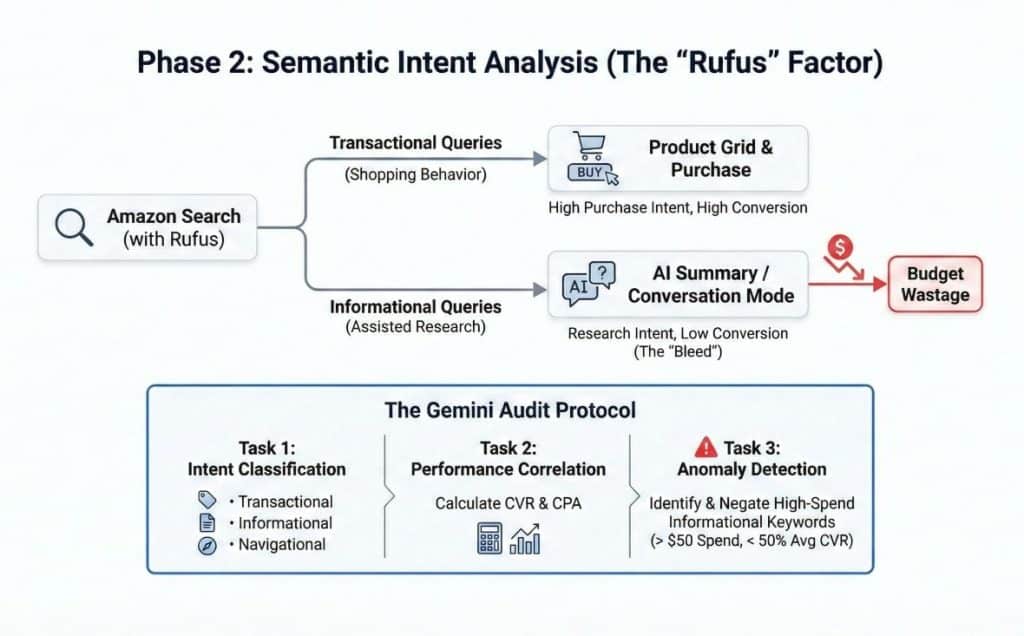
With the widespread adoption of Amazon Rufus, customer search behavior has bifurcated. We now see a distinct split between “Transactional” queries (high purchase intent) and “Informational” queries (research intent). Rufus has effectively shifted part of Amazon search from shopping behavior into assisted research behavior.
The Ads Agent, operating on legacy keyword-matching logic, often bids aggressively on Informational queries because they have high search volume. However, in a Rufus-dominated interface, these queries often trigger an AI summary or a “Conversation Mode” rather than a standard product grid. This leads to high impressions, moderate clicks, but very low conversion rates, a phenomenon known as “bleed.” High impressions no longer guarantee shopping behavior in a Rufus-led interface.
The Gemini Audit Protocol: This analysis requires Gemini to understand the meaning behind the keyword, not just the match type.
Prompt Specification:
“Reference the ‘NON-BRANDED’ segment from the previous analysis. I need a semantic intent audit to identify budget wastage due to low-intent traffic.
Task 1: Intent Classification. Classify each search term into one of three distinct categories:
Task 2: Performance Correlation Calculate the Aggregate Conversion Rate (CVR) and Cost Per Acquisition (CPA) for each of the three categories.
Task 3: Anomaly Detection Identify specific ‘Informational’ keywords where the Spend is >$50 and the CVR is <50% of the account average. These are likely queries where the user is interacting with the Rufus AI rather than shopping.
Output: Provide a list of these underperforming Informational keywords formatted for direct copy-pasting into Amazon’s ‘Negative Exact’ match tool.”
Strategic Implication: Sellers often find that 15-20% of their prospecting budget is wasted on “Informational” queries that no longer convert in 2026. By negating these terms, you force the Agent to focus strictly on “Transactional” intent, artificially raising the efficiency of the campaign.
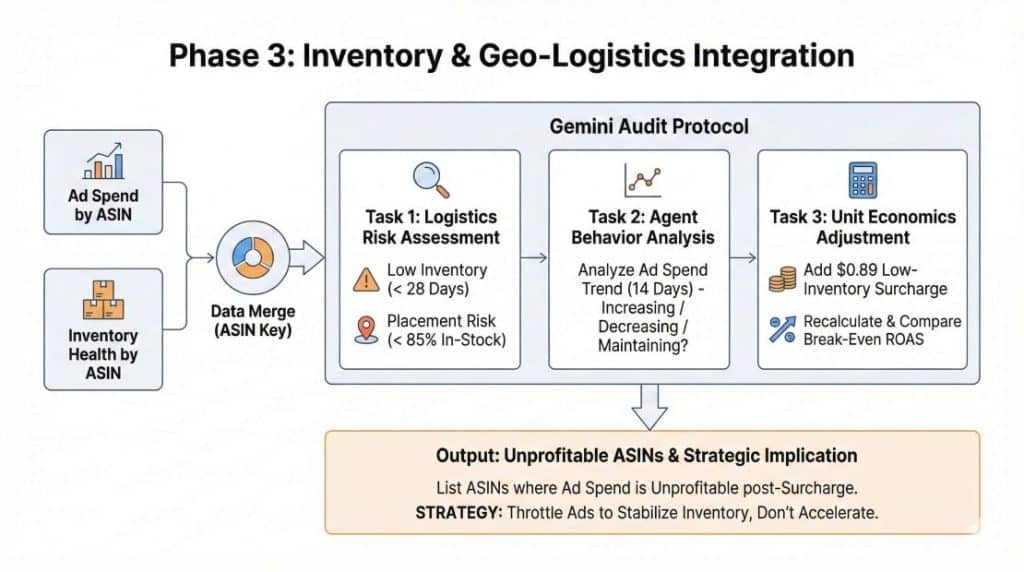
The most significant operational threat in 2026 is the disconnect between advertising and logistics. Advertising without inventory awareness is no longer inefficient; it is actively harmful to unit economics. Following the March 2026 sunset of inventory commingling, inventory placement has become rigid. An ad impression served to a customer in a zone where you have no local stock results in a “Delivery Promise” of 5+ days.
Data shows that conversion rates drop by approximately 40% when the delivery promise exceeds 2 days. Delivery speed now acts as a hidden conversion variable that most PPC dashboards ignore. The Ads Agent does not account for this “Geo-Latency” in real-time. It bids based on global metrics, potentially spending heavily in regions where your offer is uncompetitive.
Furthermore, the “Low-Inventory Level Fee” creates a penalty for driving velocity on low-stock items.
Data Extraction Requirements: You will need to merge two data sources:
The Ads Agent optimizes spend faster than most sellers can react to inventory risk. Logistics decisions now directly influence advertising profitability.
The Gemini Audit Protocol: Prompt Specification:
“I am providing two datasets: ‘Ad Spend by ASIN’ and ‘Inventory Health by ASIN’. Please merge these datasets using the ASIN as the primary key.
Task 1: Logistics Risk Assessment. Identify any ASIN that meets the following criteria:
Task 2: Agent Behavior Analysis. For the ASINs flagged above, analyze the ad spend over the last 14 days. Is the Agent increasing, decreasing, or maintaining spend levels?
Task 3: Unit Economics Adjustment. For ASINs with <28 Days of Supply, add a theoretical $0.89 ‘Low-Inventory Surcharge’ to the Cost of Goods Sold (COGS). Recalculate the Break-Even ROAS. Compare this new Break-Even ROAS to the actual ROAS achieved by the Agent.
Output: List all ASINs where the Agent is driving traffic that is unprofitable once the Low-Inventory Surcharge is factored in.”
Strategic Implication: This audit frequently reveals that the Agent is accelerating sales for products that are about to trigger a fee penalty. The correct move is to throttle ads to stabilize inventory levels, not accelerate them. This insight alone can save thousands in FBA fees.
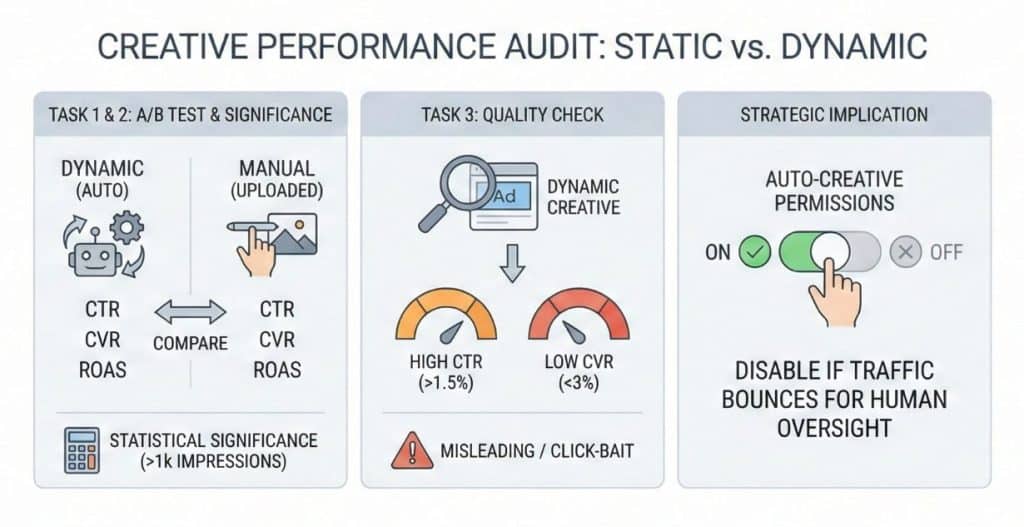
The Unified Ads Console’s “Dynamic Creative” feature uses generative AI to create video and image assets. While efficient, these assets often lack the brand-specific nuance required for high conversion. The Agent optimizes for Click-Through Rate (CTR) or even View-Through Rate (VTR), which are vanity metrics if they do not lead to sales. High click volume without conversion often signals creative misalignment rather than targeting success.
The Gemini Audit Protocol: Prompt Specification:
“Analyze the ‘Creative Performance’ section of the report.
Task 1: A/B Test Analysis. Compare the performance of ‘Dynamic/Auto-Generated’ creatives against ‘Manual/Uploaded’ creatives. Compare them across three metrics:
Task 2: Statistical Significance. For any creative variation with over 1,000 impressions, determine if the performance difference is statistically significant.
Task 3: Quality Check. Identify any ‘Dynamic’ creatives that have a high CTR (>1.5%) but a low CVR (<3%). This pattern suggests the creative is ‘click-bait’ or misleading, attracting clicks that do not convert. Creative automation still struggles with context, sequencing, and buyer psychology.
Strategic Implication: If the Agent’s auto-generated creatives are driving traffic that bounces, you must disable the “Auto-Creative” permissions in the campaign settings. Control over brand messaging is a variable that often requires human oversight.
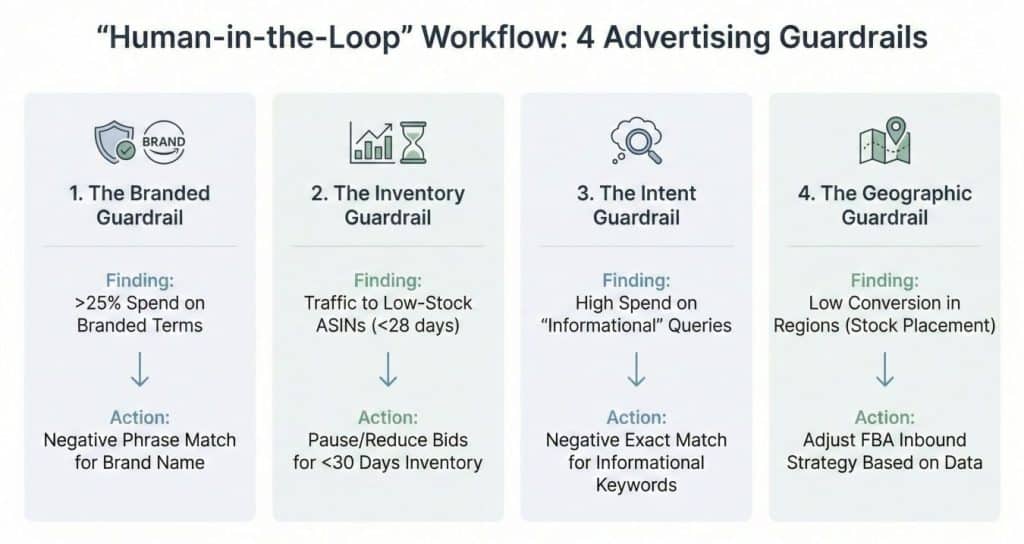
The data generated by these audits provides a clear roadmap for intervention. The goal is not to micromanage the Agent, but to set boundary conditions—”Guardrails”—within which it can operate safely without overriding business logic.
The transition to AI-driven advertising in 2026 demands a shift in the seller’s role. The value of a human operator is no longer in bid adjustment—algorithms are undeniably faster at math—but in contextual auditing. At scale, the cost of trusting automation without verification compounds quietly until margins collapse.
The Ads Agent lacks business context. It does not know your supply chain constraints, your cash flow requirements, or your long-term brand strategy. It only knows the math of the auction. By using Gemini to rigorously audit the Agent’s decisions against your actual unit economics, you create a system that leverages the speed of AI without sacrificing the profitability of the business.
This audit process should be institutionalized:
In the unified, automated landscape of Amazon 2026, trust is not a strategy. Verification is.
The Ads Agent often inflates ROAS by co-opting Branded Search traffic. Since customers searching for your brand name convert at a very high rate (often 20%+), mixing this traffic with lower-performing prospecting traffic raises the average ROAS. This “blended” metric hides the inefficiency of the new customer acquisition efforts. The Gemini audit separates these streams to reveal the true performance.
Yes, advanced sellers can build scripts to pull reports via the Amazon Ads API and feed them into the Gemini API for automated analysis. However, for most sellers, the manual CSV export/import method described in this article is safer and sufficient. It ensures a “human check” before any changes are made to the live account, preventing AI-driven feedback loops.
The fee (introduced in 2024 and adjusted in 2026) penalizes sellers for holding insufficient inventory relative to their sales velocity. If you use PPC to drive high sales velocity on an item with low stock, you inadvertently lower your “Days of Supply” metric, potentially triggering the fee. PPC spend must be inversely correlated with inventory risk: as stock gets low, ads should pull back.
Rufus has shifted many “long-tail” searches into “conversational” interactions. Users now ask questions rather than typing keyword strings. This reduces the click-through rate on traditional “informational” keywords (e.g., “best coffee maker for camping”). Sellers should shift budget toward “transactional” keywords where the user has already decided to buy and is looking for a product, not advice.
Use with caution. While it allows for easy entry into Streaming TV, automated creatives often lack the narrative arc required for effective brand building. They tend to be “slideshows set to music.” Our data suggests that human-edited video creatives typically outperform dynamic assets by 15-20% in Conversion Rate, even if the dynamic assets get more views.
The Ads Agent often struggles with competitor targeting because it requires strategic nuance (e.g., attacking a competitor only when they are out of stock). It is recommended to keep Competitor Targeting campaigns manual. You can use Gemini to analyze the “Search Term Report” to see which competitor ASINs are appearing in your auto campaigns and move the high-performing ones to a manual campaign.
No. The Ads Agent optimizes for Ad Spend relative to Sales Revenue. It does not see your “Below the Line” fees, such as Inbound Placement, Storage, or FBA fulfillment fees. A campaign might look profitable at 3.0 ROAS, but after factoring in a high placement fee for that specific batch of inventory, it might be net negative. This is why the external audit is necessary.
“Cosmo” is Amazon’s internal AI system that analyzes the visual and semantic content of your product listing to match it with user intent. If your product image shows a “wooden handle” but your text doesn’t mention it, Cosmo bridges that gap. However, if your images are poor quality, Cosmo will deprioritize your ads regardless of your bid. Gemini can help audit your listing to ensure your text matches the visual cues Cosmo is looking for.
Incremental ROAS measures the return on the extra spend. If you spend $100 to get $500 in sales, and then spend $200 to get $600 in sales, your Incremental spend was $100, but your Incremental sales were only $100 (ROAS of 1.0). The Ads Agent often pushes spend past the point of diminishing returns. You can ask Gemini to analyze your “Spend vs. Sales” scatter plot to find this tipping point.
Yes, but it has evolved. With the Ads Agent, dayparting is less about “office hours” and more about “conversion windows.” For example, if you sell B2B office supplies, conversion drops on weekends. The Agent should adjust for this, but often reacts too slowly. A manual audit of “Sales by Hour” (available in the new console) can confirm if you need to apply manual “Time of Day” modifiers to override the Agent.

9 March 2026
TweetLinkedInShareEmailPrint 18 min read By Rick Wong Updated Mar 10, 2026 TL;DR Why should new sellers...
27 February 2026
TweetLinkedInShareEmailPrint 8 min read By Rick Wong Updated Feb 27, 2026 TL;DR What is the optimal len...
18 February 2026
TweetLinkedInShareEmailPrint 8 min read By Rick Wong Updated Feb 18, 2026 TL;DR Is AMC free and availab...