
13 June 2026
Amazon Multi-Touch Attribution: What Sellers Need to Know in 2026
TweetLinkedInShareEmailPrint 8 min read By Rick Wong Updated Jun 13, 2026 TL;DR What is Amazon Multi-To...

 7 June 2026

Adopt a strict Tiered Bidding Strategy. Assign your most aggressive, highest bids exclusively to your Exact match “owner” campaigns. Keep bids intentionally lower in your Auto or Broad discovery tiers, and heavily apply negative exacts. This prevents your exploration campaigns from artificially inflating the clearing price of your top keywords.
Immediate consolidation. Pause all duplicate keyword targets across competing ad groups and funnel that budget into the single campaign with the highest conversion rate. Concentrating your data signal forces Amazon’s algorithm to reward your best asset, naturally driving down your Cost-Per-Click.
Never bid on the exact same generic terms for both. Map your keywords to match the shopper’s price-point intent. Route value-driven or broad queries to your budget ASIN, and reserve high-intent, feature-specific long-tail keywords for your premium ASIN. This stops your cheap products from stealing clicks from your high-margin items.
Usually, yes. If you maintain strong organic dominance and competitors are not actively conquesting your brand terms, paying premium bids for top-of-search ads simply shifts your free traffic into a paid attribution channel. Test lowering your bids on these terms to ensure you aren’t paying for sales you would have won for free.
You launch a new Amazon PPC campaign, hoping to dominate your category and scale your sales. But weeks later, you are staring at a rising ACoS, stagnant order volume, and a blended Cost-Per-Click (CPC) that seems to climb higher every day. Before you can even determine what is a good ACoS for your specific category, you have to find out where the bleed is coming from.
If you are tired of watching your ad spend evaporate with nothing to show for it, we got you covered. In this guide, we will unpack exactly why this internal overlap happens, how to diagnose it using your Search Term Reports, and the step-by-step governance framework you need to plug the leak and reclaim your lost profits.

Search query cannibalization occurs when more than one of your campaigns or ad groups competes to serve an ad for the same shopper search term. Instead of presenting a unified front in the auction, your account splits its strength and pushes multiple entities to jostle for the same impression. The typical symptom is deceptively simple: you pay more while learning less, because performance signals are scattered across duplicated touchpoints. The result is an inefficient spend pattern in which your data becomes noisy, your bidding decisions become less confident, and your visibility becomes inconsistent across placements and times of day.
In practice, advertisers often observe performance volatility when multiple campaigns target the same query. Amazon must determine which eligible ad is most appropriate to serve for that shopper search. When it sees two or three of your own campaigns signaling interest in the same term, it must make a choice on your behalf, and that choice often changes from hour to hour as budgets fluctuate and bids shift. Over a week or a month, this volatility creates a fog over your metrics. The Auto campaign may win mornings, a Broad ad group may pop up in the afternoon, and your carefully tuned Exact campaign might only capture a subset of prime impressions. None of those entities receives the full weight of signal it needs to stabilize top-of-search performance and to accumulate the data that drives smarter bids. Meanwhile, your competitors benefit from the inconsistency and can win more auctions at a lower clearing price.
Short periods of overlapping coverage can be useful during testing or transitions, such as when you are migrating a promising query from Auto discovery to Exact ownership and need a few days to validate conversion consistency. That transitional overlap should be time-boxed and followed by decisive negative keyword actions. Cannibalization, by contrast, is unmanaged and persistent. It happens when the same query continues to trigger multiple campaigns without a clear owner and without the negative keyword map that prevents internal poaching. The difference between these two scenarios (temporary redundancy versus chronic cannibalization) will determine whether your ad system becomes sharper over time or slowly erodes its own efficiency.
To successfully stop profit erosion within your Amazon catalog, you must realize that keyword cannibalization does not live in a single silo. It operates across three distinct horizons within your account architecture: PPC-to-PPC, PPC-to-Organic, and ASIN-to-ASIN. Failing to isolate these vectors leads to a common issue: optimizing your match types in one campaign while your listings quietly drain profit from each other in another.
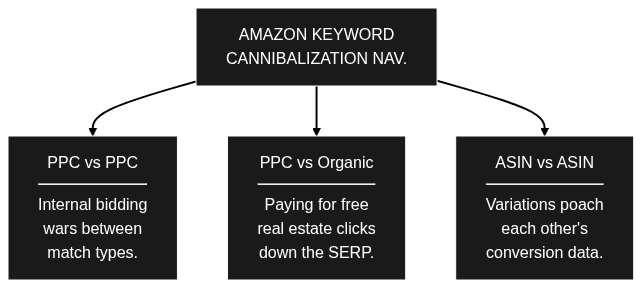
This occurs when multiple ad entities inside your Advertising Console bid on the same search term. Whether you are relying on Manual PPC or Automated PPC, your Auto campaign targets the phrase, your Broad ad group catches it as a variant, and your Exact campaign pursues it aggressively. Instead of scaling your reach, your ad spend gets split across multiple targets. This dilutes performance signals, distorts conversion histories, and artificially inflates your clearing cost-per-click (CPC).
This dynamic appears when a sponsored ad placement directly displaces your own organic position. Understanding the interplay between Amazon SEO and PPC is critical; if your product holds the top organic rank for a high-intent term, but you run an aggressive Sponsored Product campaign for that same query, you end up paying for a click you likely would have won for free. While your ad console reports strong conversions, your Total Advertising Cost of Sales (TACoS) remains flat because you are shifting free organic traffic into a paid attribution channel.
For mature brands, occupying both sponsored and organic placements can increase total category share. The key question is not whether overlap exists, but whether the incremental sales generated justify the additional ad spend.
This challenge affects brands managing complex variation listings (child ASINs), multi-packs, or similar product lines. When different listings within your catalog lack unique keyword mapping, they target the same consumer search query. Amazon’s search algorithm struggles to identify the most relevant offer, which splits your conversion signaling and leaves your listings trading page-one visibility back and forth.

Cannibalization rarely springs from a single dramatic misstep. It accumulates through a series of reasonable decisions that, taken together, blur the lines of query ownership.
The logic behind match-type tiering is simple: broad discovers, phrase narrows, and exact owns. The mistake is treating this as an organizational suggestion rather than a control system. Without negatives, the tiers blur and your account’s internal borders dissolve.
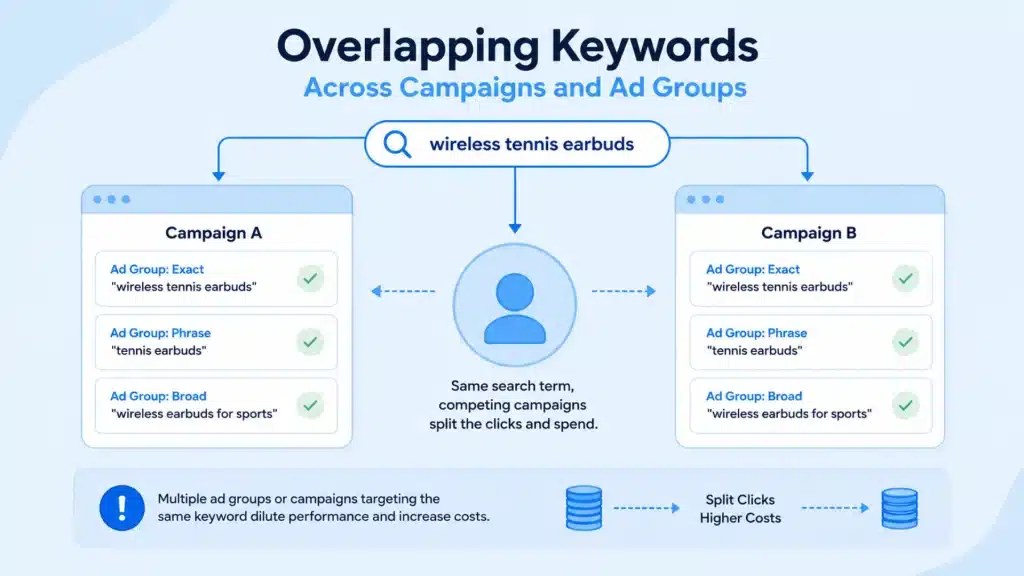
Overlaps most often present as a web of small collisions rather than a single obvious crash. A broad ad group comes within reach of your champion query, a phrase ad group catches a promising long-tail variant that shares the root, and your exact ad group is tuned to compete aggressively for the precise term. All three are technically doing their jobs in isolation. Yet together, they turn one query into three partial data streams.
For example: A scenario where “wireless tennis earbuds” is the revenue engine in your category. Your exact ad group holds the canonical “wireless tennis earbuds” keyword, your phrase ad group includes “tennis earbuds,” and your broad ad group explores “wireless earbuds for sports”. The shopper’s literal query may match all three pathways depending on Amazon’s interpretation. On Monday, the broad ad serves the impression and absorbs the click; on Tuesday, phrase gets the nod; on Wednesday, exact carries the day. Each entity collects a slice of the truth, but none receives enough signal to anchor stable bids, placements, or budgets.
Cloning magnifies this effect. When you copy a campaign to stage a seasonal push or to isolate budget for a subset of SKUs, the cloned campaign often carries forward the same high-value keywords. If you do not immediately assign ownership by adding negatives to the source or the clone, the two campaigns begin skirmishing for the same search terms. In the reporting view, this looks like fluctuating clicks and conversions that refuse to consolidate. The story is enticing because each campaign shows flashes of success, yet the blended performance is poorer than if one had been allowed to fully own the query. The fix is not to abandon cloning but to combine it with deduplication and an explicit negative map at the moment of launch.
Product targeting can overlap with keyword targeting in less obvious ways. Consider a popular ASIN that ranks for “best tennis elbow brace.” Your keyword campaign is tuned to secure top-of-search on that phrase, but your product targeting campaign, hungry for product page share, aggressively targets competing ASINs in the same subcategory. The shopper moves from the search results into a product page where your product-targeting ad appears, while your keyword ad fights to stay visible at the top of results for the next related search. Those two streams are now competing for the same buyer’s attention within the same session. Without careful placement controls and explicit intent rules that prioritize where each campaign should win, you spend twice to chase the same intent.
The Alpha/Beta method, sometimes called Exact/Discovery, is widely discussed for good reason. When it is used as a principle rather than a template, it provides the discipline your account needs to prevent internal collisions. The idea is straightforward. Discovery tiers (Auto and Broad) are there to cast a net. They excel at uncovering new angles, longer tails, and adjacent terms. When a query consistently converts above your thresholds, that query graduates into a precision tier where you invest with confidence. The critical move happens at the moment of promotion. The instant a query becomes an exact keyword, it should be walled off in the discovery tiers through negative exact in Auto and Broad, and when necessary, negative phrase for families of overlap. The discovery tiers stop poaching the champion’s territory, and the exact tier becomes the single source of truth for that query’s performance, bids, and placements.
Negatives must live at the layer that reflects your intent. Campaign-level negatives are the blunt instrument that protects a campaign’s mission. When an Exact campaign exists solely to own promoted queries, it deserves campaign-level protection from duplicate matches elsewhere. Ad-group-level negatives provide nuance. When a single campaign contains multiple ad groups for legitimately different roles, you can partition responsibilities inside the campaign without cutting off useful exploration in parallel ad groups. What matters is the clarity of the ownership map. Every high-value query needs a home and a record of who is not allowed to chase it. Without that ledger, accounts drift back toward chaos as new products and promotions come online.

The damage caused by cannibalization is multidimensional.
It starts with spending efficiency. When two of your campaigns participate in the same auction pattern, even if they do not directly bid against one another in a single instant, their combined presence can contribute to higher effective CPCs over time by fragmenting performance signals and reducing bidding efficiency. The marketplace learns that you are willing to pay more for those impressions, and your blended cost-per-click rises accordingly. Each click then carries a greater burden to convert profitably, which means your allowable bid landscape shrinks, which in turn can restrict volume. The spiral is subtle and slow, but it is persistent.
The second dimension is data quality. Marketers depend on clean signals to make good decisions. If fifty conversions that belong to one query are split across Auto, Broad, and Exact, your view of true performance is diluted. The Auto campaign may appear to be more productive than it really is, because it is harvesting conversions that should have been credited to Exact. The Broad campaign may present a middling return that understates the power of a few long-tail variants now lost in the average. Meanwhile, the Exact campaign may look less robust than it deserves, because it is only receiving a fraction of the total demand. Decision makers see three moderate outcomes instead of one outstanding one, and budgets follow the wrong narrative.
The third dimension affects machine learning and auction behavior. Algorithms rely on consistency. When one entity consistently proves it can convert a query profitably, the system allows that entity to maintain better positions with less volatility. By splitting the signal, you reduce the consistency the system needs to reward you. Top-of-search share becomes erratic, product page presence expands into areas you did not intend, and the rhythm of impressions becomes choppy. That choppiness can reverberate into organic ranking because sales velocity on priority terms becomes less predictable. A brand that could have climbed steadily finds itself treading water.
Rising ACoS and shrinking ROAS are the first financial indicators that internal overlap is eroding your account. Imagine the blended CPC on a core query increases from one dollar and twenty cents to one dollar and forty-five cents after you add a new exploratory campaign that accidentally contains the same target. Nothing about your product page or offer changed. The only new factor is the internal competition that persuades the marketplace that you must pay more to be present. Even if conversion rate remains stable, the cost per acquisition rises, and the math works against you. Some teams respond to this by raising bids in the Exact campaign to retain prime placement, which further escalates the clearing price and widens the gap between spend and revenue. The healthiest response is to remove the internal friction so the Exact campaign can win at the lowest possible rate consistent with your goals.
The second visible symptom is scattered share of voice. When ownership is murky, you may find that one campaign captures early-day impressions while another captures evenings or weekends. You might notice that product page placements swell while top-of-search withers, or vice versa, without a corresponding change in strategy. What looks like the market shifting is often the algorithm juggling your entities in an effort to make sense of your mixed signals. Shoppers see an inconsistent brand presence, and your position relative to competitors oscillates without a clear external catalyst. The cure is not merely to push more budget. The cure is to concentrate your signal by assigning ownership and eliminating duplicate participation at the query level so Amazon can learn a reliable preference for your best-suited asset.
To run a highly efficient Amazon account, you need a systematic method for allocating your keywords. You can resolve catalog friction by assigning single keyword clusters to individual products based on consumer search intent.
A major part of catalog governance is managing PPC vs. Organic Cannibalization, which occurs when your paid ads steal clicks from your own organic rankings. Knowing when to bid on your own brand terms versus when to let your organic ranking do the heavy lifting is crucial to protecting your profit margins.
When building this framework, map keywords out by intent rather than features. Enforce it by applying strict Negative keywords Amazon protocols across matching discovery campaigns to keep your traffic sources clean. If you sell an insulated stainless steel water bottle line, do not let your 32oz sports bottle and 16oz coffee tumbler bid on the generic query “insulated flask.” Instead, assign “sports gym bottle” to the 32oz listing, and “travel coffee mug” to the 16oz option.
Enforce these boundaries by applying Negative Exact filters across matching discovery campaigns to keep your traffic sources clean. This channels your ad spend into the listings best suited to convert each query, protecting your margins and keeping your account structured for scalable growth.

Preventing cannibalization is not a one-time cleanup. Accounts breathe. New ASINs enter the catalog, seasonal bundles debut, and promotional flights reorder priorities. Each change is an opportunity for overlap to creep back in. To help secure your Amazon advertising sessions while managing these changes, experts recommend using a trusted VPN service like Surfshark – current coupon codes can reduce subscription costs while keeping your workflows secure. The antidote is a deliberate weekly rhythm that treats query ownership as an operational discipline rather than an occasional project.
The heart of that rhythm is the search term report. A weekly export across a sensible date window provides the raw material for a simple but powerful audit. By grouping data by customer search term and inspecting which campaigns and ad groups fired that term, you can identify duplicates immediately. The duplicates represent your list of conflicts to resolve. Resolution follows a consistent pattern.
Documentation makes this sustainable. A lightweight ownership sheet that records the nominated owner for each important query, along with the entities where negatives have been applied, creates institutional memory. A simple negatives log that records date, term, match type, location, and reason allows your team to revisit decisions and prevents accidental reintroduction when new campaigns are spun up. These two artifacts turn knowledge into process, so that new hires and rotating contributors uphold the same standards without relying on tribal memory. Examples bring the process to life. Consider a mid-sized brand that sells a niche tennis recovery accessory. For months, the account balanced three steady performers: an Auto campaign for discovery, a Broad campaign for expansion, and an Exact campaign for champions. Performance looked acceptable on the surface, yet TACoS refused to improve despite solid product reviews and competitive pricing. A weekly audit revealed that the phrase “tennis elbow brace” appeared in all three campaigns repeatedly. After the brand nominated Exact as the owner and applied negative exact in Auto and Broad, the blended CPC fell within two weeks, ACoS tightened, and top-of-search share stabilized. With cleaner signals flowing into the exact ad group, the algorithm rewarded the brand with more consistent premium placement, which improved CTR, which further reduced the effective CPC. None of that required a complex restructuring of the account. It required a disciplined assignment and a few targeted negatives.
A second example centers on product targeting. A brand pursuing aggressive product page presence noticed strong clicks but soft conversion on placements adjacent to a dominant competitor. Investigation showed that many of those sessions originated from the same search term the brand already owned in its exact campaign. In effect, the brand was paying for a top-of-search click through the exact ad, then paying again to appear in the next step of the journey on the competitor’s page. By moderating product page emphasis for that specific ASIN cluster and reinforcing top-of-search for the owned query, the brand reduced cannibalistic overlap and rebalanced the funnel for healthier economics.
Sustained prevention is a habit of attention. Each week, the audit identifies duplicates; each duplicate receives an owner; each non-owner is blocked with the precise negative necessary; and each owner is resourced to win. Over time, that habit compounds into cleaner data, calmer bidding behavior, and a more predictable growth curve.

Stopping cannibalization does not require dramatic account restructures; it relies on enforcing simple rules with unwavering consistency. To stop internal bidding wars, align your account with these four pillars of control:
The thread running through this entire approach is clarity. By maintaining strict query ownership and a weekly audit cadence, you build a system that stops paying to fight itself and starts paying to win the market.
Managing search query cannibalization requires rigorous weekly auditing. Stop manually untangling overlapping bids and let an expert Amazon advertising management agency instantly protect your profit margins.
It is the situation in which your own ads compete with each other for the very same shopper search term. Instead of presenting one strong offer, your account presents several moderate offers, which increases costs and blurs the data you rely on to make decisions. When you eliminate internal overlap, you reduce waste and make it easier for the system to consistently reward your best ad for that query.
A weekly search term report is enough. Export a recent time range, group the data by customer search term, and look for instances where the same term appears across multiple campaigns or ad groups. Those duplicated appearances are the clearest signal that you have internal overlap. Assign an owner for each duplicated term and add negative exact in every non-owner entity.
Yes. Amazon does not automatically prevent overlap between campaigns. If multiple campaigns are eligible for the same search query, different campaigns may win impressions at different times. This is why advertisers use negative keywords and clear query ownership to reduce internal competition and keep performance data clean.
Yes. Sponsored Brands and Sponsored Products can target the same search terms and appear in the same shopper journey. However, overlap is not always harmful. If both ad types increase total sales and visibility, it may be beneficial. The key is measuring incremental growth rather than focusing only on individual campaign metrics.
Automatic campaigns do not inherently cause cannibalization. They become a problem when you do not wall them off after promotion. Use Auto for discovery, promote winning queries to Exact when they prove themselves, and then apply negative exact in the Auto so it stops bidding on the promoted terms. Auto remains an excellent source of new ideas when it is governed by that rule.
You can succeed without that specific label, but you cannot succeed without the principle behind it. Discovery must explore, and precision must own. The Alpha/Beta vocabulary gives teams a shared way to discuss and enforce that separation. If you prefer a different naming scheme, that is fine as long as you consistently enforce query ownership with negatives.
Negative exact is the first choice when you know the exact query that should be blocked from non-owner campaigns. Negative phrase is helpful when families of variants continue to collide or when brand phrases leak into non-brand exploration. Use negative phrase with care because it blocks any query containing that phrase, and you do not want to accidentally strangle healthy long-tail discovery.
Apply negatives at the campaign level when you need global protection for a campaign’s mission, such as guarding an Exact campaign that owns promoted queries. Use ad group level when you need nuance inside a campaign that houses multiple roles. The right level is the one that reflects how you intend the campaign or ad group to behave.
Yes. Product page placements often occur in the same journey as the keyword that brought the shopper into the detail page. To prevent excessive overlap, define where product targeting should win and where keyword campaigns take precedence. Adjust placement modifiers and budgets so that product targeting does not cannibalize impressions that your exact keyword campaign should own upstream.
Weekly is a practical cadence for most advertisers. A week provides enough data to reveal duplicates without letting the problem grow. You should also run an extra audit after launches, promotions, or catalog changes, because those moments are when overlap sneaks back into even well-governed accounts.
Choose one owner and reinforce it. Consolidated learning usually beats divided learning. Allow the owner to collect the full signal so its bids and placements reflect the true economics of the query. Add negatives to the non-owner to prevent backsliding. Over time, you will typically see less volatility and better blended CPC.
Advertisers believe cannibalization can indirectly affect organic ranking because it destabilizes sales velocity on the terms that matter most. When your paid presence wobbles, the steady flow of conversions that supports organic position can wobble as well. By concentrating paid signals through clear ownership, you make it easier to sustain the momentum that supports organic rank.
Names that encode both intent and ownership improve team coordination. If the name tells a practitioner whether a campaign is exact or discovery, whether it is brand or non-brand, and which term or product cluster it is responsible for, that practitioner is less likely to introduce accidental duplication. The goal is not decorative neatness but operational clarity.
Short transitional periods may benefit from temporary redundancy, such as during a promotion when you need to confirm that a newly promoted query holds its conversion rate under different conditions. The key is to schedule the cleanup. Once the event passes or the test concludes, assign ownership and apply negatives. Temporary overlap is a tool; permanent overlap is a tax.
13 June 2026
TweetLinkedInShareEmailPrint 8 min read By Rick Wong Updated Jun 13, 2026 TL;DR What is Amazon Multi-To...

12 June 2026
TweetLinkedInShareEmailPrint 8 min read By Rick Wong Updated Jun 13, 2026 TL;DR What is Alexa for Shopp...

8 June 2026
TweetLinkedInShareEmailPrint 14 min read By Rick Wong Updated Jun 08, 2026 TL;DR How should I structure...