
13 June 2026
Amazon Multi-Touch Attribution: What Sellers Need to Know in 2026
TweetLinkedInShareEmailPrint 8 min read By Rick Wong Updated Jun 13, 2026 TL;DR What is Amazon Multi-To...

 9 May 2026
Yes. Under Amazon’s updated Cosmo and A9 algorithms, paying for clicks that do not convert mathematically proves to the algorithm that shoppers do not want your product. This actively suppresses your organic real estate.
Rufus pulls answers directly from the taxonomy of your detail page. If your listing lacks explicitly structured data, the AI generates vague or unhelpful summaries. Shoppers read the AI prompt, get confused, and bounce without buying.
Amazon’s aggressive predictive pacing often burns through default daily budgets on low-intent morning “window shoppers.” To survive, you must use Intraday Budget Rules to artificially throttle morning bids and boost your budget specifically for the high-converting evening rush.
No. The platform has shifted from basic keyword targeting to Persona Targeting. If you are not utilizing the Amazon Marketing Cloud (AMC) to target specific behavioral groups (like competitor cart abandoners), you are overpaying for unqualified traffic.
If you are staring at your Seller Central dashboard asking, “why are my Amazon PPC ads getting clicks but no sales?” you are not alone. As an Amazon advertising strategist, I audit seven-figure ad accounts every single week, and a bleeding conversion rate is the single biggest profit-killer I see.
In our experience managing Amazon advertising for enterprise-level brands, a ‘non-converting ad’ is rarely the result of a single bad keyword. It is a symptom of a misaligned ecosystem. When sellers log into Amazon Seller Central and obsess exclusively over their Advertising Cost of Sales (ACoS), they miss the macro picture. Successful Amazon advertising management in 2026 requires understanding that every paid click is a data point feeding the algorithm.
If your ads are generating traffic but failing to close the sale, you are not just losing margins—you are actively compromising your product’s organic visibility. To fix a broken conversion rate, we must look beyond basic bid manipulation and audit the entire buyer journey: from the initial search term intent, to the AI’s understanding of your listing, down to the final delivery speed expectation.
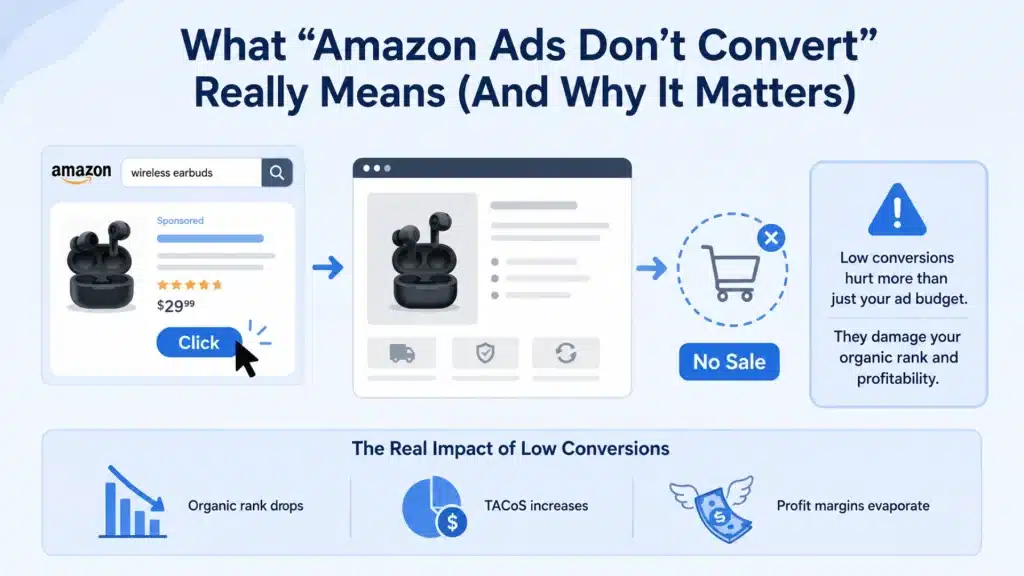
When we talk about “conversion” on Amazon, most sellers simply view it as turning an ad click into a sale. But treating a non-converting ad merely as “wasted ad spend” severely misunderstands how the modern Amazon ecosystem operates.
A lack of conversions isn’t just a hit to your daily budget; it is an active threat to your entire business model. Under Amazon’s updated Cosmo and Amazon A9 algorithms, organic ranking is heavily dictated by conversion velocity. The algorithm does not compartmentalize your paid performance and your organic performance. When you pay for hundreds of clicks that do not convert, you are actively feeding Amazon’s machine learning bad data. You are mathematically proving to the algorithm that when shoppers see your product, they do not want it.
The result? Your organic rank drops, your Total Advertising Cost of Sales (TACoS) skyrockets, and your profit margins evaporate. Diagnosing a low conversion rate isn’t just about saving your ad budget—it is about protecting your organic real estate.
Shoppers click with high intent, but bounce. Indicates a toxic AI Review Summary, weak A+ Content, or poor value proposition.
Ads are visible but ignored. You are bidding on broad terms lacking immediate buyer intent, or your main image blends in.
Listing converts beautifully, but campaigns are starving. You are losing Top-of-Search placement or capping budget too early.
You cannot fix what you cannot accurately diagnose. Staring blindly at a high Advertising Cost of Sales (ACoS) will tell you that you are losing money, but it will never tell you why.
In 2026, diagnosing a bleeding ad account requires looking at relational data, not isolated numbers. High impressions or CTRs are actively damaging if they only yield window shoppers.
Below is the ultimate diagnostic framework. By identifying your specific “Metric Profile” based on how your data points interact, you can pinpoint exactly where your advertising funnel is breaking and apply the precise, algorithmic fix.
If your Click-Through Rate (CTR) is above 0.5% but your Conversion Rate (CVR) is below 8%, your ads are doing their job, but your listing is failing. The shopper saw your main image and price, clicked with intent, but bounced upon reading your detail page. This immediately points to issues with your AI Review Summary, a lack of compelling A+ Content, or a confusing value proposition.
If your ads are generating thousands of impressions but your CTR is abysmal, you are suffering from a relevance issue. You are either bidding on top-of-funnel broad match terms where the buyer has no immediate intent to purchase, or your main image and title fail to stand out against the adjacent competitors in the search grid.
If your conversion rate is excellent (15%+) but your sales volume is flat, you are starving your own campaigns. Your Top-of-Search Impression Share is likely critically low because your bids are uncompetitive, or your campaign is running out of daily budget by noon, leaving your competitors to capture the highly profitable evening traffic.
If your primary targeting strategy relies entirely on downloading search term reports and stuffing them into exact-match campaigns, you are playing a game that ended in 2023. Amazon has evolved from a traditional search engine into an AI-driven answer engine.
Here is the reality for 2026: Shoppers no longer just type “garlic press.” They interact with conversational AI features, asking complex questions like, “What is the best rust-proof garlic press for someone with arthritis?” If you are only bidding on generic short-tail keywords, you are paying a massive premium for unqualified, top-of-funnel traffic that has no immediate intent to buy.
Transition from Keyword Targeting to Persona Targeting, utilizing insights from the Amazon Marketing Cloud (AMC). Instead of asking what words people type, ask who is buying. Segment your campaigns to target specific behavioral groups, such as “Competitor Cart Abandoners” or “High-Value Repeat Purchasers.” By shifting your budget toward audience behaviors and leveraging long-tail, hyper-specific search queries that align with those personas, your CTRs will attract highly qualified traffic that actually converts.
You already know that poor images and a lack of A+ content will kill your conversion rate. But a silent conversion killer is operating behind the scenes in 2026: Amazon’s generative AI shopping assistant, Rufus.
When a shopper asks Rufus to compare your product against a competitor, the AI pulls data directly from the taxonomy of your product detail page. If your listing lacks explicitly structured data (such as exact material composition, compatibility specs, or warranty details), Rufus will either recommend a competitor or generate a vague summary. The result? The shopper gets their answer directly from the AI, realizes your product isn’t a fit, and you suffer a “Zero-Click” interaction. Your ad might generate an impression, but your listing’s lack of semantic clarity prevented the click and the sale.
Your listing must be engineered for both human eyes and machine parsing. Audit your bullet points and backend search terms to ensure they directly answer the most common, complex questions in your niche. Your primary value proposition cannot be buried in a block of text; it must be front-loaded in the first two bullets and visually reinforced in your secondary images with clear, text-heavy infographics. When Rufus perfectly understands your product, your ads will only be shown to shoppers whose intent matches your exact offering.
We are operating in an era of “TikTok Brain”. Shoppers scroll through Amazon with ruthless speed. If your Sponsored Brands or Sponsored Display ad relies on a generic static image and a boring headline like “Premium Quality Home Goods,” you are completely invisible.
It gets worse. Even if a shopper accidentally clicks a poorly designed ad, the cognitive disconnect between the uninspiring ad creative and the product page will cause them to bounce instantly. You pay for the click, but the conversion never happens.
You must optimize for visual engagement speed. Shift your creative budget heavily toward Sponsored Brands Video (SBV). Your videos must follow the “Active Use” framework: skip the slow logo reveal and show the product solving the customer’s exact problem within the first two seconds. Furthermore, use custom lifestyle images in your Sponsored Display campaigns that visually demonstrate the scale and utility of the product. When the ad creative perfectly sets the expectation, the landing page merely has to close the deal.
Combining multiple SKUs into a single ad group or strictly separating campaigns by match type (Broad, Phrase, Exact) is a legacy architecture. This outdated structure restricts your control, muddies your data, and makes it impossible to tell which specific variation or audience is actually driving profitability.
When your campaigns are structured poorly, you end up artificially inflating your bids on underperforming ASINs simply because they are dragged along by a top-performer in the same ad group.
Modern, high-converting Amazon accounts rely on Single-ASIN Campaigns structured around the Buyer Journey. Isolate your top-performing products into their own dedicated campaigns. From there, implement a naming convention and structure based on intent: [ASIN] – [Top of Funnel – Category Terms], [ASIN] – [Middle of Funnel – Competitor Conquesting], and [ASIN] – [Bottom of Funnel – Branded Exact]. This granular architecture allows you to isolate wasted spend down to the penny and aggressively scale the exact search terms that are driving your highest conversion rates.
You might have the perfect keywords and a flawless listing, but if your daily budget is capping out by 1:00 PM, you are actively sacrificing your most profitable conversions.
Amazon’s pacing algorithms have become incredibly aggressive. If you leave your campaigns running on default settings, the algorithm will often burn through your daily budget during the morning hours, chasing high-impression, low-conversion window shoppers. By the time the evening rush hits (when shoppers are home from work, browsing on their couches, and historically highly likely to convert), your ads didn’t perform.
You must take control of your visibility using Intraday Budget Rules and dayparting strategies. Analyze your hourly sales data to identify your peak conversion windows. Use bulk operations or third-party ad software to artificially suppress your bids by 20% during historically low-converting morning hours, and automatically boost your bids and budget caps by 50% specifically for the 6 PM to 10 PM evening rush. You cannot afford to run out of fuel right when the buyer is finally ready to pull out their credit card.
If you are spending hours every week manually downloading search term reports to adjust bids by five cents and aggressively pruning negative keywords, you are doing the algorithm’s job. And honestly, the machine is faster than you.
The “Set-It-and-Forget-It” mistake today isn’t about failing to adjust bids; it is about failing to feed the algorithm the right business context. When you over-constrain your campaigns with thousands of negative keywords, you starve Amazon’s machine learning of the data it needs to find hidden, high-converting pockets of traffic.
Stop micro-managing the CPCs and start managing your profitability metrics. Allow Amazon’s campaign automation and dynamic bidding to handle the micro-adjustments. Your job as a seller is to focus on the macro: Contribution Margins and Total ACoS (TACoS). Feed the algorithm better first-party data by refining your product category mapping and utilizing Amazon’s audience insights. Your focus must shift from manual bid manipulation to strategic budget allocation across your most profitable product lines.
Many sellers believe that running Sponsored Products and a few Sponsored Brands campaigns constitutes a “Full-Funnel” strategy. It doesn’t. If you are only utilizing the search-results page, you are entirely ignoring the shoppers who clicked your ad, got distracted, and left the platform without buying.
Without a remarketing strategy, you are paying to educate consumers, only to let them buy from a competitor a week later.
You must integrate Amazon DSP (Demand Side Platform) into your advertising mix. High-ticket items and highly competitive niches require multiple touchpoints before a consumer converts. DSP allows you to serve highly targeted display and video ads to shoppers across the wider internet (on Twitch, Freevee, and premium third-party websites), who previously viewed your ASIN but failed to add it to their cart. By capturing these lost leads and pulling them back to your listing, you actively lower your overall TACoS and turn wasted clicks into recovered revenue.
It is incredibly easy to launch a Sponsored Display or Sponsored Products campaign targeting competitor ASINs. It is equally easy to burn through your daily budget without a single sale.
When you target a competitor’s product page, your ad appears directly beneath their buy box or within their carousel. The shopper is already looking at a viable product. To pull them away and secure the conversion, your offer must present an undeniable, immediate advantage. If your product is priced $5 higher, has 500 fewer reviews, or boasts a lower star rating, you are effectively paying Amazon to prove why the shopper should buy your competitor’s product instead of yours.
Audit your Product Targeting reports. Filter your targets using bulk operations to isolate ASINs where you have a clear competitive edge. Target products that are priced higher than yours, have inferior star ratings, or lack prime shipping. Stop fighting uphill battles; position your ads exclusively where your product is the undisputed better choice.
More than half of all Amazon transactions take place on a mobile device. If your PPC campaigns are driving high CTRs but abysmal conversion rates (CVR), pull out your smartphone and look at your listing exactly how your customer sees it.
On desktop, your carefully crafted title and five bullet points are prominently displayed next to your images. On the Amazon mobile app, the title is heavily truncated, and the bullet points are buried deep beneath the fold, often requiring the shopper to tap “Read more” just to understand what your product actually does. If your primary selling point or crucial compatibility information is hidden in bullet point number four, mobile shoppers will never see it. They will click your ad, get confused, and bounce.
To optimize for mobile conversions, front-load your title with the most critical, high-converting keywords and benefits. Ensure your secondary images contain infographics and text overlays that visually communicate your bullet points. A mobile shopper should be able to understand your entire value proposition just by swiping through your image gallery.
In the current Amazon ecosystem, having the Prime badge is no longer a unique advantage; it is the bare minimum. What dictates conversion today is the actual delivery estimate displayed on the product page.
If a shopper clicks your Sponsored Product ad and sees a delivery estimate of four days, but they know they can search organically and find a similar product with Next-Day or Same-Day delivery, they will bounce. You pay for the click, but the competitor gets the sale. This delivery gap often occurs due to inventory misallocation across fulfillment centers or relying too heavily on FBM (Fulfilled by Merchant) during peak demand periods.
Check your regional inventory levels and ensure your products are adequately distributed to fulfill fast shipping promises. If you are running PPC on an ASIN that is currently suffering from slow regional delivery times, pause the campaigns or lower your bids until your fulfillment speeds can match user expectations.
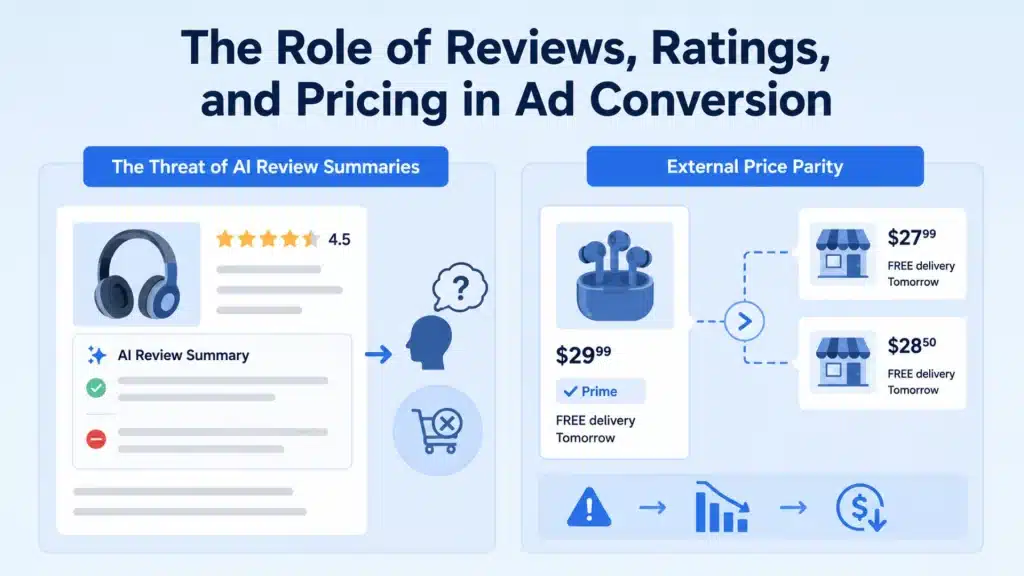
You can execute a flawless, full-funnel advertising strategy, but if your external trust signals are broken, your ads will never convert. In the modern Amazon landscape, comparison shopping happens in fractions of a second.
Having a 4.5-star average is no longer a guaranteed safety net. Amazon now places a generative AI Review Summary at the very top of your review section, synthesizing hundreds of reviews into a single paragraph. Shoppers no longer scroll to read individual complaints; they read the AI’s bullet points. If your product has a recurring minor flaw—and that flaw makes it into the AI’s “Negative” summary bullet—your conversion rate will plummet overnight. You must utilize review analysis tools to monitor exactly what themes the AI is extracting and preemptively address those concerns in your A+ content and secondary images.
Amazon buyers are ruthless when it comes to pricing, and Amazon’s algorithms are even more aggressive. The platform constantly scrapes off-platform competitors (like Walmart, TikTok Shop, and Target) to enforce external price parity. If your product appears even slightly overpriced compared to the exact same item on another platform, Amazon may suppress your Buy Box. If you are running Sponsored Products ads while losing your own Buy Box, you are literally paying to send traffic to a hijacked listing or a suppressed page where checkout is artificially difficult. Your pricing must exist in harmony with the broader e-commerce market, not just the Amazon search grid.
Amazon ads failing to convert is one of the most frustrating, margin-crushing challenges an e-commerce brand can face. But as we have established, a low conversion rate is never a mystery—it is a highly diagnosable chain of events.
The days of relying on manual keyword stuffing and “set-it-and-forget-it” bidding are over. They utilize expert Amazon listing optimization services to align their taxonomy with generative AI prompts, they structure their campaigns around buyer personas, and they aggressively manage their intraday budget pacing to strike when buyer intent is highest.
If your impressions are up, your clicks are climbing, but your revenue is flat, it is time to stop guessing and start diagnosing.
Want a second pair of eyes on your bleeding campaigns?
Stop paying for clicks that don’t buy. Let our team of SEO and PPC specialists tear down your campaign structure and identify your exact conversion bottlenecks. Get a free, comprehensive Amazon ad account audit from our experts today.
This usually indicates a disconnect between the ad and the listing. Shoppers are interested in the keyword or image that prompted the click, but once they land on your page, poor reviews, a high price, slow shipping, or unclear product details cause them to leave without buying.
While it varies by category, a healthy Amazon PPC conversion rate generally falls between 10% and 15%. If your conversion rate drops below 8%, it is time to audit your listing and keyword targeting.
Yes. Broad match keywords can cast too wide of a net, pulling in search terms that are only loosely related to your product. This drives irrelevant traffic to your listing, resulting in wasted ad spend and a low conversion rate.
Analyze your Search Term Report to see which queries drive clicks without conversions. High spend and low sales from specific terms are red flags. Use negative keywords and adjust match types to eliminate unqualified traffic.
Negative keywords prevent your ads from showing up for irrelevant or unprofitable search queries. By adding non-converting search terms as negative exact or negative phrase matches, you funnel your budget exclusively toward high-intent buyers, instantly lifting your conversion rate.
Absolutely. If a shopper clicks your ad and sees that your product is priced 20% higher than identical competitors on the same page, they will bounce. Your price must be competitive within your specific niche for ads to convert profitably.
Video ads often fail to convert if the video does not clearly explain the product within the first 3 seconds, lacks text overlays (most users watch on mute), or directs traffic to a generic storefront instead of a specific, highly optimized product page.
ACoS = Ad Spend ÷ Ad Revenue
TACoS = Ad Spend ÷ Total Revenue (Ad + Organic)
TACoS gives a broader view of your business impact and reveals whether your ads are driving long-term growth or just short-term sales.
No. Increasing bids will only get you more impressions and clicks. If your listing is unoptimized or your product is overpriced, raising bids will simply cause you to lose money faster. You must fix the listing before scaling the spend.
Sponsored Products ads will only run if you are currently winning the Buy Box. However, if you are running Sponsored Brands and lose the Buy Box to a hijacker or reseller, you will be paying for clicks that send shoppers to another seller’s checkout cart.
Instead of turning off the entire campaign, use your Search Term Report to identify exactly which keywords are bleeding spend. Pause or negate the poor performers, and reallocate that budget to the exact match keywords that have a proven history of converting.
Yes. Amazon shoppers rely heavily on social proof. If you are running aggressive PPC campaigns on a product with less than 15 reviews or a star rating below 4.0, shoppers will click your ad out of curiosity but ultimately buy from a competitor with more established trust.
13 June 2026
TweetLinkedInShareEmailPrint 8 min read By Rick Wong Updated Jun 13, 2026 TL;DR What is Amazon Multi-To...

12 June 2026
TweetLinkedInShareEmailPrint 8 min read By Rick Wong Updated Jun 13, 2026 TL;DR What is Alexa for Shopp...

8 June 2026
TweetLinkedInShareEmailPrint 14 min read By Rick Wong Updated Jun 08, 2026 TL;DR How should I structure...