
13 June 2026
Amazon Multi-Touch Attribution: What Sellers Need to Know in 2026
TweetLinkedInShareEmailPrint 8 min read By Rick Wong Updated Jun 13, 2026 TL;DR What is Amazon Multi-To...

 25 May 2021

While Sponsored Products capture shoppers at the bottom of the funnel, SD Audiences allow you to proactively generate demand. By targeting behavioral data rather than search queries, you reach prospective buyers before they ever type a keyword into the search bar.
Select your bidding model based strictly on your funnel position. Use the CPC (cost-per-click) model for direct page visits, but switch to vCPM (cost per thousand viewable impressions) when your objective is maximizing broad brand awareness without paying for accidental clicks.
Because SD Audiences focus on top-of-funnel reach, standard ACoS is an insufficient metric. Success must be measured using New-To-Brand (NTB) metrics, which calculate the exact acquisition cost of net-new customers who haven’t purchased from your brand in the past 12 months.
Not until your foundation is secure. Best practices dictate that you must fully optimize your high-intent, bottom-funnel campaigns (specifically Sponsored Products (SP), Sponsored Brands (SB), and SD Product Targeting (PAT)) before allocating budget to broader audience segments.
The expansion of Sponsored Display audiences represents a fundamental shift in how brands target shoppers within the Amazon ecosystem.
Originally an exclusive, high-barrier feature restricted to the enterprise-level Amazon DSP (understanding the difference between Amazon ads vs Amazon DSP is crucial here), this robust audience targeting capability is now fully integrated into the self-serve advertising console for brand-registered sellers.
Operating alongside standard Views remarketing, it empowers advertisers to move beyond simple retargeting and proactively capture new market share using Amazon’s proprietary behavioral data.
To effectively leverage this tool, let’s first break down exactly what these audience segments entail and how they operate within the larger Amazon advertising ecosystem.
Amazon audience is a targeting type where your Sponsored Display ads, also called Amazon display advertising, can be displayed on and off Amazon based on pre-built audiences. It differs from Views remarketing in that the potential shopper does not have to interact with your ads beforehand.
Sponsored Display audiences allow advertisers to engage prospective buyers based on rich, behavioral data. This means your ads can appear both on and off Amazon, targeting users based on their established shopping habits, lifestyle signals, and content consumption, allowing you to proactively drive demand before a shopper ever types a keyword into the search bar.

Hundreds of pre-built Amazon audiences can help Amazon sellers reach new prospective customers through awareness or brand building.
We don’t know how exactly these Amazon audiences are created. A safe guess is that it is created via a treasure trove of shopping history and behavior recorded on the Amazon shopping platform or/and Amazon-owned websites such as IMDb. These audience marketing formats are actually quite similar to the audience marketing done on Facebook advertising. With these new audience features, we can see how Amazon’s advertising is evolving to compete against the other digital ads platform giants such as Google and Facebook.
Below are the main Amazon Audience categories available:

As mentioned, the key difference between the two audience types is that Views remarketing requires the shopper’s previous interaction with your ads. This is either directly: “Advertised products” or indirectly: “Similar to advertised products”. Basically, remarketing to your existing audience, hence the name “View Remarketing.”
View remarketing is a very effective audience marketing type, but the downside is that the potential reach to these audiences is limited by your existing traffic. Therefore, it can’t be scaled as well as Amazon audiences.
The issue of tapping into new audiences using Amazon Audience will not be an issue. There are hundreds of different audiences by lifestyle, interest, events, and behavior. Some Amazon audiences have a potential reach in the millions. It can be a very effective way to scale your sales and your brand awareness.

Successful top-of-funnel advertising relies heavily on matching the right product with the right consumer behavior. Amazon facilitates this by leveraging trillions of first-party data points; ranging from retail browsing history to streaming habits on Prime Video and Twitch. To help advertisers navigate this vast ocean of data, Amazon segments Sponsored Display targeting into distinct audience types, each serving a unique strategic purpose within your marketing funnel.
In-Market targeting is designed to reach shoppers who are actively researching or browsing products within a specific category, signaling a high intent to purchase in the near future. Amazon’s algorithm identifies these users based on their recent search queries, page views, and add-to-cart actions.
For example, if a user has spent the last three days comparing cribs and strollers, Amazon places them in an “In-Market for Baby Gear” segment. Targeting this audience allows you to position your product in front of consumers who are already primed to buy but have not yet finalized their decision. This is a highly efficient segment for capturing market share from competitors and driving direct consideration.
While In-Market audiences focus on immediate purchase intent, Lifestyle audiences are built around long-term behavioral trends and sustained interests. Amazon curates these segments by analyzing a user’s historical shopping data, search durability, and content consumption across Amazon-owned properties like IMDb, Twitch, and Prime Video.
Lifestyle targeting is highly effective for broad brand awareness and top-of-funnel acquisition.
For example, if you are selling a high-end organic protein powder, you can target the “Fitness Enthusiasts” or “Conscious Consumers” lifestyle segments. These shoppers may not be actively searching for protein powder today, but their established behavioral profile indicates a high likelihood of affinity for your brand. Because the potential reach of Lifestyle audiences frequently scales into the millions, careful budget monitoring and vCPM bidding strategies are highly recommended to ensure efficient ad spend.
For advertisers requiring granular control over their targeting parameters, Custom Built Audiences offer the ability to move beyond Amazon’s pre-packaged segments. This feature allows you to define exact engagement criteria based on a shopper’s historical interactions with your brand or specific product categories.
With Custom Audiences, you can target users who have viewed your specific ASINs, purchased from your catalog within a defined lookback window, or interacted with complementary product nodes. This is an essential tool for executing cross-selling strategies—such as targeting customers who bought your coffee maker with ads for your proprietary coffee filters. By leveraging custom parameters, you can significantly improve customer retention rates and maximize the lifetime value (LTV) of your existing buyer base.
| Bidding Metric | Vendor Central (DSP / vCPM) | Seller Central (PPC / CPC) |
|---|---|---|
| Primary Model | vCPM (Viewable Cost Per Thousand Impressions) | CPC (Cost Per Click) |
| Optimization Goal | Top-of-funnel brand awareness & impression scale | Bottom-of-funnel direct response & conversion efficiency |
| Waste Mitigation | Frequency caps & audience exclusion modeling | Negative keyword targeting & placement modifiers |
When structuring a Sponsored Display audience campaign, selecting the proper bidding strategy is critical for budget control. Amazon provides options to optimize for different outcomes, directly affecting how you are billed. Advertisers can choose between cost-per-click (CPC) and cost per thousand viewable impressions (vCPM). The CPC model charges the advertiser only when a user actively clicks the ad, making it a highly efficient method for driving product page visits and direct conversions.
Conversely, the vCPM model charges based on viewable impressions, meaning the ad must be visible on the screen for at least one second. This model is efficient for broad awareness campaigns where the primary goal is reaching a maximum number of relevant shoppers, regardless of immediate click-through rates. Aligning the bid optimization strategy (whether prioritizing reach, page visits, or conversions) with the specific audience segment ensures efficient budget allocation and measurable, objective returns.
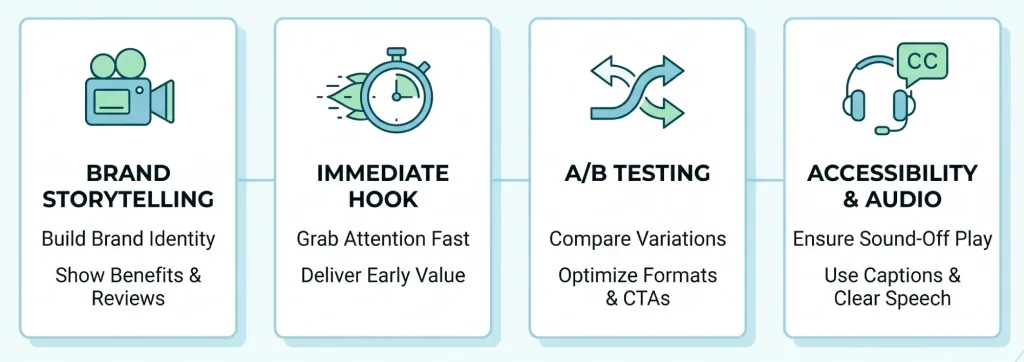
While standard custom lifestyle images serve a functional purpose, sponsored product video ads provide a significantly more effective medium for demonstrating product utility, scale, and unique selling propositions directly within the ad unit.
Because Sponsored Display videos auto-play silently by default, it is imperative to design creatives that do not rely on voiceovers. Incorporating clear, high-contrast text overlays and focusing the first three seconds on the core product benefit ensures your value proposition is communicated instantly, capturing the shopper’s attention as they scroll.
Evaluating the success of a top-of-funnel Sponsored Display campaign requires moving beyond standard Return on Ad Spend (ROAS). Because audience targeting is designed to introduce your products to new shoppers, Amazon provides New-To-Brand (NTB) metrics to accurately measure customer acquisition.
NTB data identifies whether a purchase was generated by a returning customer or a shopper who has not purchased from your brand within the past 12 months. By analyzing your NTB orders and NTB sales percentage, you can definitively measure the acquisition cost of net-new customers. Optimizing your campaigns against NTB metrics ensures your advertising budget is actually expanding your market share, rather than simply paying to re-engage shoppers who would have purchased organically.
Executing a Sponsored Display audience campaign requires precision within the Amazon Advertising console. To ensure your targeting parameters are accurately deployed, follow this step-by-step technical workflow.

Navigate to your Amazon Advertising console and click on the “Create campaign” button located on the main dashboard.

You will be presented with three distinct advertising architectures. Under the “Sponsored Display” tile, click “Continue” to proceed.

Enter your primary campaign parameters in the settings section. This crucial step involves establishing a strict nomenclature for your Campaign name, defining your start and end dates, and allocating your daily budget.

Scroll down to the “Targeting” section. By default, the system may suggest context-based targeting. You must actively toggle this selection to “Audiences”.

Within the expanded “Audiences” interface, you will see options for retargeting. Bypass the “Views remarketing” option and explicitly click on “Amazon audiences” to access the proprietary, pre-built behavioral segments.

Browse or utilize the search function to filter through the available Lifestyle, Interests, Life events, and In-market categories. Click “Add” next to the specific audiences you have identified for your strategy. The interface allows you to add multiple audiences at the same time to effectively build your desired potential reach.
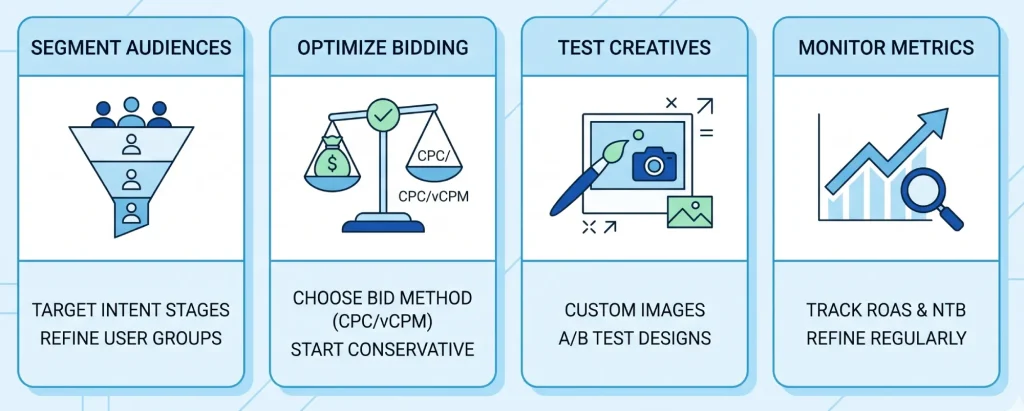
The defining characteristic of Sponsored Display Amazon audiences is a broader targeting scope combined with a high potential reach. Unlike Sponsored Products, which target high-intent search queries at the bottom of the funnel, Sponsored Display audiences target behavioral and demographic segments. Consequently, these campaigns typically exhibit a higher Advertising Cost of Sales (ACoS) (forcing sellers to re-evaluate what is a good ACoS on Amazon for top-of-funnel initiatives) and a lower immediate conversion rate profile Strict cost attribution and diligent performance monitoring are essential for maintaining an efficient campaign.
Scaling an Amazon brand in 2026 requires more than just “optimizing for ACoS.” It requires an integration of financial data and algorithmic execution to protect net margins against rising fulfillment costs and aggressive marketplace competition.
At SellerMetrics, we make sure that we are Sponsored Display compatible before launch. We can make automatic bid adjustments, reporting, and rules for Sponsored Display campaigns.

As Amazon CPCs continue to escalate, manual bid adjustments are no longer a viable strategy for enterprise-scale accounts. SellerMetrics utilizes advanced algorithmic bid automation to analyze trailing conversion data and real-time search term performance.
By executing high-frequency micro-adjustments, the software ensures your bids remain competitive for high-intent keywords while instantly throttling spend on low-velocity terms. This precision prevents the “budget bleed” that often occurs during aggressive 3P scaling, keeping your ACoS within a sustainable range even as baseline acquisition costs rise.

One of our best features to allow the user a certain level of control in their optimization. Our manual bidding page allows you to make manual changes to the bid of the Amazon audience. As long as bid automation is not enabled in the campaign then the user can change the bid according to the following:

A clean and organized Analytics and Charting page that allows you to analyze data by date range and account. We offer a reporting function by the following:

Using our rules settings, you can create rules around your Sponsored Display campaigns. For example, you can set to harvest ASIN to a Sponsored Display campaign from a Sponsored Product auto, using the following perimeters:
Every time there is 1 order that is less than 45% ACoS in the source campaign, it will automatically add it to the destination campaign/ad group.
Mastering Amazon Sponsored Display audiences is no longer just an experimental tactic; it is a fundamental requirement for scaling an e-commerce brand in today’s highly competitive marketplace. By shifting focus from purely bottom-of-the-funnel search intent to sophisticated, data-driven behavioral targeting, advertisers can proactively capture market share, build durable brand awareness, and drive incremental growth.
However, success with these campaigns requires moving beyond basic implementation. Leveraging video creatives to capture shopper attention, strictly optimizing bids between CPC and vCPM models based on your specific funnel objectives, and rigorously tracking customer acquisition via New-To-Brand (NTB) metrics are what separate average campaigns from highly profitable operations. Because audience targeting inherently operates with a broader net than exact-match search, diligent performance tracking is non-negotiable.
As you scale these advanced, top-of-funnel strategies, manual bid adjustments often become an operational bottleneck. At SellerMetrics, our Amazon PPC software is engineered specifically to support complex Sponsored Display architectures. Whether you need automated bid optimization based on strict ACoS targets, bulk manual adjustments for specific lifestyle segments, or granular analytics across your entire portfolio, our platform provides the algorithmic infrastructure required to scale your ads and maximize your overall return on investment.
About the author: Rick Wong is a Senior Amazon PPC Strategist at SellerMetrics with seven years of experience managing Amazon advertising campaigns across CPG, electronics, and home goods categories. He has overseen more than $50M in cumulative Amazon ad spend and specializes in Sponsored Brands and DSP strategy for mid-market brands scaling on Amazon.
Sponsored Display audiences are a top-of-funnel targeting architecture that allows advertisers to reach specific shopper segments based on first-party behavioral data, lifestyle signals, and content consumption across Amazon’s retail media network and third-party publishers.
Yes. In 2026, leveraging generative AI is standard practice. Amazon natively provides AI-driven image and copy generation within the ad console to quickly iterate lifestyle backgrounds and headline variants. Additionally, sophisticated sellers frequently utilize external AI video generation tools to scale high-quality video assets at a fraction of traditional production costs.
Beyond standard desktop and mobile retail pages, Sponsored Display video assets are now heavily integrated into Amazon’s premium off-platform properties. This includes shoppable interactive video formats on Twitch, Freevee, and premium Connected TV (CTV) placements, allowing you to drive direct conversions from living room screens.
Amazon’s advertising ecosystem is highly resilient to third-party cookie deprecation because it relies primarily on Amazon’s proprietary, first-party login data. Shoppers are tracked via their Amazon accounts across Prime Video, Twitch, and Kindle devices, ensuring highly accurate audience mapping even off-platform.
Top-of-funnel awareness campaigns should be evaluated using New-To-Brand (NTB) metrics, which measure the cost of acquiring shoppers who haven’t purchased from you in 12 months. For advanced attribution, sellers should utilize Amazon Marketing Cloud (AMC) to analyze path-to-purchase overlaps, revealing how SD Audience impressions assist downstream Sponsored Products conversions.
Advertisers choose between cost-per-click (CPC) for conversion-focused objectives, and cost per thousand viewable impressions (vCPM) for top-of-funnel reach. Because CPCs have risen significantly, integrating algorithmic bid automation software is highly recommended to manage micro-bidding efficiently.
Views remarketing is a bottom-funnel tactic targeting shoppers who have already viewed your specific product detail pages. Sponsored Display audiences target broad, prospective behavioral segments, meaning the shopper does not need to have any prior interaction with your brand.
Yes. Through the Amazon Ads console (and AMC integrations), brands can upload hashed, anonymized first-party customer lists (such as DTC email subscribers) to create Custom Built Audiences. This is highly effective for cross-selling strategies or building Lookalike audiences based on your best buyers.
Amazon categorizes audiences by analyzing an immense web of first-party deterministic data, including retail search frequency, purchase history, and content consumption across Amazon-owned properties like Prime Video, Amazon Music, and IMDb.
Optimization in 2026 requires a multi-layered approach: A/B testing generative AI ad copy, analyzing AMC reports to establish optimal frequency caps (to prevent ad fatigue), and dynamically shifting budgets between CPC and vCPM bidding models based on real-time acquisition costs.
13 June 2026
TweetLinkedInShareEmailPrint 8 min read By Rick Wong Updated Jun 13, 2026 TL;DR What is Amazon Multi-To...

12 June 2026
TweetLinkedInShareEmailPrint 8 min read By Rick Wong Updated Jun 13, 2026 TL;DR What is Alexa for Shopp...

8 June 2026
TweetLinkedInShareEmailPrint 14 min read By Rick Wong Updated Jun 08, 2026 TL;DR How should I structure...