9 March 2026
Wholesale vs Private Label: A Guide for Amazon FBA Sellers
TweetLinkedInShareEmailPrint 14 min read By Rick Wong Updated Mar 09, 2026 TL;DR What is Private Label ...

 10 August 2021

You need to design your modules to flow like a dedicated, cohesive landing page. Use high-quality images or 3D renderings, rely primarily on full-width modules, and use text overlays sparingly to ensure the layout remains clean and highly readable on mobile devices. Avoid heavy, generic text-based modules that detract from your brand’s premium feel.
No, you must view A+ content as a compounding, long-term investment. Unlike Amazon PPC which simply buys temporary traffic, A+ content is a permanent investment in your brand’s conversion rate. It builds long-term consumer trust and directly initiates your sales “Flywheel”—where higher conversions lead to more sales, better reviews, and improved organic rank over time.
Yes, A+ content is a highly effective mechanism for cross-selling and up-selling. By strategically showcasing your broader product line, you can present complementary items or premium alternatives to shoppers who are already engaged with your listing, thereby encouraging them to invest more in your brand and increasing your overall basket size.
Absolutely. While Amazon’s internal A9 algorithm might not directly index the visible text for native searches, Google’s crawlers absolutely read, index, and rank the text, headers, and image alt-attributes contained within your A+ modules. Meticulously writing keyword-rich copy helps your Amazon listing rank on Google’s first page for long-tail queries and gets your products on the radar of AI search engines.
In this article I will go over:
➡️ What effect does A+ have on conversion rates?
➡️ What an A+ Content can do to increase AOV and basket size?
➡️ What factors influence Amazon ranking and how A+ may help you enhance yours
➡️ 3 criteria that determine your keyword relevancy on Amazon
➡️ How great A+ content can initiate your Amazon flywheel
➡️ What components of an A+ page should you include and why
➡️ Understanding that A+ is a long-term investment rather than a one-time expense
➡️ When I think of A+ content, what are the MICRO and MACRO tactics?
In the world of Amazon consulting, a popular theme commonly occurs.
Right now, Amazon Advertising is making a lot of noise. As it should be. It’s bursting at the seams.
It doesn’t matter whether you advertise on Amazon if you can’t convert those customers.
The golden rule will always be:
This is my Pyramid Strategy, which I refer to frequently:
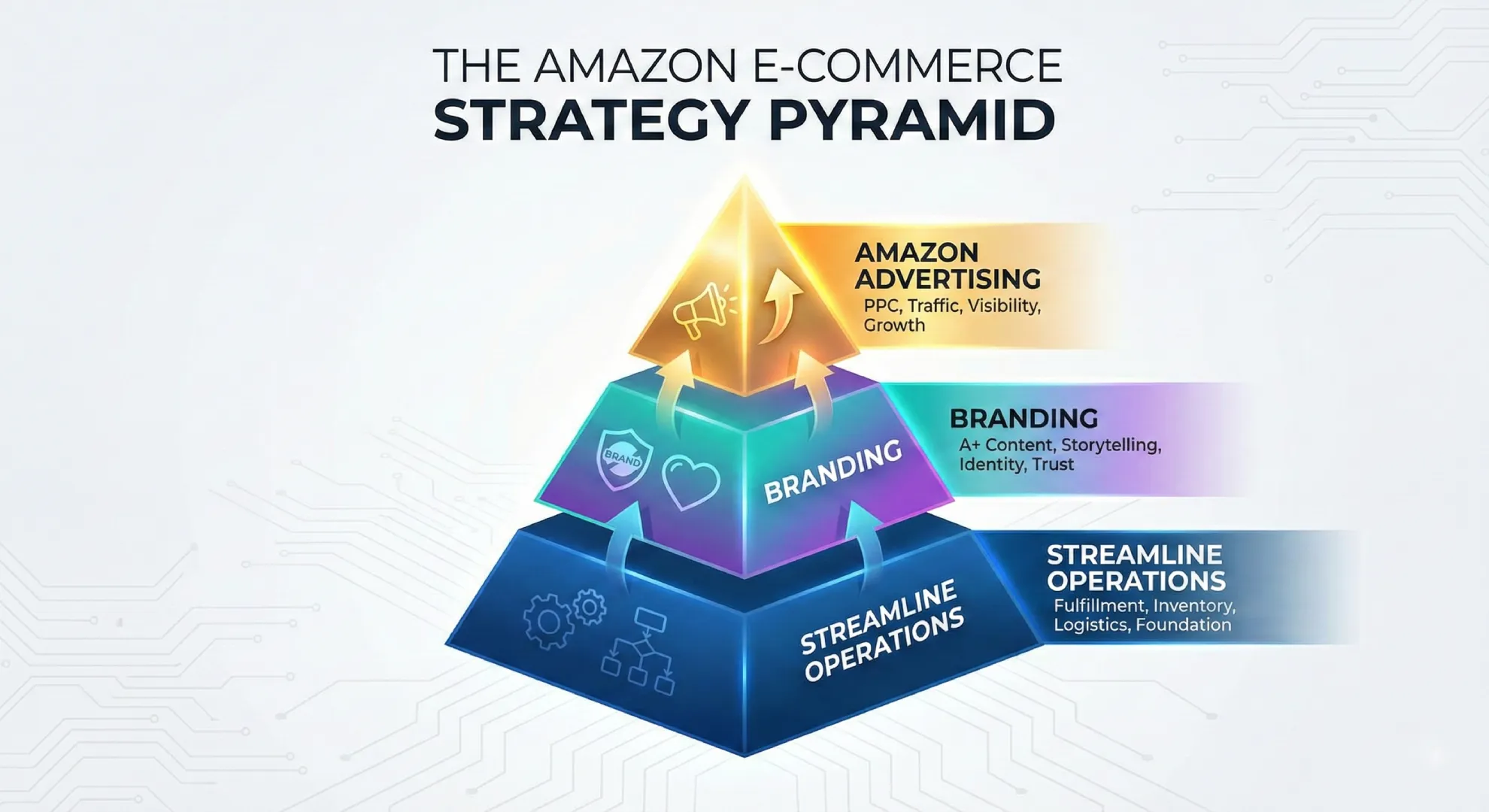
Brands selling on Amazon often report a bump in sales when adding or improving the A+ content of their listing. Especially when combined with a comprehensive Amazon Listing optimization, we’ve observed substantial sales growth across many of the accounts that we manage.
The logic is simple: If Amazon A+ Content is done well, it provides additional information and thus makes it more likely to persuade a customer to buy your product. It is also the only place on an Amazon product detail page where you can truly showcase your own branding.
Some argue that A+ content is not key because Amazon does not index keywords used on this section and it does not provide any direct rank juice. However, A+ will influence and improve your organic ranking indirectly for the reasons mentioned above and also Google does crawl your entire Amazon listing and therefore more compelling copy DOES impact your Google SEO!
According to internal Amazon A+ content benefits conversion rate studies, adding basic A+ Content to a product listing can yield a baseline conversion rate increase of up to 8% (Source). However, this is just the floor. When sellers optimize their layouts with highly targeted lifestyle imagery, scannable comparison charts, and persuasive brand storytelling, we routinely see conversion rate spikes of 15% to 20%.
This is particularly true for Amazon A+ Premium Content with Amazon not made available to almost all Amazon sellers (it used to be reserved for big brands only).
For high-ticket items or highly competitive categories like dietary supplements and electronics, the implementation of Premium A+ content, which features interactive hotspots and integrated video modules can really move the needle and push conversion rates up significantly. For other products that are fairly self explanatory (think clothing hangers), the conversion lift that can be expected from implementing A+ content is naturally much lower.
The psychology behind this conversion rate increase is simple but powerful: Online shoppers cannot touch or feel your product. By utilizing rich multimedia to answer lingering questions, showcase exact dimensions, and demonstrate the product in real-world scenarios, you effectively eliminate barriers to purchase. Shoppers that had questions about your product and were hesitant to pull the trigger are more likely to make it past the finish line if your listing leaves no question unanswered. Also: the branding benefits are significant. Any seller knows how hard it is to build a recognizable brand in the static corset that the Amazon product detail page is. The A+ content section is the one place where you can break free and create a visually unique experience: You are no longer just selling a commodity, you are providing a premium digital storefront experience that inherently builds trust, justifies your price point, and pushes the shopper to click the “Add to Cart” button.
A widespread misconception within the seller community is that the text inside your A+ Content modules is useless for SEO because Amazon’s A9 algorithm does not actively index it for organic Amazon search rankings. While it is true that A+ text won’t directly boost your keyword ranking within Amazon’s native search bar, ignoring the text in these modules is a massive mistake due to the profound Amazon A+ content Google SEO optimization impact.
Google’s crawlers behave differently than Amazon’s. Google crawls your entire listing and absolutely reads, indexes, and ranks the text, headers, and image alt-attributes contained within your A+ Content! This means that if you write comprehensive, keyword-rich copy within your A+ modules, your Amazon product detail page gains a significantly higher chance of ranking on the first page of Google for long-tail search queries.
The same is true for AI search engines such as Gemini and ChatGPT: They rely on crawling technology and robots to visit your Amazon listing pages to determine which products they recommend to their users. Adding keyword optimised A+ content that highlights different product usage scenarios and specific benefits to users will thus also help get on the radar of AI search platforms.
For US-based Amazon sellers, external traffic is the holy grail. Shoppers searching on Google typically have incredibly high buyer intent. By meticulously optimizing your A+ Content with secondary keywords, semantic variations, and descriptive image alt-text, you essentially turn your Amazon listing into an SEO-optimized landing page. This dual-engine approach allows you to capture shoppers who begin their buying journey on Google, funneling highly qualified external traffic directly to your listing, which Amazon ultimately rewards with a stronger organic rank via the Flywheel effect.
To truly master Amazon A+ content optimization, you must understand the tools at your disposal. Amazon currently offers two distinct tiers of enhanced content: Basic A+ Content and Premium A+ Content (sometimes referred to as A++). Knowing which to leverage depends heavily on your brand’s eligibility, catalog size, and overall marketing budget.
Basic A+ Content is completely free and accessible to any seller enrolled in the Amazon Brand Registry. It allows you to select from a variety of standard modules, including high-resolution image headers, standard text blocks, and the highly effective product comparison charts. For the vast majority of sellers, Basic A+ Content provides more than enough visual firepower to differentiate a product from non-brand-registered competitors, tell a compelling brand story, and cross-sell other products within your catalog.
Premium A+ Content takes the customer experience to an entirely new echelon. Historically reserved for massive vendors paying exorbitant fees, Amazon has slowly rolled out Premium A+ to third-party sellers who meet specific, much easier to achieve criteria: typically requiring a brand story published across the catalog and a history of approved A+ submissions. Premium A+ unlocks next-level interactive modules. Sellers gain access to wide-format lifestyle imagery, looping high-definition videos, interactive hover-and-click hotspots, and dynamic carousel galleries. If you are selling a luxury product, an item with complex mechanical features, or you simply want to dwarf your competitors with a high-end visual experience, upgrading to Premium A+ Content is a non-negotiable optimization strategy.
Amazon A+ content is only available to sellers that are brand registered or Amazon Launchpad program participants. To enroll in the Amazon brand registry, the IP of your brand (ie trademark/logo) should be registered with government trademark offices in the following countries:
United States, Brazil, Canada, Mexico, Australia, India, Japan, France, Germany, Italy, Turkey, Singapore, Spain, Netherlands, Saudi Arabia, the United Kingdom, the European Union, and the United Arab Emirates.
You can see the detail requirements from the official brand registry page here.
The overarching goal is to make The Flywheel Effect happen. As mentioned previously.
However, here’s a rundown of each component. What is each component’s purpose:
You are in effect creating momentum for the “Flywheel Effect”
Amazon A+ content is seen as a sunk cost by many brands when it should be considered an investment. In the first month, it may or may not earn a positive ROI. However, unlike Amazon Advertising, where you invest in traffic, A+ is all about conversion. You’re making an investment to build long-term consumer connections. You’re putting money into your brand’s image.
This is a compounding investment. The Flywheel Effect is directly influenced by A+. Over time, the Flywheel gain momentum. Your Flywheel spins faster when conversions increase, sales increase, basket size increases, repeat purchases occur, reviews increase, and sales rank improves. That procedure is repeated over and over again. For two years, one A+ page might not need to be changed, but you are still reaping the benefits
We are SellerMetrics, our Amazon PPC Software helps Amazon sellers, brands, KDP Authors and agencies navigate Amazon Advertising PPC via bid automation, bulk manual bid changes, and analytics.
Amazon A+ Content is a premium feature available to sellers enrolled in the Amazon Brand Registry. It allows brands to replace the standard text product description with rich media, including high-resolution lifestyle images, detailed infographics, comparison charts, and custom brand storytelling modules.
Multiple case studies and Amazon’s own data show that adding highly optimized A+ Content can increase your conversion rate by 5% to 20%. By visually answering customer questions, demonstrating product benefits, and building brand trust, A+ content directly reduces buyer hesitation and drives more sales.
Basic A+ Content is free for brand-registered sellers and includes standard image, text, and comparison chart modules. Premium A+ Content (A++) offers advanced, highly interactive features such as looping videos, clickable hotspots, wide-format imagery, and Q&A modules, offering a high-end shopping experience.
Yes. While Amazon’s internal A9 algorithm does not directly index the text within A+ modules for native Amazon searches, Google’s algorithm does index both the text and the image alt-attributes. This means well-optimized A+ Content can help your Amazon listing rank higher in Google search results, driving lucrative external traffic to your product.
The text visible to customers in your A+ Content modules is not indexed by Amazon’s A9 search algorithm. However, the image alt-text (the descriptive text assigned to the images you upload in the backend) is indexed by Amazon. Therefore, it is critical to use relevant keywords in your alt-text.
Currently, Amazon is offering Premium A+ Content for free to third-party sellers who meet specific eligibility requirements, which usually include having an approved “Brand Story” applied across your catalog and a history of approved A+ submissions. Historically, it was a paid feature reserved exclusively for Vendor Central users.
To create Amazon A+ Content, you must be a professional seller enrolled in the Amazon Brand Registry. This requires having an active, registered trademark for your brand. Sellers participating in the Amazon Launchpad program are also eligible.
Absolutely. Brand-registered sellers can use Amazon’s “Manage Your Experiments” (MYE) tool within Seller Central to run split tests on their A+ Content. This allows you to test different layouts, images, and copy against each other to see which version generates a higher conversion rate.
Image size requirements vary depending on the specific module you choose. For example, standard full-width header images typically require a resolution of 970 x 600 pixels. It is crucial to adhere strictly to Amazon’s sizing guidelines when cropping your images to prevent pixelation, distortion, or module rejection.
Once you submit your A+ Content through Seller Central, Amazon’s system reviews it to ensure it complies with their guidelines (e.g., no prohibited claims, no promotional pricing text). Approval typically takes anywhere from 24 hours to 7 business days. If rejected, Amazon will provide a reason so you can adjust and resubmit.

9 March 2026
TweetLinkedInShareEmailPrint 14 min read By Rick Wong Updated Mar 09, 2026 TL;DR What is Private Label ...

15 February 2026
TweetLinkedInShareEmailPrint 8 min read By Rick Wong Updated Feb 16, 2026 TL;DR Why is Amazon charging ...

15 February 2026
TweetLinkedInShareEmailPrint 8 min read By Rick Wong Updated Feb 16, 2026 TL;DR Is investing in custom ...