
13 June 2026
Amazon Multi-Touch Attribution: What Sellers Need to Know in 2026
TweetLinkedInShareEmailPrint 8 min read By Rick Wong Updated Jun 13, 2026 TL;DR What is Amazon Multi-To...

 18 January 2026

Your “healthy” ACOS relies on outdated math that ignores new 2026 variable fees like the “Logistics Tax” and “Low-Inventory Surcharges.” You are likely overspending because your actual margin is much thinner than what your dashboard displays.
Real ACOS” targets Contribution Margin rather than just Revenue. You calculate your true break-even point by subtracting all variable fees (Inbound Placement, Returns, Low-Inventory) from the sales price before setting your target.
You must act immediately to avoid the “Death Spiral” of the $0.89/unit Low-Inventory Surcharge. If stock drops below 35 days, slash your bids and lower your target ACOS by 10 points to slow velocity and escape the fee.
Treat these fees as a “Customer Acquisition Cost” that lowers your profit ceiling. If you pay the premium for minimal shipment splits (~$0.30/unit), you must bid less aggressively than competitors who optimized their logistics to avoid the fee.
It is mid-January 2026. The Q4 dust has settled, and you are likely staring at your year-end P&L, wondering why your record-breaking revenue didn’t result in record-breaking profit. You hit your ACOS targets. You optimized your bids. You expanded your catalog. Yet, the cash landing in your bank account feels lighter than it should.
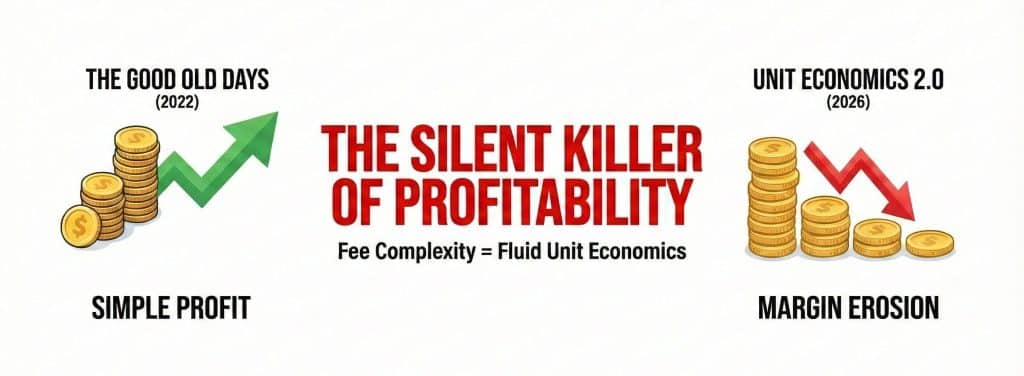
If this sounds familiar, you are the victim of a silent killer that has been slowly suffocating Amazon sellers for the last 24 months: Margin Erosion via Fee Complexity. Most sellers did not “mess up” in 2025; they simply carried old assumptions into a new fee model.
In the “good old days” (circa 2022), calculating profitability was simple. You had your Cost of Goods Sold (COGS), a flat referral fee, and a predictable FBA fulfillment fee. Your “Break-Even ACOS” was a static number you could scribble on a napkin. If your margin was 30%, your Break-Even ACOS was 30%. Simple.
Those days are dead.
If your dashboard still shows “healthy” ACOS numbers but your bank balance keeps shrinking, the problem is not traffic or conversion: it is math that no longer reflects reality.
With the rollout of the 2026 fee structure—including the more aggressive Inbound Placement Service fees, the granular Low-Inventory Level surcharges, and the new Returns Processing expansions—your unit economics are no longer static. They are fluid. A product that is profitable today might be unprofitable tomorrow simply because your stock level dipped below 28 days, triggering a fee that destroys your contribution margin.
If you are still managing your PPC campaigns using 2025 ACOS targets, you are likely bleeding money on every sale. It is time to upgrade your operating system. Welcome to Unit Economics 2.0.
In this guide, we are going to dismantle the “Traditional ACOS” metric, expose why it is failing you, and teach you how to calculate “Real ACOS”, the only metric that matters in the high-fee environment of 2026.
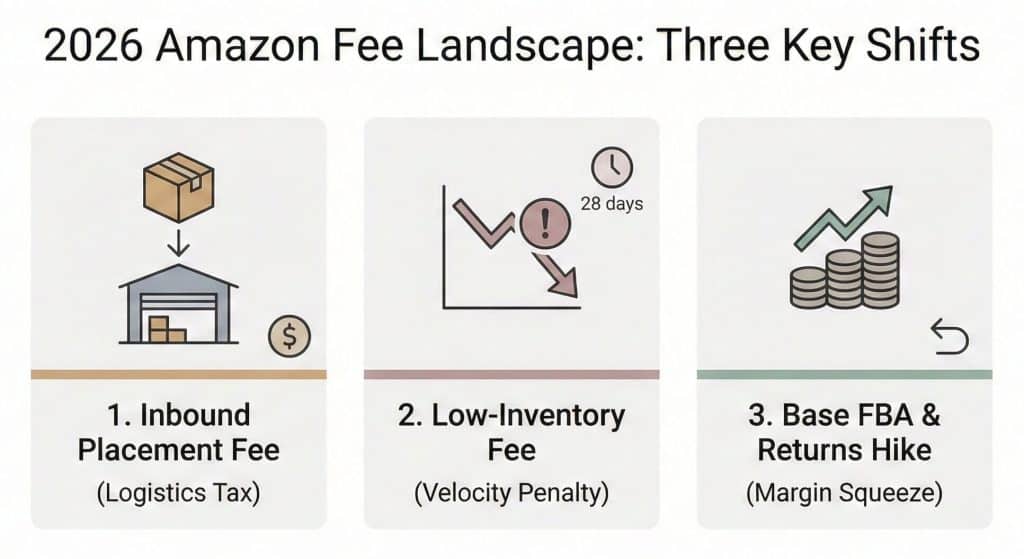
Before we fix the math, we have to acknowledge the damage. Amazon’s 2026 fee update wasn’t just a price hike; it was a structural shift toward “Granularity.” Amazon claims this aligns costs with services. For sellers, it means you are now paying for inefficiencies you used to get for free. These fees rarely appear in isolation, which is why their combined impact feels worse than any single increase.
Here are the three horsemen of the 2026 margin apocalypse:
Introduced in 2024 and tightened in 2026, this fee charges you for the privilege of sending inventory to a single location.
This is the most dangerous fee for PPC operators. As of January 15, 2026, this fee applies at the FNSKU level (not just parent ASIN).
The average base FBA fee increased by roughly $0.08 per unit this year. That sounds negligible until you realize it is an average. For “Large Standard” items, the bread and butter of most private labelers, the hike is often steeper when combined with dimensional weight adjustments. Furthermore, high-return categories (apparel, home goods) now face aggressive “Returns Processing Fees” that effectively tax you for bad customer behavior.
Let’s look at the math that is likely losing you money right now.
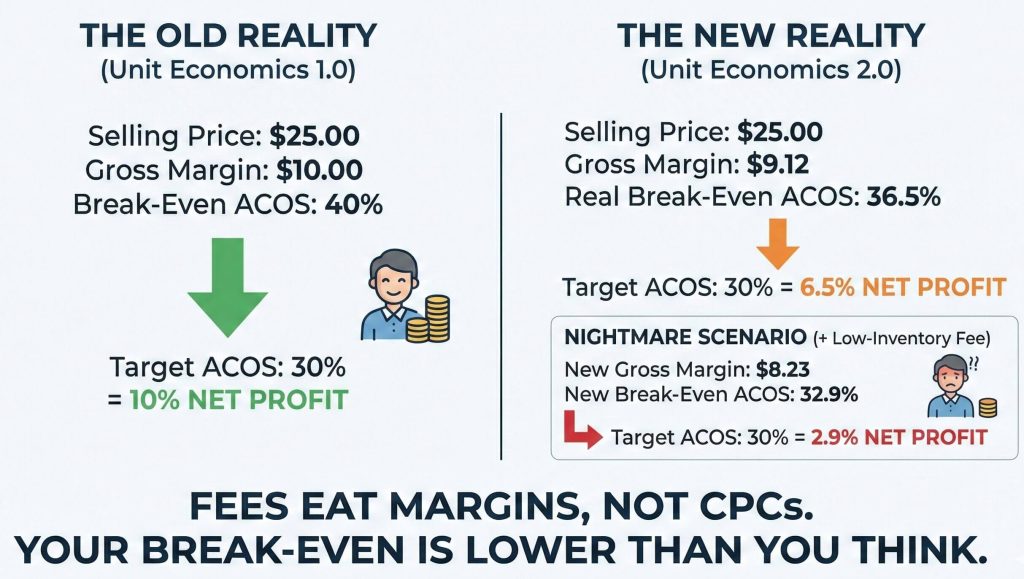
The Old Formula (Unit Economics 1.0):
In this world, if your PPC ACOS is 30%, you are making a 10% net profit. You feel good. You scale spend. This is the same math most sellers still use inside Amazon Ads, even though Amazon’s own fee structure no longer supports it.
The New Reality (Unit Economics 2.0):
Now, let’s apply the 2026 reality to that same product.
Notice that nothing about your ads changed here: no CPC increase, no bid mistake, only fees quietly eating margin.
The Deviation:
Your Break-Even point has dropped from 40% to 36.5%.
If you are still targeting a 30% ACOS, your profit buffer has shrunk from 10% to 6.5%. You have lost 35% of your net profit without your CPCs changing by a single penny.
And this is the best-case scenario.
The Nightmare Scenario:
What happens if you run a successful lightning deal, your inventory dips to 20 days of supply, and you trigger the Low-Inventory Fee?
If your PPC dashboard shows a 30% ACOS, you think you are profitable. In reality, you are operating at a razor-thin 2.9% margin. One bad return, and you are underwater. This is why many sellers feel profitable all week and then realize on payout day that they worked for almost nothing.
To survive 2026, you must stop calculating ACOS based on Revenue and start calculating it based on Contribution Margin.
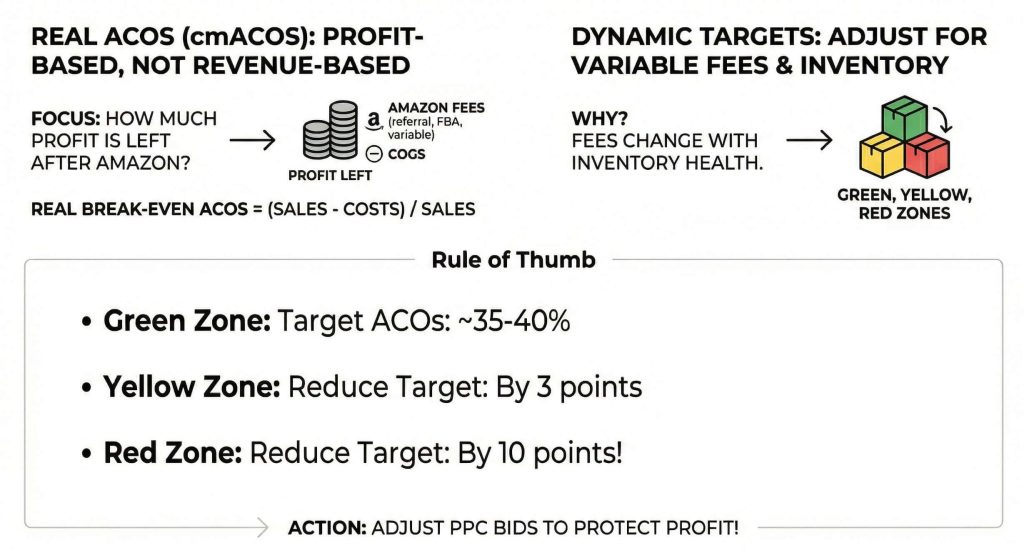
We call this “Real ACOS” or cmACOS.
Real ACOS forces every advertising decision to answer one question: How much profit is actually left after Amazon gets paid?
The formula for your new Break-Even target is:
$$\text{Real Break-Even ACOS} = \frac{\text{Sales Price} – (\text{COGS} + \text{Referral Fee} + \text{FBA Base} + \text{Variable Fees})}{\text{Sales Price}}$$
Where Variable Fees = Inbound Placement Fee + Low-Inventory Fee + Returns Processing Fee.
The “Dynamic Target” Methodology
The problem is that “Variable Fees” change. You cannot set a static ACOS target for the year anymore. In 2026, a single static ACOS target is a liability, not a benchmark. You need a Dynamic ACOS Target that changes based on your inventory health.
Rule of Thumb for 2026:
If you do not adjust your PPC bids when you enter the “Red Zone,” you are effectively paying Amazon a fee to penalize yourself.
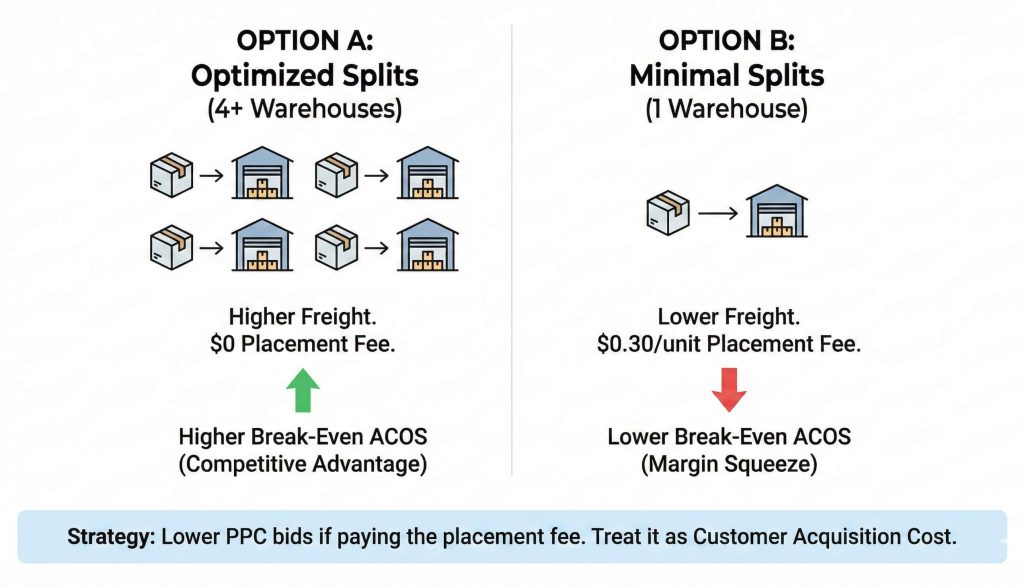
Let’s dig deeper into the Inbound Placement Service fee. Many sellers treat this as “Cost of Goods.” I argue you should treat it as “Customer Acquisition Cost.”
Why? Because speed converts.
Amazon charges you less if you split shipments to 4+ warehouses (Amazon-Optimized Splits). They charge you more if you send to one (Minimal Splits).
If you choose Option B, that $0.30 comes directly out of your margin.
For a $20 item, $0.30 is 1.5% of revenue.
This means your Break-Even ACOS is permanently 1.5% lower than a competitor who chooses Option A.
Two sellers with identical products and ads can now have very different profit ceilings based purely on shipping choices.
Actionable Strategy:
Audit your “Inbound Placement” reports. If you are consistently paying the minimal split fee, you must lower your PPC bid aggression. You cannot afford to bid head-to-head with a competitor who has optimized their logistics to avoid that fee. They have a mathematical advantage over you.
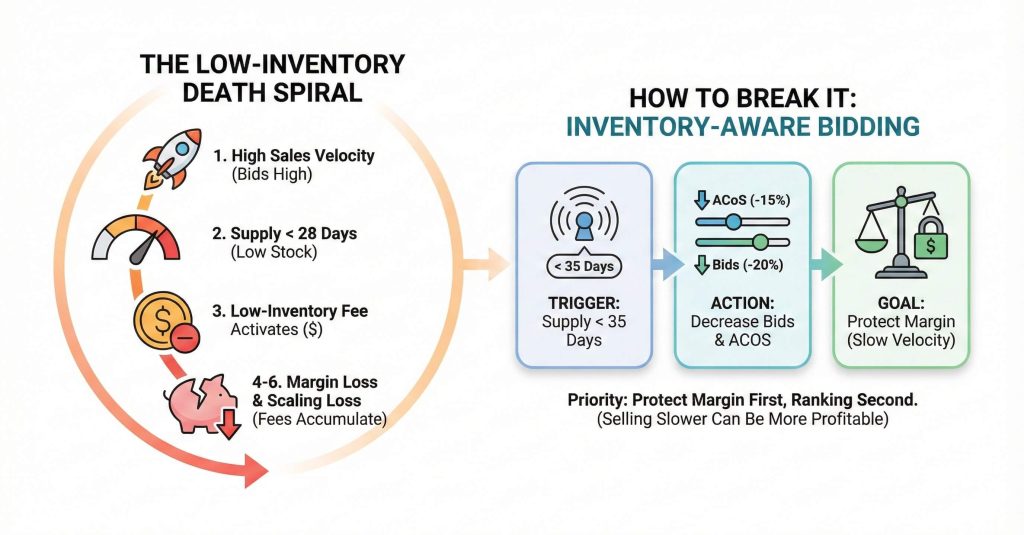
This is the scenario that keeps seasoned sellers up at night.
Phase 1: You launch a new campaign. Bids are high. Sales velocity spikes.
Phase 2: Your “Historical Days of Supply” drops below 28 days.
Phase 3: Amazon activates the Low-Inventory Level Fee ($0.89/unit).
Phase 4: You do not adjust your PPC bids. You keep spending at a 30% ACOS.
Phase 5: The extra fee eats your remaining margin. You are now scaling a loss.
Phase 6: Because you are selling out faster, you stay in the Low-Inventory zone longer, racking up more fees.
Most sellers notice this spiral only after profits disappear, not when the fee first activates.
This is the Death Spiral.
How to Break It:
You must implement Inventory-Aware Bidding.
Using software (like SellerMetrics) or robust spreadsheets, you need to tag SKUs that are approaching the 35-day supply mark.
This adjustment protects margin first and ranking second, which is the correct priority in a high-fee environment.
In 2026, selling more slowly is sometimes more profitable than selling faster.
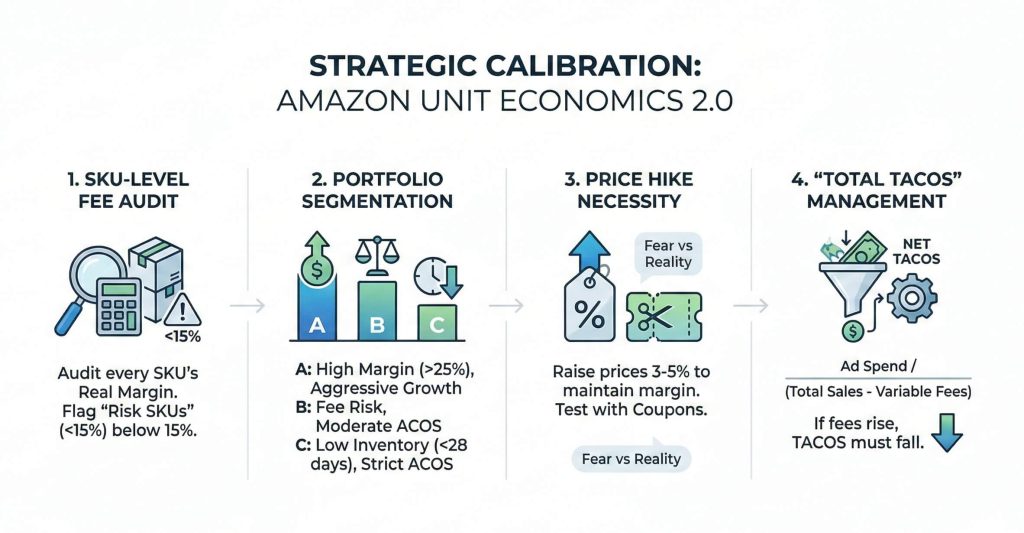
You cannot change Amazon’s fees. You can only change your reaction to them. Here is your battle plan for Unit Economics 2.0.
Stop looking at account-wide averages. Account averages hide loss-making SKUs that quietly subsidize the rest of your catalog. Go to the Revenue Calculator in Seller Central or download the Fee Preview Report.
Identify the “Fee Weight” of every SKU.
Don’t structure your PPC portfolios by product category (e.g., “Pants,” “Shirts”). Structure them by Margin Profile.
This structure makes bid decisions mechanical instead of emotional.
There is no way around it: For many US sellers, the 2026 fees require a retail price adjustment.
To maintain your 2025 margin dollars, you likely need a 3% – 5% price increase.
ACOS (Ad Spend / Ad Sales) is becoming less useful. TACOS (Total Ad Spend / Total Sales) is the king.
However, you need to track “Net TACOS”—Total Ad Spend / (Total Sales – Variable Fees). TACOS only matters if the “S” still represents profit.
If your variable fees are rising, your TACOS must fall to keep the business healthy.
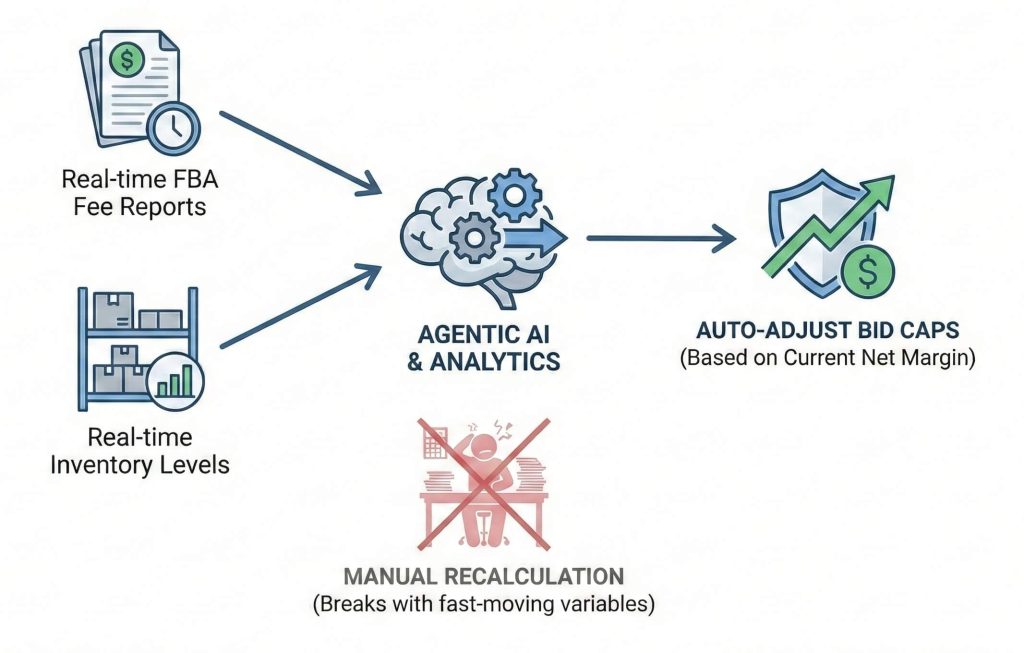
Let’s be honest: You cannot manually recalculate the Break-Even ACOS for 500 SKUs every time a shipment arrives or stock dips. The variables move too fast. Manual PPC management breaks once fees change faster than humans can react.
This is where “Agentic AI” and advanced analytics tools come in. You need a system that:
If your PPC software is blind to your Inventory Health, it is driving you off a cliff.
In 2026, sellers who chase revenue without recalculating profit will grow faster—and fail faster. The era of “Top Line Vanity” is over. In 2024 and 2025, you could brag about $10 million in sales. In 2026, if that $10 million comes with $4 million in ad spend and $5 million in fees, you have built a hobby, not a business.
The 2026 FBA fee hikes are a wake-up call. They demand precision. They demand that we stop treating ACOS as a static goalpost and start treating it as a dynamic lever that moves in rhythm with our logistics.
Your Action Plan:
Unit Economics 2.0 isn’t about selling more. It’s about keeping more. The sellers who survive 2026 will not be the loudest. They will be the most disciplined.
It is a surcharge applied to units sold when your product’s historical days of supply (measured over the last 30 and 90 days) drops below 28 days. In 2026, this is calculated at the FNSKU level, meaning it is very specific to the exact variation (size/color) you are selling. The fee typically ranges from $0.32 to over $1.00 per unit, depending on size.
It increases your Cost of Goods Sold (COGS). If you pay an average of $0.30 per unit in placement fees, your profit margin decreases by that amount. This means your Break-Even ACOS is lower. If you don’t lower your PPC ACOS target to match, you will burn cash.
Not necessarily, but you should lower your bids. Turning off ads completely can hurt your organic ranking (“ranking cliff”). The better strategy is to lower your target ACOS significantly (e.g., from 30% to 15%) to maintain visibility while protecting your reduced margin.
Yes, by selecting “Amazon-Optimized Shipment Splits” when creating a shipping plan. This usually requires you to send inventory to 4 or more different fulfillment centers. You save the Amazon fee, but you pay higher freight costs to your carrier. You must calculate which option is cheaper for your specific shipment.
Because your costs went up. Break-Even ACOS is calculated as (Sales Price – All Costs) / Sales Price. Since Amazon increased fulfillment fees and added placement fees, “All Costs” is a higher number, leaving less room for ad spend.
Not all, but the scope has expanded. High-return-rate products (even outside of apparel) can now trigger processing fees if their return rate exceeds the category threshold. Check your “FBA Returns” report to see if you are being charged this fee.
In 2026, you should do it monthly or whenever you send a new batch of inventory. Because placement fees vary by shipment, your margin fluctuates throughout the year.
Historically, 15-20% was the gold standard. In the high-fee environment of 2026, maintaining a 15% Net Margin is considered excellent performance. Anything below 10% is risky due to the volatility of ad costs.
It might be temporary, but profit is more important than rank. Furthermore, most competitors are facing the same fee hikes and will also be forced to raise prices. The entire market floor is lifting.
Yes. Advanced analytics tools allow you to input your COGS and automatically pull Amazon fee reports to show you your “True Net Profit” per SKU. This allows you to bid based on real profit, not just revenue.
13 June 2026
TweetLinkedInShareEmailPrint 8 min read By Rick Wong Updated Jun 13, 2026 TL;DR What is Amazon Multi-To...

12 June 2026
TweetLinkedInShareEmailPrint 8 min read By Rick Wong Updated Jun 13, 2026 TL;DR What is Alexa for Shopp...

8 June 2026
TweetLinkedInShareEmailPrint 14 min read By Rick Wong Updated Jun 08, 2026 TL;DR How should I structure...