
1 July 2026
Amazon vs Walmart: What’s the Best Place to Sell in 2026?
TweetLinkedInShareEmailPrint As Walmart continues growing its marketplace, many US eCommerce brands start won...

 29 March 2026

While driving traffic to your own site gives you better data, sending traffic to Amazon leads to unmatched checkout conversion rates. Additionally, Amazon’s algorithm rewards external traffic with a “Halo Effect.” This means the sales velocity you create off-platform directly improves your organic keyword rankings on the marketplace. The 10% bonus essentially supports this strategy.
No. In 2026, you can bypass the traditional months-long wait time for a trademark. By filing your trademark through a law firm in the Amazon IP Accelerator network, you can gain early access to Brand Registry and the Brand Referral program while your trademark is still pending.
No. Generating and implementing Amazon Attribution tags in your Seller Central or Advertising console is completely free. Your only expenses are your actual ad spends on external platforms like Google, Meta, or TikTok (the Brand Referral Bonus helps pay for).
Stocking out. If your external ads (like a viral TikTok or an email blast) are too successful and deplete your FBA inventory, your listings will go inactive. A stock-out completely neutralizes the organic ranking boost you earned from the external traffic. Always align your off-Amazon ad spend with your current inventory levels.
If you have been selling on Amazon lately, you already know the harsh reality: Amazon PPC costs are rising, and organic real estate is shrinking. But what if, instead of fighting for expensive clicks in the Sponsored Products carousel, you could get Amazon to actually pay you to bring in your own traffic? Enter the Amazon Brand Referral Bonus (BRB).
The genesis of this can be seen in their Amazon Associates program, which allows affiliate marketers to drive non-Amazon traffic into Amazon marketplace products. For Amazon sellers, we see progressively how the Amazon A9 algorithm is updated to give stronger weights to off-Amazon traffic.
In 2026, this program is a vital lifeline for protecting your margins. By rewarding you with an average 10% credit on sales driven by external traffic, Amazon is literally subsidizing your off-platform marketing. Whether you are running Meta ads, building an email list, or working with TikTok creators, here is everything you need to know to set up your attribution tags, drive high-converting external traffic, and scale your profits this year.
The Amazon Brand Referral Bonus program allows Amazon merchants to earn bonuses from off-Amazon marketing activities.
Brands/Sellers receive an average of 10% on sales from visitors they generate to Amazon through the Brand Referral Bonus program.
This program will attribute the Amazon sale generated from off Amazon traffic from up to 14 days. The one drawback is that this bonus will not be in a form of cash, but will be a credit against their Amazon fees.
As mentioned Brands can earn a 10% bonus on their qualifying sales on average. Estimate your bonus by multiplying your qualifying sales by the minimum bonus rate in the respective product category. Your real bonus rate may differ depending on factors like additional shipping and gift-wrapping fees, which may differ amongst sellers.
The bonus applied to your off Amazon attributed sales can be seen in your weekly report. You can see the exact bonus schedule here.
So how can Amazon figure out what sales you have driven for them? You will need to set up Amazon attribution tags, more on that later.
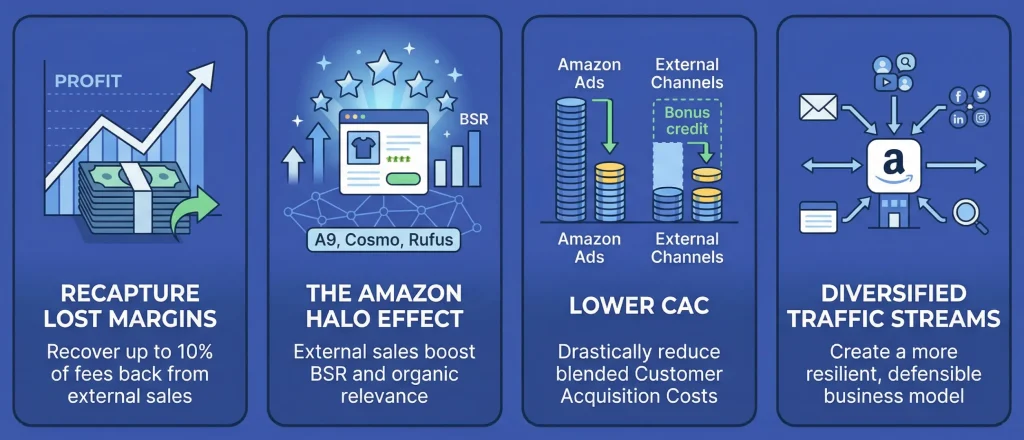
Earning a credit on your referral fees is just the tip of the iceberg. Forward-thinking brands are utilizing the Brand Referral Bonus (BRB) program as a cornerstone of their 2026 growth strategies for several strategic reasons:
Only brand-registered merchants are eligible for the Amazon Brand Referral Bonus. Your brand’s intellectual property (i.e., your trademark or logo) must be registered with government trademark offices in eligible countries, such as the United States, Canada, Mexico, the United Kingdom, and the European Union to qualify for enrollment in the Amazon Brand Registry.
Pro Tip for 2026: You do not necessarily need to wait months for a fully approved trademark. By filing through an Amazon-approved law firm via the Amazon IP Accelerator, you can gain early access to Brand Registry (and the Brand Referral Bonus program) with a pending trademark.
If you are not the brand owner, you cannot use the BRB program, but you may still be able to join the Amazon Associates program to earn commissions from the sales you generate. Notably, Amazon allows eligible sellers to participate in both the Amazon Brand Referral program and the Amazon Associates program simultaneously. You can essentially “double dip” and earn rewards from both channels for the exact same traffic.
While Amazon advertises an “average of 10%” bonus, the actual credit you receive is heavily dependent on the specific product category you are selling in. It is crucial to factor these minimum bonus rates into your advertising margins. Here is a look at the typical breakdown:
Note: Your exact bonus is calculated by multiplying your qualifying sales by the category’s minimum bonus rate, factoring in variables like shipping and gift-wrapping fees.
As mentioned it will not be a cash bonus, but a credit against your Amazon fees.

To allow for order cancellations and customer returns, there is a two-month wait before the credit will appear in your account. If an eligible sale was made in July, the bonus will be credited to your account in September. In September and beyond, the bonus will be utilized to deduct referral fees until the all the attributed bonus is credited.
To find the report for Amazon Referral Bonus, you can download a report within Seller Central. On the Seller Central home you can go to Brands>>Brand Referral Bonus. Every Friday, the system provides a report that summarizes the estimated bonus amount earned over the preceding 90 days.
You will need to create tags with Amazon Attribution to track your non-Amazon marketing efforts. To begin creating tags with Amazon Attribution, click here, or register if you are not already a member of the Amazon Attribution program.
We have a very detailed how-to tutorial on the Amazon Attribution set up here.
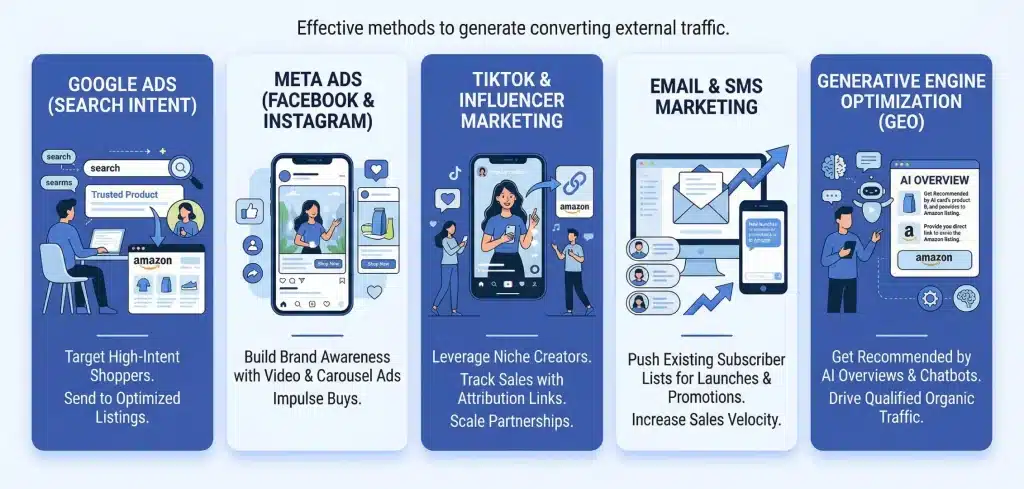
To truly capitalize on the Brand Referral Bonus, you need a multi-channel marketing approach. Here are the most effective strategies to generate external traffic that converts:
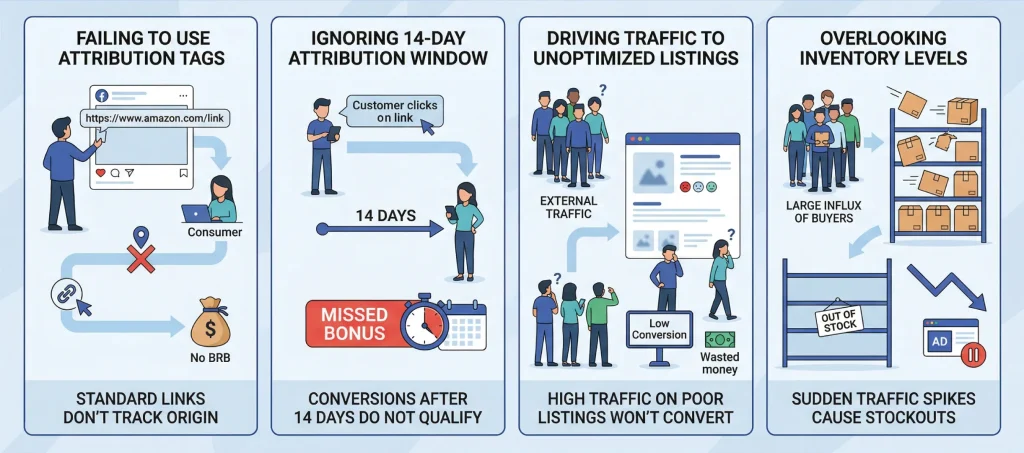
While the BRB program is highly lucrative, sellers frequently leave money on the table by making these common operational errors:
By driving off-Amazon traffic to your Amazon product will be the ultimate win-win between yourself as a seller and Amazon.
A lot of sellers seem to lose sight of the bigger plot, and that is Amazon is in a long-term struggle with Google and Facebook for the audience’s attention. Yes I know Amazon seems, at times, very antagonistic towards its sellers. But if Amazon can win the battles against its competitors, it can only benefit the Amazon sellers as the overall pie gets bigger.
If you can create a situation where you can improve your Amazon SEO, get credit for sales, and help Amazon increase its marketplace presence at the same time then you are aligning your goals with Amazon’s. The sellers that are successful in doing this will be rewarded with tangible and intangible benefits that allow your brand to be more competitive on Amazon over time.
Navigating the intersection of off-Amazon advertising, Amazon Attribution, and the Brand Referral Bonus can be overwhelming. At SellerMetrics, we help Amazon sellers and brands orchestrate this exact ecosystem. We provide comprehensive Amazon PPC audits, advanced keyword targeting, and holistic advertising management to ensure that every dollar you spend (both on and off Amazon) is driving maximum profitability. By aligning your external traffic strategies with your internal Amazon PPC campaigns, we help you lower your ACoS, recapture referral fees, and dominate your category.
There is a lot to consider when implementing the Amazon Brand Referral Bonus, but the payoff is undeniable. If you already have a brand website, an email list, or are running external ads, adding Amazon Attribution tags is a low-effort, high-reward optimization that instantly boosts your bottom line. It incentivizes you to finally build those off-Amazon funnels, diversifying your traffic and protecting your brand from rising PPC costs.
As the marketplace matures, the blueprint for a successful Amazon business is evolving. We are seeing Amazon enforce much stricter supplier and supply chain requirements in 2026, making formal business structures (like having a registered LLC and a valid Resale Certificate) more vital than ever to verify and protect your brand. However, do not let that intimidate you. The barrier to entry remains low enough for anyone willing to put in the work to get started. By legally formalizing your business and leveraging profitability programs like the Brand Referral Bonus, you are building a defensible, highly lucrative brand that thrives both on and off the platform.
About the author: Rick Wong is a Senior Amazon PPC Strategist at SellerMetrics with seven years of experience managing Amazon advertising campaigns across CPG, electronics, and home goods categories. He has overseen more than $50M in cumulative Amazon ad spend and specializes in Sponsored Brands and DSP strategy for mid-market brands scaling on Amazon.
The Amazon Brand Referral Bonus (BRB) is a program that rewards brand-registered sellers for driving external traffic to their Amazon listings. Sellers receive an average bonus of 10% of the product’s sales price, credited against their Amazon referral fees.
To be eligible, you must be a brand owner enrolled in the Amazon Brand Registry. Additionally, you must use Amazon Attribution tags to track the external traffic you send to your listings.
While the average bonus is 10%, the exact amount depends on your product category. Categories like Toys and Apparel earn around 10%, while Electronics may earn around 5%, and Jewelry can earn up to 14%.
Amazon tracks these sales using Amazon Attribution tags. You must generate a unique tracking URL within the Amazon Advertising console and use that specific link in your external ads, emails, or social media posts.
The program operates on a 14-day attribution window. If a customer clicks your external link and purchases your product on Amazon within 14 days, you will receive the bonus credit.
Bonuses are not paid out immediately. There is a two-month waiting period to account for order cancellations and customer returns. After two months, the bonus is applied to your account.
No, the Brand Referral Bonus is not a cash payout. It is issued as a credit that is automatically applied against your future Amazon referral fees.
Yes, indirectly. By driving external traffic to your listings, you increase your sales velocity. Amazon’s A9 algorithm heavily favors listings that bring new traffic to the platform, which can significantly boost your organic search rankings.
Yes, Amazon allows you to participate in both programs simultaneously. If you are an Amazon Affiliate and a brand owner, you can earn both the affiliate commission and the Brand Referral Bonus on the same sale.
The most effective channels vary by product, but highly successful strategies typically include Google Search Ads for high-intent buyers, Meta (Facebook/Instagram) Ads for brand awareness, email marketing to existing customers, and influencer partnerships on TikTok or YouTube.

1 July 2026
TweetLinkedInShareEmailPrint As Walmart continues growing its marketplace, many US eCommerce brands start won...

8 May 2026
TweetLinkedInShareEmailPrint 8 min read By Rick Wong Updated May 09, 2026 TL;DR Can I use AI tools like...

8 May 2026
TweetLinkedInShareEmailPrint 9 min read By Rachel Go Updated May 08, 2026 TL;DR Why is operating exclus...