5 April 2026
The MCP Blindspot: How to Feed Real-Time FBA Margins into Claude Code
TweetLinkedInShareEmailPrint 20 min read By Rick Wong Updated Apr 05, 2026 TL;DR Why is my AI ad tool d...

 24 January 2026

In 2026 boosting Amazon Product Listing traffic via an effective Amazon SEO Strategy (more about our Amazon SEO Services) is more important than ever: Amazon PPC advertising CPCs are constantly increasing and having a healthy share of organic traffic is key to staying profitable. What’s new in 2026 is that Amazon shoppers are increasingly turning to “COSMO” and “Rufus” – Amazon’s AI Search tools (More on this topic: How to optimize amazon listing for Rufus). So besides optimizing for Amazon’s traditional A9 algorithm Amazon sellers need to be ready for Amazon AI search.
In this post we dissect the mechanics behind Amazon’s search algorithm, share nine critical steps to help you get your listing featured on top of Amazon search results and as bonus help you bulletproof your Amazon SEO strategy for the age of AI.
Following this SEO step-by-step guide will help you get your product listings to the top of the Amazon search results.
Article Contents
For those of you who are looking for straight answers, here is a list of the seven steps you need to follow to optimize your listing pages:
Now let’s break all these steps down in more detail.
When thinking about ways to squeeze more out of your product listings, you inevitably realize that you need to understand which variables Amazon looks at when it rolls the dice on a search query.
The decision making that makes this split second decision is referred to as the A9 algorithm. The objective of this sophisticated system is ultimately designed to arrange the search results page in such a way that both Amazon and also potential shoppers benefit: it features the products that a shopper is most likely going to buy and that thus generate the most revenue for Amazon on top of the search results page.
Sales velocity, click-through rate, and conversion rate each play a significant role in how your product appears in search results.
Listings that generate higher sales relative to competing products within the same category tend to gain more visibility, as Amazon’s algorithm interprets consistent sales and positive engagement as indicators of a desirable product.
When you try to improve your listings, you thus need to do so with both Amazon shoppers, but also the Amazon algo in mind.
You need to ensure that your listing is written in a clear, concise manner and fully aligned with buyer expectations. Also other factors like the quality of the images that you use and whether or not your listings have A+ content, how many (positive) reviews you have etc. impacts the verdict of the search algorithm. From a technical point of view, the process of search-engine-optimization has the goal to brush up your listings so that they stand the best chance to feature in prominent positions on the search results page. This article is the most comprehensive guide on this topic you can possibly find and will leave no questions unanswered. Read our detailed blog post on the Amazon A9 algorithm to learn more about the weighting of different ranking factors.
For the last decade, Amazon SEO strategy was a straightforward game: sellers reverse engineered the “A9 Algorithm”, did their keyword research (more on this in the next section) and then stuffed their listing titles, bullet point copy and backend sections with keywords. While traditional SEO optimization is still key in 2026, the landscape is evolving:
According to official statistics from Amazon, in 2025 250 million Amazon shoppers used Rufus. Monthly users are up 140% YoY and interactions were up 210% YoY as compared to 2024. What’s most critical for sellers is that Amazon users who use Rufus during a shopping journey are 60% more likely to buy a product (Source).
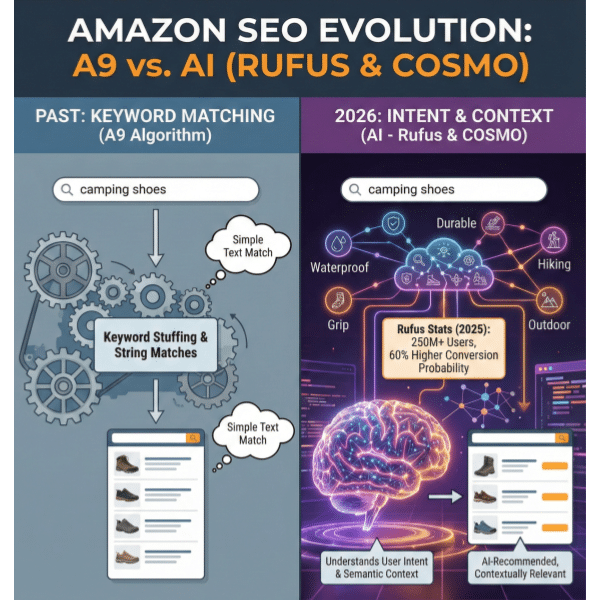
Amazon is currently rolling out COSMO and integrating its AI assistant, Rufus into COSMO. This shifts the engine from a simple keyword-matcher to a “Knowledge Graph.”
What This Means for Your SEO Strategy: The new algorithm doesn’t just look for string matches, it now tries to understand User Intent and Semantic Context.
The Strategy: You must stop writing just to match keywords or search terms and start writing to match actual user intent by covering the broader context of your listing’s main entity. Your listing needs to explicitly answer questions related to your listing and cover keywords that are contextually related to your listing’s main entity. In practice this means that instead of just listing specs, your copy must explain usage cases. We are moving from “Search Engine Optimization” to “Answer Engine Optimization.”
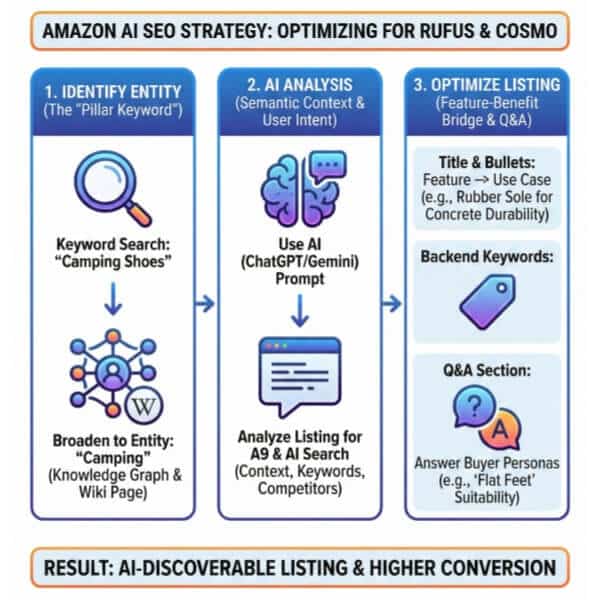
To optimize your product listing for AI you need to first identify its main entity. Entity is defined as a unique, well-defined, distinguishable, and broadly known “thing” or concept. So, whereas all words can be keywords, entities are sort of “pillar keywords”. Here is a step-by-step guide to optimizing your Amazon listing for entity driven AI discovery:
Review the output this prompt generates and update your listing accordingly. Make sure that your bullet points no longer just list features (“Rubber Sole”) but that they bridge a feature to its specific use case (“High-abrasion rubber sole engineered specifically for concrete and asphalt durability”).Bonus tip: Review your listings (and competitor listings) Q&A section. You can also feed them to your AI tool of choice and use them to augment the prompt provided above. The “Questions & Answers” section provides you with a clear picture that specific buyer personas actually ask (“Is this suitable for flat feet?”). Answering these questions with keyword-rich copy will ensure that Rufus can scrape your listing and recommends it.
If you need help with optimizing your listing for AI discoverability, check out our GEO optimization services for ecommerce.
The first step on your SEO roadmap is keyword research – always. Keywords are the foundation of almost any type of SEO. If you don’t even know what search terms you’re trying to rank for, the rest of the strategy doesn’t matter. To conduct keyword research, you can pick from a number of popular keyword research tools, or use the Seller Central Amazon Ads platform. If you are already selling on Amazon, reviewing keywords, or more specifically search terms that your product listings already index for, and then optimizing these is the most promising strategy. We explain how to do this in this article on Amazon Search Term Optimization.
Popular keyword research tools are provided by popular Amazon marketing tools, such as Helium 10’s Keyword Research Tool, or Jungle Scout’s Keyword Scout. You can even use the Google Ads Keyword Planner to get an idea as to what keywords may be worth targeting (although search behavior on Google is of course not perfectly correlated with search behavior on Amazon). Our favorite tool for Amazon keyword research: Sellersprite. Sellersprite’s pricing is more competitive than that of most of its peers while offering the same (if not better) functionality. For any number of keywords, these tools provide you with tons of statistics, such as search volumes, competitiveness of a given keyword, number of competing ASINs and so on.

To get a full overview of your options, check out this in-depth article on Amazon SEO Tools. Get a keyword research tool, and spend time coming up with a full list of keywords for your product.
If you just want to get a first idea as to what keywords may be relevant for your products, start by getting ideas from the Amazon search bar. Type in so-called root keywords and let the Amazon auto-complete feature do its magic: It will suggest other, popular search queries related to your search term.

If keyword research is entirely new to you, you may still be wondering what I am talking about. How on earth are you supposed to know just WHERE to get started?
Point taken! Let me share another, very effective and time-saving approach to conducting Amazon keyword research: Reverse ASIN keyword lookup. This term describes the process of researching keywords that your competitors’ product listings already rank for. This allows you to reverse-engineer their SEO keyword strategy. All the popular keyword tools listed above have such a reverse ASIN lookup feature (see below).

We highly suggest that you test this approach. Start by searching for a broad but relevant keyword that describes your product (i.e. “electronic toothbrush” if that is what you are selling), see which products show up in the Amazon search results, then copy their ASINs (you can find that on the product detail page) and then research which keywords these ASINs rank for. This will help you identify so-called long-tail keywords (the holy grail of keyword research).
One note on keyword research is to understand long and short-tail keywords. You’re going to find some keywords that are short and broad. For example, “pillow” or “backpack”.
These generally have a lot of search volume. However, they’re not very focused. If someone searches for “backpack”, there are a lot of different types of products they could be looking for.
On the other end, you’ve got long-tail keywords. These are longer search terms, with multiple words. Examples could be “hiking backpack with water bladder” or “pillow standard size set of 4”. These keywords tend to have fewer people searching for them. But they’re much more focused, and generally much more likely to lead to a sale.
Don’t get caught up in looking at search volume alone when judging the most important keywords for your product listing. You may get in front of more people by targeting a short-tail, high-volume keyword. But these people are not as far along in the purchasing journey and are often not ready to buy right away. To gain deeper insights, use a SERP tracker to analyze what content ranks for those queries. This will help you understand search intent and identify where potential clients may be in their journey.
You will likely generate more sales by focusing your SEO efforts on long-tail keywords with less search volume but more focused intent.
To recap this section: There are two steps to successful keyword research: First, come up with a few keywords that will be your core keywords. These are the most relevant keywords, with the highest search volume. You’ll put more effort into these keywords, because they have the highest sales potential, should you get your product listing to rank.
Second, find as many relevant keywords as possible and focus on long-tail keywords that you can rank for easier, as they are less competitive. The reason therefore is that, for most queries, the first three search results account for around 60-70% of all clicks. So in other words, just like at the Olympics, finishing 4th is really unfortunate when it comes to SEO. You really want to break into the top results to ensure that your product listings do get clicks (and subsequently sales).
So, most products have a huge number of search terms that shoppers might use to find them, focusing on those that you can “win” is the backbone of a successful eCommerce SEO strategy. The more of these search terms you can show up for in high positions, the more searches your product will show for, and the more you will eventually sell.
The next step is to place the keywords you’ve found in your product listing. The above is a good example of using keywords naturally. Notice the variations and different long-tail versions of the main keyword.

There’s an art to doing this effectively. You’ll have a large list of relevant keywords, and only so much real estate to use them.
You have to balance keyword inclusion with writing your product listing to maximize conversion rate as well. Which means your product listing has to read well, and the keywords should feel natural. Keyword stuffing will just turn away potential customers.
It’s also important here to prioritize the most important keywords in the most important areas.
Your product title is the top spot. This is where you’ve got the least room, and where the most important keywords should go.

You’ve got more of a chance of ranking and getting click-throughs if the keyword is in your product title. So reserve this space for 2-3 keywords that are super-relevant and that have the most search volume. Writing highly effective product listing titles is probably the most important component of climbing the search engine results page. After this, add keywords to your bullet points and product description. Bullet point copy is also critical for keyword optimization.
Your listing bullet points are a good place to start adding long-tail keywords. Fill your bullet points with specific use cases for your product, which generally have high search intent. “Running shoes for _____”, for example.

Try to include as many keyword variations in the bullet points, while keeping it brief and readable. Amazon only indexes the first 1000 bytes (characters + spaces) in the bullet points, so if you go overboard, the algorithm will just ignore the excess.
Pro tip: While most Amazon Sellers think of all relevant product description variations many forget including product usage scenarios when optimizing their search rankings. However, when users search for products, they often think of them in a specific context. “Charcoal BBQ” is very different from “Charcoal BBQ for camping”. The later product needs to be light, easy to assemble etc. If you sell barbecues that are ideal for camping, then consider this when writing your bullet point copy. Keywords and user intent go hand in hand and understanding how your customers use your product is key, because it provides you with the reason why they chose your products over competitors’ products.
Lastly, you can also add keywords to the backend of your Amazon Listing. Include all your most important (i.e. commercially viable) keywords here. These keywords are not visible to shoppers, but to the A9 algorithm.
SEO best practices are all about satisfying the search algorithm. But Amazon doesn’t want product listings that are written for an algorithm. They want product listings written for humans, because Amazon customers are humans.
The algorithm takes conversion rates into account, so craft your listing with human readers in mind, because ultimately only that will maximize results.
Copywriting, product images, and pricing are three key parts of your product listing to focus on here.
Many Amazon product copies are, truthfully, quite awful from a copywriting perspective. They’re focused only on keywords and are hard to read. They also talk solely about features. Instead, you should, as mentioned above, focus on benefits.
Focus on Product Benefits – not just Features
Features explain what a product is or what it does. For example, size, capacity, material, and functionality. Benefits explain what it means for the customer. How the size or capacity helps them. Why that type of material is a good thing. Why a certain functionality is useful.
Benefits help sell the product much better than talking about features. Key product features are still worthwhile to mention, but explain why these features matter. Here are two examples of effective and not-so-effective copy.

The first talks about features – “Velocity Flow Ventilation system”, “NutraFog II anti-fog, anti-scratch and UV-protected shield”. While these lines partly describe benefits, they’re quite cold, and don’t speak directly to the customer.

This example focused more on benefits – what the features mean to the customer. “FOR SMALL & BIG HEADS”, “NO PINCHING”.
Images can be overlooked when rolling out an eCommerce SEO Strategy because they don’t include keywords. But they’re vital for selling the product, which makes them a key part of your Amazon SEO optimization efforts as well.
Use your product images to show your product from different angles, with different uses, and highlighting key features using infographics.

High-quality images are important, showing your product off in its best light.
Give potential buyers as much information as possible to convince them to make a purchase. Product images can oftentimes communicate more than product titles, product descriptions, and bullet points.
The fastest way to rank on Amazon isn’t always by winning the Amazon search game. First of all, ranking in top spots for competitive keywords is often difficult on Amazon, but more importantly, Amazon is desperate for new customers and rewards sellers who drive external traffic to their listings! Drive traffic from outside sources, such as Google Ads (Google Ads for Amazon Listings), Meta Ads (Facebook Ads for Amazon Products), TikTok ads, or via an Email Blast (Amazon email marketing services), Amazon will reward you with a “ranking multiplier” that internal PPC simply cannot match.
Using off-Amazon channels to drive traffic to your products is a surefire way to also supercharge your Amazon SEO performance: traffic and sales ranking factors of the A9 algorithm. So additional sales of your product signal the A9 algorithm that your product has gone “viral,” forcing your organic rank on Amazon search results to also improve! Be sure to fully optimize your entire Amazon marketing funnel to give your Amazon SEO efforts an extra push. More on this in our dedicated blog post on: How to drive external traffic to Amazon.
When driving external traffic to Amazon listings, you can also benefit from the Amazon Brand Referral Bonus (BRB) program. Amazon effectively subsidizes your external marketing. Through the Brand Referral Bonus program, Amazon credits you back ~10% of the referral fee for every sale you generate from external traffic (more about this in our article on the Amazon brand referral bonus).
The Playbook: Don’t just run Facebook or TikTok ads to your Amazon store front. Run them to your Amazon listing instead and make sure to add an Amazon Attribution Tag (More about the Amazon attribution tool). This tracks sales (not just of your products, but of ANY product that a shopper ends up buying) and unlocks the 10% bonus.
Consider your pricing here too. Again, you might not think of this as relevant to grow Amazon search results, but it plays a part.
The right price point will help maximize sales. You don’t want to be too high, or too low, compared to the competition.
Amazon’s algorithm also wants to see competitive pricing. Amazon wants to be known as a place to find good deals. If your product is way overpriced, they’re less likely to want to recommend it to shoppers. This is where Amazon is different from Google. While the Google algorithm only considers clicks, Amazon goes one step further: Amazon’s ultimate goal is to maximize its own revenue and that is tied to shoppers buying products. Thus, while clicks are great, sales are king! Pricing is ultimately a key factor that impacts sales. So while your product pricing does not directly impact your Amazon SEO activities, it does impact it very much indirectly by skewing your conversion rates. Thus finding a sweet spot where you can optimize your product listing traffic and conversion rate to maximize PROFIT is key.
If you are the original manufacturer of the goods you sell on Amazon, you should most definitely register your brand on Amazon. This will unlock advanced features that can significantly impact your visibility and growth. With Brand Registry, you gain access to Brand Stores which are an excellent way to showcase your product portfolio on what is essentially a collection page. Best of all, Amazon Storefronts are ad free – so there is no risk that competitors steal your sales. Also Amazon Stores allow you to inject a few more branded elements into the otherwise rather generic Amazon marketplace. These upgrades can lead to higher conversion rates and strengthen customer trust by offering a consistent brand experience.
Brand Analytics is another great tool to use: It provides critical insights into how customers interact with your products and those of your competitors. Review high-frequency, search terms, market basket analysis, and item comparison reports are just a few metrics that you can review to better identify elements and sections of your listings that deserve further tweaking. By examining which search queries convert for your products, you can refine your keyword targeting for improved organic ranking. Additionally, Brand Analytics data can help you discover new market segments or emerging product niches, guiding strategic product development or expansion.
There are a few other things you can do to get higher conversion rates (alongside writing good copy and having high-quality images on your product detail page).
Click-Through Rate (CTR) and Conversion Rate (CVR) are two of the most critical factors influencing your product’s search ranking on Amazon.
Video, for one, is a great tool to get more conversions. Video content works essentially the same way images do, giving customers a better look at the product, and how to use it.
Many product listings include a video in the image carousel these days, and for good reason – it works to sell the product.

A+ Content is another valuable section on your listing page. This feature (formerly known as Enhanced Brand Content), lets you add rich, more detailed content to your product listing. This is great for going in-depth into the differentiating features and benefits of your product, as well as promoting additional products in your line (read this detailed guide on Amazon a+ premium content).

Benefits of A+ content are:
Finally, product reviews are also crucial too.

You can have the best copywriting, images, video, etc, but potential buyers still want to see some positive reviews. These reviews are proof that other people have bought the product before and been happy with it.
More reviews help tilt the scale in your favor when it comes to click throughs for competitive search terms and help push people over the line after they come through to your product listing.
Though Amazon SEO is about building organic visibility, Amazon Advertising (Amazon PPC Services) also impacts whether or not the ranking algorithm will favor your listings or not.
Remember, it’s important to build a history of sales, to show the search algorithm that people are willing to buy your product. But that creates a circular problem when you’ve just launched your product.
If you’re not showing up in Amazon searches yet, you can’t make any sales. Yet you need sales to start showing up in these searches.
When your product is new, you’ll need to pay to jump the queue. Amazon ads are a great way to do it. You can get your product into the SERP for your targeted search terms and start building the momentum you need to rank organically.
When this happens, you can start scaling back your Amazon advertising campaigns (Amazon Ads Management Services). But at the start, it will help you break the circular loop that a lot of product listings get stuck in early on.
If you’re new to PPC, or just want help managing your Sponsored Products campaigns (Amazon Product Ads Management), use a tool like our Amazon PPC Software to boost performance. You might also want to consider a managed service from an Amazon PPC Agency to ensure you get optimal results from your ad campaigns.
High-level sellers use this trick to boost their Amazon SEO. They don’t just drive a lot of external traffic to their Amazon product – they drive high-intent traffic. If you’ve been sending a ton of people to your listing, you’re getting a lot of sales, but still aren’t increasing in rankings, this might be why.
You need to set up a step in between your traffic source and product page, so people can learn about your product before actually landing on your Amazon product listing.
By filtering your traffic, ensuring the only people who click through to your listing are invested and in the mood to buy, you’ll dramatically increase your conversion rate, and thus your keyword visibility too.
An Amazon landing page works great for this. Create a page with your Amazon product images, bullet points, listing copy and all relevant buying info, hosted outside of the Amazon platform.

LandingCube is the best tool for creating Amazon landing pages. Click here to try it for free – it takes just 2 minutes to create a professional, optimized landing page featuring all your key product details, images and an opt-in form to collect emails.
Finally, providing a great customer experience should also be a part of your Amazon SEO efforts. Though it’s not clear if customer experience metrics like seller feedback and order defect rate have a direct impact on visibility on Amazon, they’re good to focus on regardless.
In general, if you’re making Amazon customers happier, you’re going to rank higher.
And as the Amazon algorithm matures, things that go into a great customer experience will only become more important as ranking factors. It’s more likely that the algorithm will reward product descriptions and product titles that are easy to read, and written for humans, not computers.
Keyword stuffing doesn’t make for a good customer experience. Amazon wants it to be easy for people to browse product listings and collect information before making a purchase. If Amazon wants that, you should too.
We hate to break it to you, but mastering Amazon SEO strategy won’t help if your products don’t live up customer expectations. You can have the best keywords in the world and optimize for Amazon AI Assistants – if your product has a high NCX (Negative Customer Experience) rate, Amazon will bury you.
Why? Because Amazon protects its customers, not its sellers! The ultimate goal of Amazon is to feature products in top positions that help Amazon maximize its own sales! Products that get returned a lot fail to achieve that. So if your return rate is 2% higher than your category average, the algorithm “quarantines” your visibility. In essence this is Amazon protecting its reputations and its bottom-line.
The Fix:
Listen to Voice of Your Customer: Check your NCX dashboard weekly. If customers complain about “confusing instructions,” fixing your PDF manual is actually an SEO activity.
As this article outlines, nailing your Amazon SEO is by no means a straightforward task! You have to juggle many activities, such as keyword research, copy writing and even creative to optimize all aspects of your listings!
While many of us may excel in one area (i.e. maybe you are great with data analytics), few are a “jack of all trades” and are good at everything. No to blow our own horns here, but this is where we come in handy and can help you race to the top faster! We have tons of experience optimizing all aspects of Amazon SEO and follow a highly methodological process for picking keywords that you can actually rank for in top positions. Please get in touch with us to discuss your specific Amazon SEO optimization needs!
Related articles:
Amazon SEO strategy summarizes the process of optimizing Amazon product listings to rank higher in Amazon search results. This includes improving titles, descriptions, backend keywords, and images to increase visibility and sales.
It helps customers find your products, leading to better visibility, more traffic, and higher sales. Optimized listings align with Amazon’s focus on conversions.
The A9 search algorithm ranks products based on relevance, performance, and customer satisfaction. It considers keywords, sales velocity, customer reviews, and CTR.
Backend keywords are hidden terms that improve discoverability. Use synonyms, alternate spellings, and related terms, avoiding duplicates or restricted words.
Use tools like Helium 10 or Jungle Scout to find high-volume and niche keywords. Balance popular terms with long-tail keywords and analyze competitors.
No. In fact, it can hurt you. The new COSMO algorithm looks for natural language and context. If your title is just a jumble of keywords (“Water bottle flask gym sports running blue”), Amazon may flag it as low quality. You need to write for the human eye first, integrating keywords naturally into readable sentences.
When you launch a new ASIN, Amazon gives you a temporary “artificial” ranking boost to test your product’s potential. This usually lasts 30-45 days. The goal of SEO during this phase is to blast sales velocity (via PPC and External Traffic) to prove to the algorithm that you deserve to stay at the top once the honeymoon ends.
There isn’t one universal number, but we recommend 150-180 characters for desktop, ensuring the most critical keywords (and your USP) are in the first 80 characters for mobile users. Using all 200 characters often leads to “keyword dilution” where your main terms lose potency.
Absolutely not. This is a direct violation of Amazon Terms of Service (ToS) and is the fastest way to get your listing suspended or your search terms suppressed. Focus on generic synonyms, not brand names.
This is Amazon’s term for Conversion Rate. It is arguably the #1 ranking factor. If 100 people visit your page and 15 buy (15%), and your competitor only converts 10%, Amazon will rank you higher—even if your competitor has better keywords. SEO gets them to the door; Conversion Rate invites them in.
A+ Content indirectly boosts SEO by increasing conversions and customer engagement, which Amazon’s algorithm favors.
Use high-resolution images with keyword-rich file names. Include multiple angles, lifestyle shots, and infographics to improve CTR and conversions.
Yes, massively. Your Main Image dictates your Click-Through Rate (CTR). If nobody clicks, Amazon stops showing you. We have seen listings jump 10 spots purely by changing the main image to something that stands out more in the search results.
Reviews build trust, boost conversions, and positively impact product rank.
Update listings quarterly or when metrics like CTR, conversions, or market trends show a need for changes.
Yes, external traffic increases sales velocity, positively impacting listing rank. Use Amazon Attribution to track performance.
Organic ranking depends on SEO and conversions, while paid ads provide immediate visibility but require ongoing investment. Both work best together.
Mistakes include keyword stuffing, ignoring backend keywords, low-quality images, and not tracking or updating listings regularly.
Monitor metrics like keyword search query performance, CTR, conversions, and reviews using tools like Helium 10 or Seller Central reports.
Ignore them. Platinum Keywords are a legacy field only used for very specific merchant accounts. Filling them out does nothing for 99% of sellers. Focus your energy on “Search Terms” and “Subject Matter” fields instead.
You have a Velocity Problem, not a Content Problem. Amazon knows you are a “Garlic Press,” but it doesn’t trust you yet. You need to force sales velocity through aggressive PPC or external traffic to prove to the algorithm that customers actually want your product.
We recommend a “Quarterly Audit.” Search trends change (e.g., “Fidget Spinners” vs “Sensory Toys”). However, do not constantly tinker with a listing that is performing well. “If it ain’t broke, don’t fix it” applies to high-ranking keywords. Only optimize what is lagging.
Optimize for “Choice.” Alexa almost exclusively recommends the product with the “Amazon’s Choice” badge for a specific query. To win this, you need high conversion velocity on that specific keyword. Also, keep your title concise enough that Alexa can read it clearly.

5 April 2026
TweetLinkedInShareEmailPrint 20 min read By Rick Wong Updated Apr 05, 2026 TL;DR Why is my AI ad tool d...

4 April 2026
TweetLinkedInShareEmailPrint 8 min read By Rick Wong Updated Mar 30, 2026 TL;DR What is the difference ...

31 March 2026
TweetLinkedInShareEmailPrint 8 min read By Rick Wong Updated Mar 30, 2026 TL;DR What exactly is the Uni...